
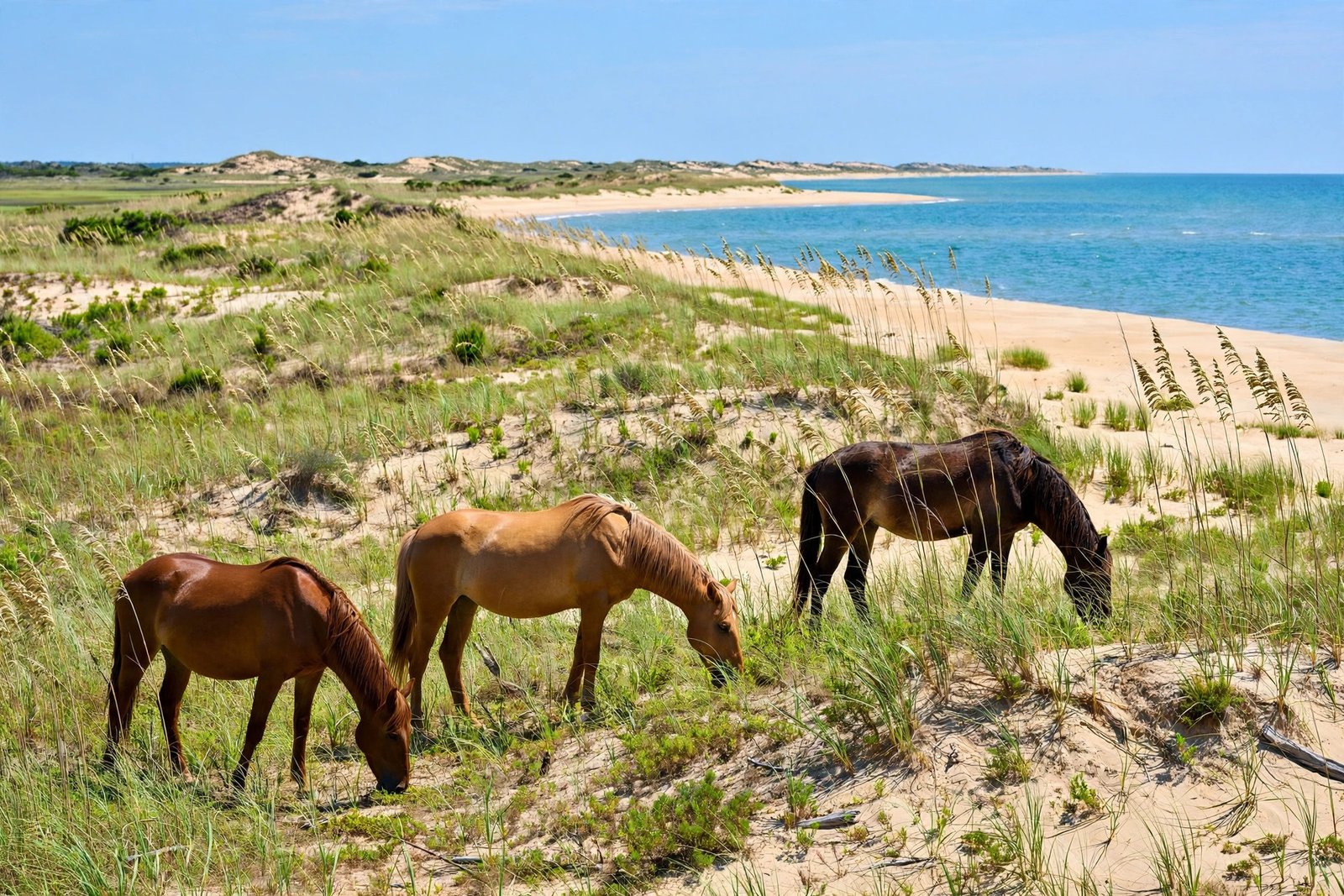
There is no bridge to Cumberland Island, and that single fact explains everything about it. To reach Georgia’s largest barrier island, you board a passenger ferry in the small coastal town of St. Marys, cross about 45 minutes of open water, and step onto an island where wild horses graze among the ruins of a Gilded Age mansion, where 17 miles of Atlantic beach stretch out empty in both directions, and where the loudest sounds are wind, waves, and birdsong. It is one of the wildest places on the American East Coast, and it is hiding in plain sight at the southern edge of Georgia.
Cumberland Island National Seashore, managed by the National Park Service, was established in 1972 and preserves one of the most unspoiled barrier island ecosystems on the Atlantic coast. The island stretches about 17.5 miles long and up to 3 miles wide, with maritime forests draped in Spanish moss, salt marshes on the inland side, and a long, undeveloped beach facing the ocean. There are no chain stores, no cars for visitors, and no crowds, because the ferry limits how many people can arrive each day. What you get instead is a place that feels like the modern world forgot it, in the best possible way.
Getting There: The Ferry From St. Marys
Every visit to Cumberland Island starts in St. Marys, Georgia, a quiet waterfront town on the southeast coast near the Florida line. The passenger ferry departs from the visitor center on the St. Marys waterfront and carries foot passengers only. There is no car ferry, and no bridge has ever been built. That limitation is deliberate: it keeps the island wild and uncrowded, and it means every visitor arrives the same way, on foot, with whatever they can carry.
The crossing takes about 45 minutes to the Sea Camp and Dungeness docks, and the ride itself is part of the experience. Dolphins frequently swim alongside the boat in Cumberland Sound, and the skyline of the island grows slowly on the horizon: first the trees, then the dunes, then the white walls of the Dungeness ruins. Ferry space is limited and reservations are essential, especially in the spring and fall when the weather is at its best. Daily visitation is capped at roughly 300 people, so a spontaneous trip is risky. Book ahead, arrive early to check in, and bring everything you will need for the day.
What you need to bring is worth thinking about carefully, because the island provides almost nothing beyond a few drinking-water spigots. There are no restaurants, no shops, and no supplies for sale once you step off the ferry. Pack food, water, sunscreen, insect repellent, and a hat, and wear sturdy walking shoes. Bikes are a popular way to cover ground on the island’s main road, Grand Avenue, but rental availability has varied in recent seasons, so check the current situation before you count on one.
The Wild Horses of Cumberland Island
The island’s most famous residents are its feral horses, and they are the reason many visitors come. These are not tame animals, and they are not managed the way a ranch herd would be. According to the National Park Service, the horses on Cumberland Island receive no food, water, veterinary care, or population control. They live entirely on what the island provides, which is why their lives are shorter and harder than those of domestic horses: the Park Service notes their lifespan may be as long as 9 to 10 years, compared with 25 to 30 years for a domestic horse.
The horses’ history on the island goes back centuries. A few horses were probably brought to Cumberland as livestock when Spanish missions were established in the late 1500s, although evidence from that period is scarce. The earliest historic account dates to 1742, when Spanish forces found fifty to sixty horses in a corral within Fort St. Andrews during a battle with the English over the north end of the island. By the end of the 1700s, island landowners were reporting around 200 domestic horses and some mules kept as free-ranging livestock. Property owners managed horses as free-ranging livestock from the 1940s until the 1960s, and by the time the park was established in 1972, the horses had become feral.
Genetic studies conducted in 1991 by the University of Georgia and the University of Kentucky found that today’s horses are closely related to Tennessee Walkers, American Quarter Horses, Arabians, and Paso Finos. That mix reflects the many waves of horses brought to the island over the centuries, from working livestock to riding and polo horses. The Park Service has conducted population surveys since 2003 that have returned counts ranging from 120 to 148 horses a year. Those numbers are a measure of abundance rather than a total count: the actual number of horses on the island could be 30 to 40 animals higher than any given survey result.
Seeing the horses is easy. They graze in the open lawn of the Dungeness Historic District, wander the dune meadows, and appear along Grand Avenue and the beaches. Watching a band of horses graze in front of crumbling mansion walls, with Spanish moss overhead and the ocean behind them, is the signature Cumberland Island moment. But the safety rules are serious and non-negotiable. The Park Service asks visitors to stay at least 50 feet away from the horses and never to feed or approach them. Visitors have been injured in the past, usually by kicks, bites, or being knocked down. These are big, powerful, wild animals, and they have the right-of-way. Admire them from a distance, take your photographs, and let them be wild.
Dungeness Ruins: A Gilded Age Ghost
The most haunting sight on Cumberland Island is the ruin of Dungeness, the mansion built by Thomas Carnegie and his wife Lucy in the 1880s. At one time, the Carnegie family owned 90 percent of Cumberland Island, and Dungeness was the centerpiece of their island estate: a grand, sprawling home built for a family that had come to define American industrial wealth. The mansion burned down in 1959, and what remains today is a magnificent skeleton of walls, arches, and staircases, open to the sky and slowly being reclaimed by vines and weather.
Walking through the ruins feels like stepping into another century. The walls still suggest the scale of the place, and the grounds around it, where horses now graze, hint at the formal gardens and lawns that once surrounded it. The Carnegie story is also part of how the island became a park: the family later invited the National Park Service to assess the island as a possible national park, and after nearly two decades of negotiation, Congress established Cumberland Island National Seashore in 1972. The ruins are a reminder that even the grandest human ambitions fade, while the island itself endures.
Dungeness is also the best place to understand the island’s layered history. Before the Carnegies, the island was home to Timucuan people, Spanish missionaries, Revolutionary War figures, and enslaved communities whose labor built the island’s early plantations. The Park Service preserves these stories alongside the natural landscape, and the island’s historic districts, cemeteries, and old structures reward visitors who take the time to look beyond the beach.
Beaches, Trails, and Wildlife Beyond the Horses
While the horses get the headlines, the island’s beaches are just as extraordinary. Cumberland’s Atlantic beach runs for roughly 17 miles, and on most days you can walk for a long stretch without seeing another person. The sand is wide and firm, the dunes behind it are covered in sea oats, and the ocean rolls in without a single high-rise, boardwalk, or beach bar in sight. It is one of the few places on the East Coast where you can experience a barrier island beach the way it existed before development.
The island is also a haven for wildlife. More than 300 bird species have been recorded here, from painted buntings with their jewel-toned plumage to great blue herons stalking through the marshes. Sea turtles nest on the beaches, and the island protects some of the most valuable loggerhead nesting habitat in Georgia. Armadillos rustle through the undergrowth, alligators lurk in the island’s ponds, and raccoons are famously bold around the campgrounds, which is why food storage rules matter. The diversity is no accident: the island contains over 9,800 acres of congressionally designated wilderness, and its mix of beach, dune, forest, and marsh supports an unusually rich web of life.
For walkers, the island offers a satisfying range of options. The short trails around Sea Camp and Dungeness are easy and rewarding, while the long walk down the beach or along Grand Avenue suits visitors who want to cover real distance. The island’s main road runs roughly north to south, and the northern end, around the Settlement and the First African Baptist Church, tells a powerful story about the island’s African American history. Plan your route around the ferry schedule, since the return boat waits for no one, and carry more water than you think you will need.
Planning Your Visit: Day Trip or Camping?
Most visitors come for a day trip, and a day is enough to see the highlights: the ferry ride, the Dungeness ruins, the horses, and a stretch of beach. A day trip gives you roughly seven hours on the island between the morning arrival and the afternoon return, which is plenty for the southern end of the island. Arrive at the St. Marys visitor center at least 30 minutes before departure, and remember that the ferry does not run every day in the off-season, so check the schedule before you travel.
Camping is the way to see the whole island. The Park Service maintains campgrounds at Sea Camp, which is close to the dock and relatively accessible, and at more remote sites further north for experienced backpackers. Camping lets you watch the sunrise over an empty beach, hear the island at night, and explore the northern reaches that day-trippers never reach. Campsites require reservations and permits, and the same self-sufficiency rules apply: you carry in everything, including food, and you carry out all trash.
A few practical rules will make your visit smoother. Dogs are not allowed on the ferry and are heavily restricted on the island, so this is not a trip for pets unless you arrive by private boat and follow the specific rules. Fires are allowed only in designated areas. Stay on trails in sensitive dune areas, and never disturb wildlife or historic structures. And above all, respect the visitor cap: the island stays wild because the number of people on it stays small. Booking early is not just good advice. It is the price of keeping this place the way it is.
For official planning information, start with the National Park Service’s page on the island’s feral horses at home.nps.gov, the detailed visitor guide at More Than Just Parks, and the horse guide at Secret Atlanta. Check the ferry schedule and reservation system before you travel, since schedules vary by season.
Related reading
- White Sands National Park: New Mexico’s Gypsum Dunes
- Apostle Islands, Wisconsin: Sea Caves and Ice Caves
- Marfa, Texas: Art Pilgrimage and the Marfa Lights
Frequently Asked Questions
How do you get to Cumberland Island?
There is no bridge. You take a passenger ferry from St. Marys, Georgia, which takes about 45 minutes to the Sea Camp and Dungeness docks. Private boats are the only other option. Reservations are essential because daily visitation is capped.
Are the horses on Cumberland Island truly wild?
They are feral, meaning they descend from domesticated horses but now live without human management. The National Park Service provides no food, water, veterinary care, or population control for the herd.
How close can you get to the horses?
Stay at least 50 feet away and never feed or approach them. Visitors have been injured by kicks, bites, and being knocked down. The horses always have the right-of-way.
Can you camp on Cumberland Island?
Yes, the Park Service maintains campgrounds including Sea Camp near the dock and more remote backcountry sites. Reservations and permits are required, and campers must carry in all food and supplies.
When is the best time to visit Cumberland Island?
Spring and fall offer the most comfortable weather, with milder temperatures and fewer insects than summer. Winter is quieter and the ferry runs less often, so check the schedule carefully before planning a cold-weather trip.