
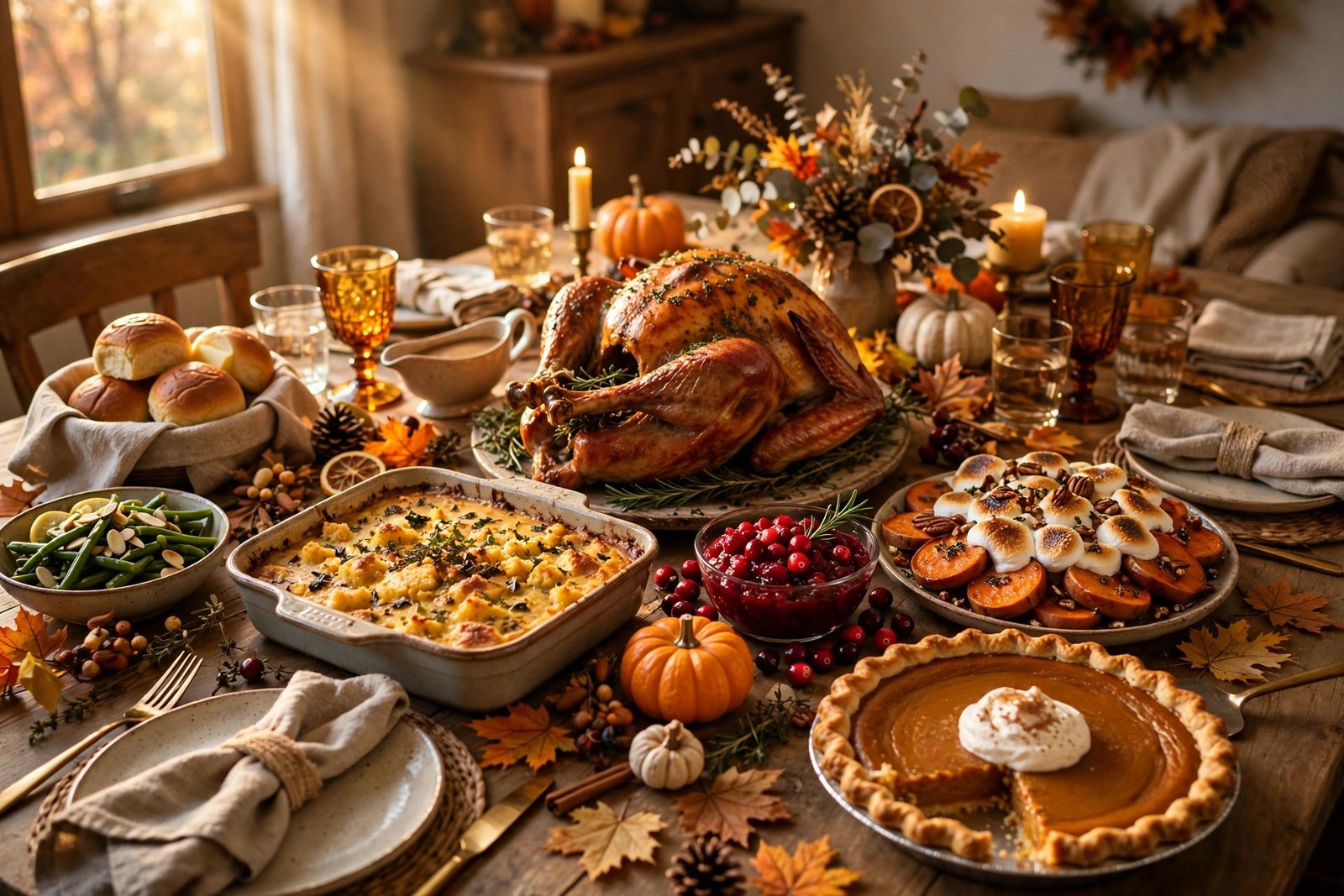
Ask an American what Thanksgiving dinner looks like, and you will get a different answer depending on where they grew up. In New England, the stuffing might be studded with oysters. In the South, it is cornbread dressing, baked in its own pan, and calling it stuffing might earn you a gentle correction. In Minnesota, wild rice might steal the show. In New Mexico, green chile finds its way into everything, including the gravy. Thanksgiving is America’s most food-centered holiday, and the table is where the country’s regional cultures show themselves most deliciously. As the holiday approaches, here is a tour of the Thanksgiving table from coast to coast, and what each region’s dishes say about where they come from.
The turkey itself is the great unifier, but even the bird is not universal. Roasted turkey is the classic centerpiece everywhere, yet fried turkey is a proud tradition in the South, especially in Texas, where deep-frying gives the bird a crisp skin and juicy meat, along with a set of safety warnings that fire departments repeat every November. In the Mountain West, some tables feature deer or bison roast alongside or instead of turkey, a nod to hunting traditions and to the land itself. In the Southwest, the turkey might wear a chile rub, seasoned with Hatch green chile and Southwestern spices, a flavor that would be unrecognizable in New England but feels entirely natural in Santa Fe.
Stuffing, dressing, or filling: the great divide
No Thanksgiving dish divides the country like the bread-based side that accompanies the turkey, and the argument starts with its name. In much of the South, it is dressing, baked in a pan rather than stuffed into the bird, and it is built on cornbread, seasoned with sage, celery, and onion. Cornbread dressing leads in ten states across the South, from Alabama to Texas, and in Mississippi it is the most searched Thanksgiving side by a wide margin. The cornbread base gives Southern dressing a crumbly, savory richness that pairs naturally with gravy and with the collard greens and macaroni and cheese that share the Southern table.
In the Northeast and Midwest, the same dish is usually called stuffing, and it is built on cubes of white or wheat bread, sometimes baked inside the bird, sometimes in a pan, but always called stuffing regardless. Regional add-ins push the split further. Oyster stuffing has long roots in New England and the Mid-Atlantic, where seafood was plentiful and oysters were a natural addition to a celebratory meal. In Pennsylvania Dutch country, the dish becomes filling, built on mashed potatoes rather than bread, a tradition that reflects the region’s German heritage. In Louisiana, cooks sometimes build dressing around rice, ground meat, and the holy trinity of onion, bell pepper, and celery, a Cajun and Creole influence that makes Louisiana dressing unlike any other.
In the Upper Midwest, wild rice stuffing is a point of pride, especially in Minnesota, where wild rice still grows in northern lakes and where the grain’s nutty, earthy flavor feels like a taste of place. On the West Coast, sourdough stuffing brings San Francisco’s famous tang to the table, a distinctly Californian twist. The lesson of the stuffing wars is simple: the dish is never just a dish. It is a map of migration, agriculture, and family memory, and every family’s version is, by definition, the correct one.
Sides that tell a region’s story
Beyond stuffing, each region has sides that reveal its history. In the South, collard greens, cooked low and slow with smoked pork, onion, and a splash of vinegar, are a staple, and the broth left in the pot, known as pot likker, is considered a treat in its own right, often sopped up with cornbread. Sweet potatoes appear across the country, but in the South they lean toward pecan streusel topping or candied yams simmered in butter, sugar, and warm spices, traditions with deep roots in Black American cooking. Macaroni and cheese, baked until bubbling and golden, is not a children’s afterthought in the South but a serious side dish, and some Southern tables serve several versions at once.
In New England, cranberry sauce is a point of pride, and the region leans toward homemade relish over the canned jelly that is beloved elsewhere. Creamed pearl onions, a fussy, old-fashioned dish, still appears on New England tables, along with hasty pudding, a cornmeal and molasses dessert with colonial roots. In the Mid-Atlantic, sauerkraut is a Thanksgiving staple in Maryland, particularly in Baltimore, where German heritage made fermented cabbage a holiday tradition, and crab cakes and corn on the cob sometimes join the table as well.
In the Midwest, casseroles rule. Green bean casserole, invented in the Midwest in the 1950s, is a national favorite, but the region also claims corn casserole, scalloped corn, and the infamous Jell-O salad, a wobbly, fruity concoction that Midwesterners defend with surprising passion. Cranberry fluff, a whipped mixture of cranberries, marshmallows, and cream, is another Midwestern holiday signature. In the Southwest, green chile is the signature ingredient, folded into cornbread stuffing, stirred into cheesy casseroles, or served as a salsa alongside the turkey, while tres leches cake offers a sweet, milky finish that reflects the region’s Mexican heritage.
Dessert: pie as regional identity
If stuffing is the most argued-over side, pie is the most beloved dessert, and here too the regions differ. Pumpkin pie is the national default, but sweet potato pie is the Southern favorite, a silky, spiced pie that many Southerners consider superior to pumpkin in every way. In Pennsylvania, shoofly pie, a molasses pie with Pennsylvania Dutch roots, appears on some tables, while chess pie, a buttery, custardy pie made from pantry staples, is a Southern classic. In the Pacific Northwest, marionberry pie, made from Oregon’s signature blackberry, is a local treasure, and in the Southwest, tres leches cake and sopapillas offer a different kind of sweetness.
The dessert table is also where family traditions are most fiercely guarded. Every family has a pie recipe that cannot be changed, a cranberry sauce that must be made exactly so, and a dressing that must taste like childhood. Thanksgiving cooking is, in this sense, a form of storytelling: each dish carries a memory of a grandmother’s kitchen, a hometown grocery, a farm, a coast, or a church supper. When Americans travel for Thanksgiving, they often bring a dish from home, and that dish becomes a small act of diplomacy, a way of saying, this is where I come from, and I want you to taste it.
Building your own regional Thanksgiving
You do not have to choose a single region. Some of the best Thanksgiving tables are patchworks, borrowing a dish from each branch of the family tree: cornbread dressing from a Southern grandmother, oyster stuffing from a New England uncle, wild rice from a Minnesota cousin, green chile from a New Mexico friend. The holiday is flexible enough to hold all of it, and the table is big enough for every tradition.
A few practical tips can help. Make the dishes that must be made fresh, like mashed potatoes and gravy, on the day itself, and prepare casseroles, cranberry sauce, and pies a day or two ahead. If you are frying a turkey, follow safety guidance carefully: fry outdoors, away from the house, with the turkey fully thawed and dried, and never leave the fryer unattended. If you are trying a new regional dish for the first time, test it before the holiday, or at least have a backup, because Thanksgiving is not the day to discover that your first attempt at oyster dressing is not a family favorite.
Above all, remember what the meal is for. Thanksgiving began as a harvest celebration, and its modern form is a celebration of abundance, gratitude, and togetherness. The regional dishes are not a competition; they are evidence of how many different Americas can sit down at one table and share a meal. Whether your table holds cornbread dressing or oyster stuffing, sweet potato pie or pumpkin, collards or cranberry fluff, the point is the same: good food, shared generously, with people you love.
Frequently asked questions
What is the difference between stuffing and dressing? In general, stuffing is cooked inside the turkey and dressing is baked separately, but the terms are regional: the South says dressing, usually cornbread-based, while the Northeast and Midwest say stuffing, usually bread-based.
Why do Southern tables serve cornbread dressing? Cornbread has long been a Southern staple, and cornbread dressing, seasoned with sage, celery, and onion, became the region’s signature version of the dish.
What is oyster stuffing? A traditional New England and Mid-Atlantic stuffing made with bread cubes and oysters, reflecting the region’s coastal seafood heritage.
Is fried turkey safe? Deep-fried turkey can be safe if done outdoors, away from structures, with a fully thawed and dried bird, and with constant supervision. Fire departments issue safety guidance every year.
What desserts are regional Thanksgiving favorites? Pumpkin pie is the national default, sweet potato pie is a Southern favorite, shoofly pie reflects Pennsylvania Dutch heritage, and tres leches cake is popular in the Southwest.
Related reading
- Macy’s Thanksgiving Day Parade 2026: Your Complete Guide
- Tailgating in America: The Game-Day Tradition, Explained
- The American Bison Comeback: From Near Extinction to Success
Sources: Thanksgiving side dishes that vary most by state, Regional twists on a Thanksgiving staple.