
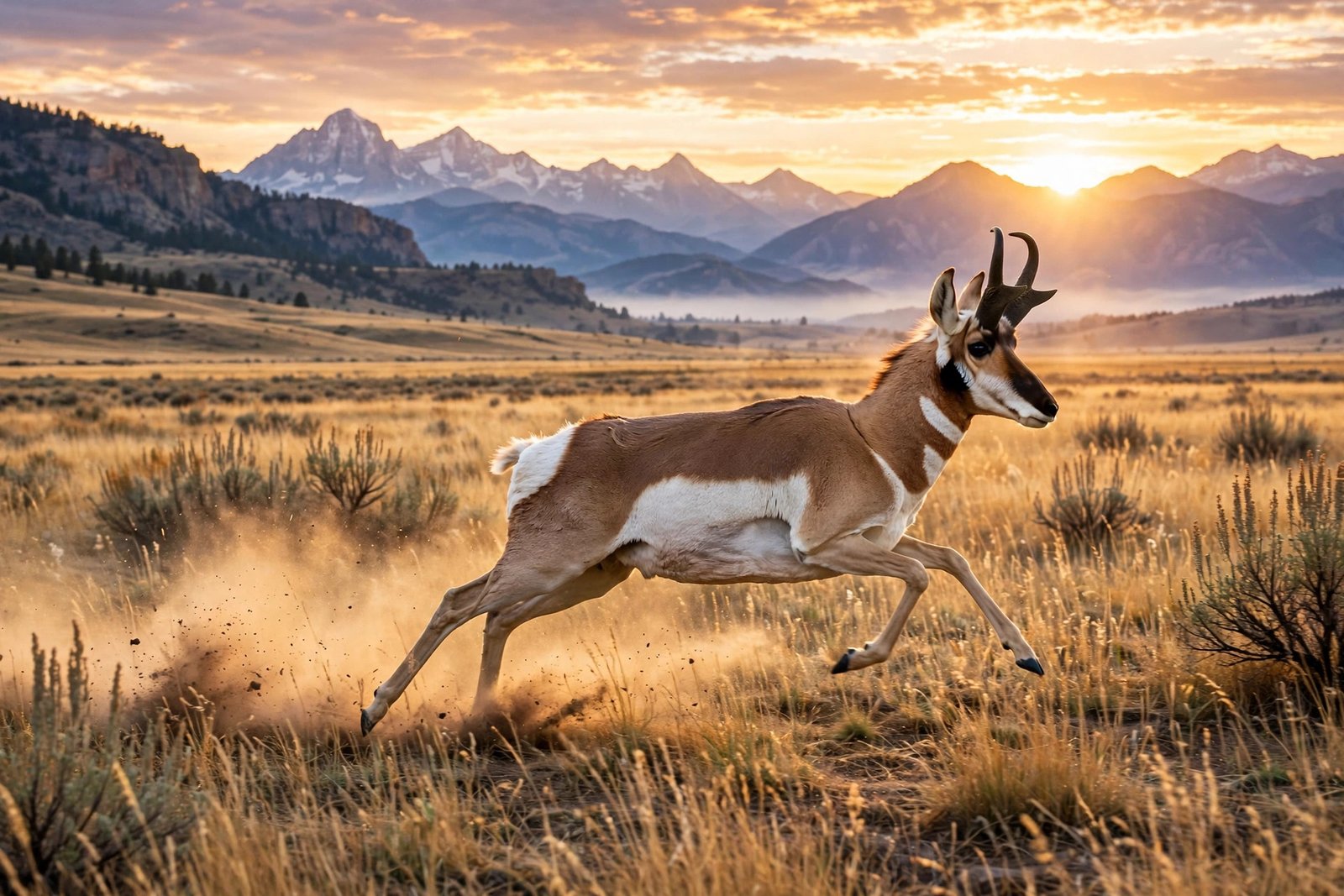
Out on the open sagebrush plains of Wyoming, a flash of tan and white moves across the horizon, and before your eyes can quite follow it, the animal is already far away. That is a pronghorn, North America’s fastest land animal, and it is built for speed in a way no other animal on the continent can match. It can sprint at close to 60 miles per hour, and unlike the cheetah, which tires quickly after a burst, a pronghorn can hold a fast pace for miles. It is a survivor from an ancient America, a creature shaped by predators that no longer exist, running across a landscape that has changed around it.
To most travelers, pronghorn are a familiar sight and a mystery at the same time. They are often called antelope, though they are not true antelope at all. They look like deer, but they are not deer either. They are the last surviving member of their own family, a lineage found nowhere else on Earth but North America. Spend a little time learning about them and the animal becomes even more remarkable: the horns that shed like no other horns, the eyesight that spots danger from miles away, and the migration that ranks among the longest land journeys on the continent.
Built for Speed, and for Distance
The pronghorn, Antilocapra americana, is the fastest land animal in North America and the second-fastest land mammal in the world, behind only the African cheetah. According to the National Park Service, pronghorn can sprint to speeds of 60 miles per hour and sustain over 40 miles per hour for a mile. Other accounts describe them holding 30 to 40 miles per hour for several miles at a stretch. That combination of top speed and endurance is what sets them apart. A cheetah is faster in a short sprint, but it cannot keep the pace. A pronghorn can, and that is why nothing in North America today can run one down.
The speed is written into the animal’s body. Pronghorn have long, slender legs built for long strides, a deep chest that houses oversized lungs and a large heart, and a body that is light for its size. Adult bucks typically weigh around 125 pounds, with does a little lighter, and their hollow hair helps insulate them against the cold wind of the high plains. Their eyes are large and set high on the head, giving them wide, almost panoramic vision, and they can spot movement from a great distance. When a pronghorn senses danger, it raises the white hairs on its rump, a flash of white that warns the rest of the herd, and then it runs, often in a bounding, rocking gait that eats up ground with surprising ease.
Scientists believe this extraordinary speed evolved to outrun a predator that no longer exists: the American cheetah, a fast-running cat that roamed North America during the Ice Age and went extinct roughly 12,000 years ago. The pronghorn kept the speed long after the hunter vanished, like an athlete still training for a race that will never be run. Today, the main predators of adult pronghorn are coyotes, bobcats, and occasionally mountain lions, but a healthy adult pronghorn in open country is rarely caught. Fawns are more vulnerable, and coyotes take many young animals in their first weeks, which is why does give birth to twins in hidden spots in the sagebrush and keep the fawns still and scentless while they are small.
Not an Antelope, Not a Deer
People across the West call pronghorn antelope, and the nickname is so common that even official place names use it. The Hart Mountain National Antelope Refuge in Oregon and the Sheldon National Wildlife Refuge in Nevada were both created to save pronghorn, and both carry antelope in their names. But pronghorn are not true antelope. True antelope live in Africa and Asia. Pronghorn are native only to North America, and they are the sole surviving member of the family Antilocapridae, a group that once included many species across the continent. Their closest living relatives are giraffes and deer, but they are distinct from both, an evolutionary line of their own.
Pronghorn are herbivores, and their diet shifts with the seasons. In spring and summer they eat forbs, the broad-leafed wildflowers of the prairie, along with grasses and new growth. In fall and winter, when snow covers the ground, they turn to sagebrush, which makes up a large part of their cold-season diet, along with other shrubs. They can go for long stretches without drinking free water, getting much of the moisture they need from the plants they eat, a useful talent in the dry country they call home. They are most active in the early morning and late afternoon, resting during the heat of midday, and they gather in herds that shift with the season, larger mixed groups in winter and smaller bands of does with fawns in summer.
The Horns That Make Them Unique
The pronghorn name comes from the horns, and the horns are unlike those of any other animal on Earth. Both males and females grow horns, though the male horns are far larger and more dramatic. A buck’s horns can grow up to about 18 inches long, curving back and then forward, with a forward-pointing prong that gives the species its name. Does have much smaller horns, often just short spikes, and some females have horns so small they are barely visible. The horns are not antlers. Antlers are made of bone and are shed and regrown each year by deer and elk. True horns, like those of bison and bighorn sheep, are never shed. Pronghorn sit in a category of their own.
Each pronghorn horn has a bony core covered by a keratin sheath, the same material as human fingernails. Every year, the outer sheath is shed and a new one grows in its place, making the pronghorn the only horned animal in the world that sheds its horns. The National Park Service explains that the sheath is shed annually, usually after the autumn rut for bucks. That annual renewal is one of the animal’s defining features, and it is a reminder of how distinct its lineage is. During the rut in late summer and early fall, bucks become territorial, defending patches of ground and the does that pass through them, and they fight with sharp clashes of horns that can be fierce and sometimes fatal.
Home on the High Sagebrush Sea
Pronghorn live only in North America. Their range once stretched from southern Canada to northern Mexico, and from the Pacific coast to the Great Plains, but today they are mainly found in the western United States, in Wyoming, Montana, South Dakota, Colorado, Utah, Nevada, Arizona, New Mexico, and parts of California, Oregon, and other western states, with smaller populations in southern Canada and northern Mexico. The largest numbers are in Wyoming, which holds more pronghorn than any other state, and the animals are especially dense in the Red Desert and the Yellowstone region. The open sagebrush steppe is their ideal home: wide, flat or gently rolling country where they can see for miles, run without obstacles, and find the shrubs and forbs they eat.
That open country is also what makes them vulnerable. Pronghorn are built to run, not to jump, and fences are a serious problem for them. A pronghorn can squeeze under a fence if the bottom wire is high enough, but a low, tight fence can block a migration route or trap animals in deep snow. Roads are another danger, and the animals are often seen standing near highways, waiting for a gap in traffic before they cross. Energy development, housing, and the plowing of native grassland have all shrunk and broken up the habitat, and drought can reduce the food available in winter, when the animals need it most. Conservation groups now work with ranchers and landowners to raise the bottom wire of fences, install pronghorn-friendly crossings, and keep migration corridors open.
The Path of the Pronghorn
The most famous pronghorn journey in America is the Path of the Pronghorn, a migration corridor in western Wyoming that runs between summer range in Grand Teton National Park and winter range in the Upper Green River Basin. According to the National Park Service, herds migrate up to 150 miles each way along this route, the second-longest terrestrial migration in North America, after the caribou. The National Wildlife Federation notes the same distance and calls it the longest land migration in the continental United States. As winter sets in and snow deepens in the Tetons, the animals move southeast, following the Gros Ventre drainage and the Green River, and in spring they return north to the rich summer grass.
The corridor was the first federally designated migration corridor in the country. In May 2008, the Forest Service designated the northern 45 miles of the route, and in 2020, Wyoming Governor Mark Gordon signed an executive order prioritizing the protection of mule deer and pronghorn migration corridors, including the Path of the Pronghorn. Wildlife biologists have mapped the route using GPS collars fitted to the animals, tracking their movements across highways, fences, and private land. The work has shown how narrow the corridor can be in places, sometimes just a few hundred yards wide, and how easily a single new fence or road could cut it off.
A Comeback Written in the Sagebrush
The pronghorn story is one of the great wildlife comebacks in American history, and it began at a very low point. Before European settlement, pronghorn may have numbered 30 million or more, as many as the bison, roaming from Canada to Mexico. Market hunting, fencing, homesteading, and the plowing of the prairies cut them down fast. By 1909, their numbers had fallen to about 5,000 animals across the entire range, and the species was in danger of disappearing altogether. Hunters, ranchers, and conservationists who had watched the decline began to act.
The recovery came from three things working together: laws that stopped the uncontrolled hunting, refuges that protected the habitat, and the moving of animals back into places where they had vanished. The Boone and Crockett Club, founded by Theodore Roosevelt and others, helped raise money to move pronghorn from Yellowstone to refuges in the early 1900s, and in 1931, President Herbert Hoover established the Charles Sheldon National Antelope Range in Nevada, which grew into the Sheldon National Wildlife Refuge. The Hart Mountain National Antelope Refuge in Oregon was created in 1936. In 1937, Congress passed the Pittman-Robertson Federal Aid in Wildlife Restoration Act, which directed excise taxes on firearms and ammunition to state wildlife work, and within a decade, state agencies had relocated more than 7,000 pronghorn to new ranges.
The numbers tell the story of the recovery. By 1954, the population had reached about 273,000. By 1976, it was around 400,000. Today, estimates place the total population at roughly 750,000 to about one million animals, and the International Union for Conservation of Nature lists the species as Least Concern. That is a remarkable turnaround, but it is not the end of the story. One subspecies, the Sonoran pronghorn of Arizona and northern Mexico, remains endangered, having fallen to just 21 animals in the United States in 2002 after a severe drought. Captive breeding and new water sources have helped it recover, but it remains fragile, a reminder that the main species recovery depends on habitat that is still under pressure.
Where to See Pronghorn in the Wild
For travelers, pronghorn are one of the easiest western animals to spot, because they live in open country and are active during the day. Grand Teton National Park, Yellowstone National Park, Theodore Roosevelt National Park, and the wide sagebrush basins of Wyoming are all good places to look, especially in the early morning and late afternoon. Bring binoculars, keep a respectful distance, and use a spotting scope if you have one. Pronghorn are wary animals with excellent eyesight, and they will move away if you approach too closely. The best views come from staying in your car or at a turnout and letting the animals come to you.
Related reading
- The American Bison Comeback: Near Extinction to Success
- Elk Rut in Rocky Mountain National Park: A Guide
- Gray Wolf Recovery in the American West
Frequently Asked Questions
How fast can a pronghorn run?
Pronghorn can sprint at close to 60 miles per hour, according to the National Park Service, and they can sustain over 40 miles per hour for a mile. That makes them the fastest land animal in North America and the second-fastest land mammal in the world.
Are pronghorn really antelope?
No, pronghorn are not true antelope, even though they are often called antelope in the West. They are the only surviving member of the family Antilocapridae, found only in North America, while true antelope live in Africa and Asia.
Do female pronghorn have horns?
Yes, both males and females grow horns, though female horns are much smaller, often just short spikes. Male horns are larger, forked, and can grow up to about 18 inches long. Pronghorn are the only horned animals that shed the outer sheath of their horns each year.
How far do pronghorn migrate?
The longest pronghorn migration is the Path of the Pronghorn in Wyoming, where herds travel up to 150 miles each way between Grand Teton National Park and the Upper Green River Basin. It is the second-longest land migration in North America.
Are pronghorn endangered?
No, the pronghorn as a species is listed as Least Concern, after recovering from about 5,000 animals in 1909 to roughly a million today. One subspecies, the Sonoran pronghorn, remains endangered and is the focus of captive breeding and habitat work.
Learn more from the National Park Service Path of the Pronghorn page, the National Wildlife Federation pronghorn guide, and the Theodore Roosevelt National Park pronghorn page. Conservation history in this article draws on the Theodore Roosevelt Conservation Partnership.