
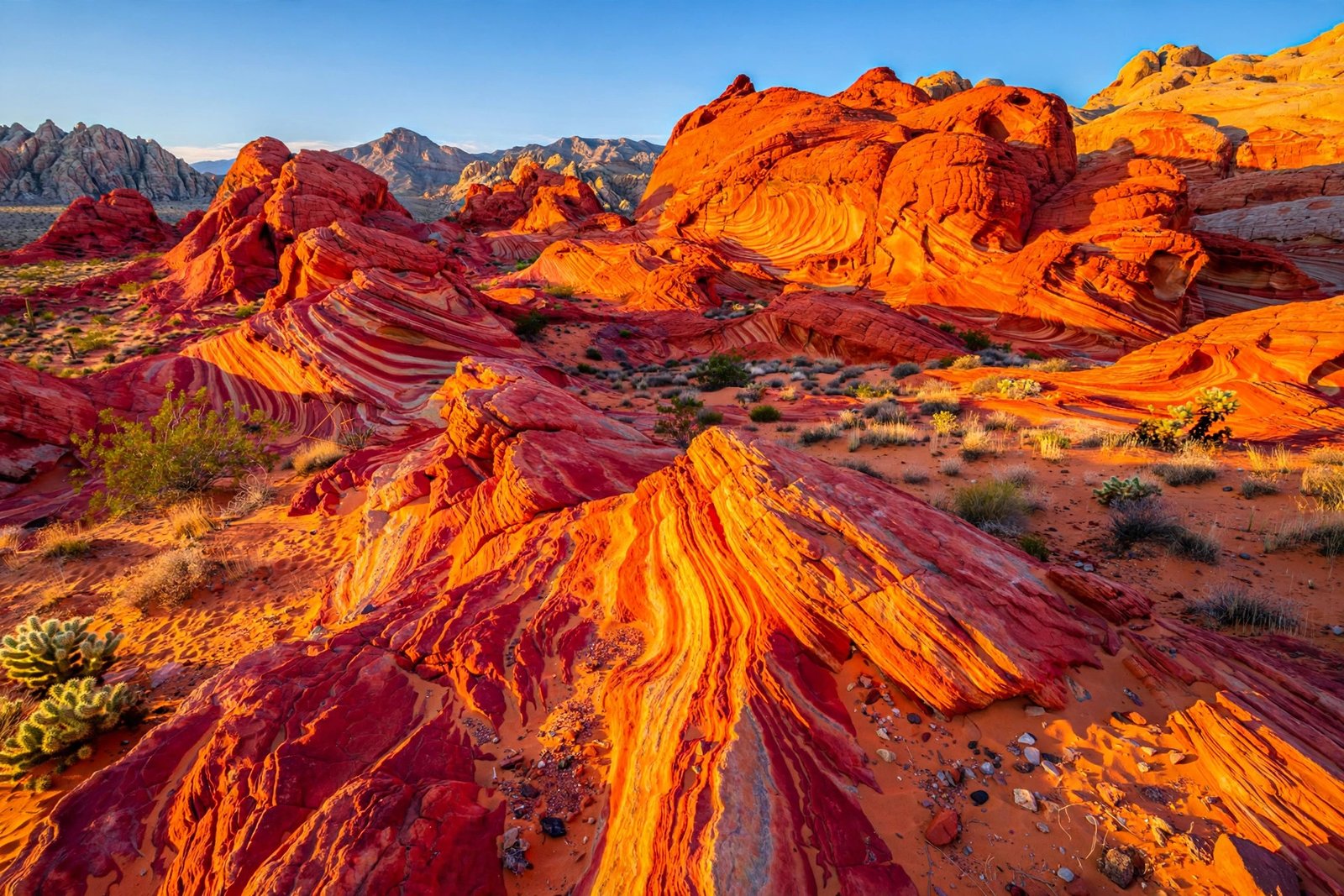
About an hour northeast of Las Vegas, the Mojave Desert suddenly turns to fire. Red and orange sandstone rises in fins, domes, and twisting canyons, glowing brightest in the low light of morning and late afternoon. This is Valley of Fire State Park, Nevada’s oldest and largest state park, and one of the most visually stunning landscapes in the American West. It takes its name from the vivid Aztec sandstone formations that seem to blaze beneath the desert sun, and for visitors who arrive early and take their time, it feels less like a park and more like another planet.
Valley of Fire covers more than 40,000 acres of desert near Overton, Nevada, roughly 50 miles northeast of the Las Vegas Strip. It was dedicated in 1935, making it Nevada’s first state park, and it remains one of the state’s most visited natural attractions. The park’s ancient petroglyphs, carved by people thousands of years ago, add a human story to the geology, and its trails range from short, easy walks to winding routes through narrow canyons. November through April is the ideal season to visit, when daytime temperatures are mild and the light is at its best.
This guide covers what to see, how to plan, and what to know before you go, drawing on Nevada State Parks information so you can arrive prepared and make the most of a day in the desert.
A Landscape Shaped by Time
The story of Valley of Fire begins more than 150 million years ago, when shifting sand dunes were buried, compressed, and cemented into sandstone. Later, faulting and erosion lifted and carved that stone into the shapes visitors see today: sweeping waves of red, pink, and orange, balanced rocks, and narrow slot canyons. The color comes from iron oxide in the rock, the same mineral that gives rust its color, and it changes with the light. At midday the formations look bright and bold; at sunrise and sunset they glow deep red and gold.
The park’s most famous formation is the Fire Wave, a swirling ribbon of pink and red stone that looks like a frozen wave. It is reached by a trail that Nevada State Parks closes seasonally in summer for safety, from mid-May through September, because of extreme heat. In the cooler months the trail is open and popular, so an early start is the best way to enjoy it without crowds. Other signature sights include Elephant Rock, a formation that genuinely resembles an elephant, Rainbow Vista, a sweeping viewpoint over white and red rock, and Mouse’s Tank Road, the scenic drive that cuts through the heart of the park.
Geology is only half the story. The park’s petroglyphs, some estimated to be around 3,000 years old, are carved into dark desert varnish on canyon walls. Atlatl Rock and Mouse’s Tank, also known as Petroglyph Canyon, are two of the best places to see them. These carvings are fragile and irreplaceable, so visitors are asked never to touch, trace, or climb on them. Looking closely, without touching, is the way to enjoy them and to leave them for the next visitor.
Planning Your Visit: Hours, Fees, and Seasons
Valley of Fire is open daily from sunrise to sunset, year-round, and the visitor center is open daily from 9 a.m. to 4 p.m. Day-use entrance is $10 per vehicle for Nevada residents and $15 per vehicle for non-residents, according to Nevada State Parks, with a $2 per person charge for visitors arriving on foot, bicycle, or horseback. Camping is $20 per vehicle per night for Nevada residents and $25 for non-residents, plus $10 for sites with utility hookups. Fees can change, so it is wise to confirm current charges on the Nevada State Parks website before you travel.
The park closes entirely for annual maintenance from December 1 through December 14 each year, during which all access is prohibited, including on foot. That closure is worth noting for December planners: a trip in late November is fine, but early December is not the time to go. Day-use visitors do not need an advance reservation, but camping should be booked in advance through the state’s reservation system, since the park’s two campgrounds, Atlatl Rock and Arch Rock, fill up in the popular cooler months.
The best time to visit is October through April, when temperatures range from near freezing on winter mornings to the mid-70s Fahrenheit on mild days. Summer is a different story: desert temperatures regularly exceed 110 degrees Fahrenheit, trails close for safety, and hiking is not recommended. If you do visit in warmer weather, go at dawn, carry far more water than you think you need, and turn back at the first sign of heat illness. In November, by contrast, the park is at its most comfortable, and the low sun makes the rock glow.
The Best Trails and Viewpoints
For a first visit, start at the visitor center, where exhibits explain the park’s geology, ecology, and human history. Staff can suggest hikes suited to your group and current conditions, which is especially valuable because trail closures change seasonally. From there, Mouse’s Tank Road offers a scenic drive with pullouts at the park’s most photogenic spots, and several short trails branch off along the way.
Mouse’s Tank, an easy three-quarter-mile walk over loose sand, leads through a canyon lined with petroglyphs to a natural water basin. It is a good choice for families and for anyone who wants a gentle introduction to the park. Rainbow Vista is an easy viewpoint walk with sweeping views of white domes and red rock. The Fire Wave and Seven Wonders Loop, about 1.5 to 1.8 miles, is moderately strenuous and rewards hikers with the park’s most photographed formation. White Domes Loop, another popular route, winds through a narrow slot canyon and past a small film-history site.
For a longer outing, the park offers routes such as Prospect Trail and Pinnacles Loop, but these are best attempted by experienced desert hikers with plenty of water, sun protection, and a clear sense of the route. Cell phone service is poor or nonexistent across much of the park, so download maps before you arrive and tell someone your plan. Stay on marked trails, watch for uneven ground, and remember that desert washes can flash flood during rare rainstorms, even when the sky above you looks clear.
Wildlife, Plants, and Desert Safety
Valley of Fire is home to desert wildlife that is often easier to hear or spot at dawn and dusk: bighorn sheep, coyotes, roadrunners, lizards, and a wide variety of birds. Bighorn sheep are the park’s most celebrated residents, and patient visitors sometimes spot them on rocky slopes in the cooler months. Keep your distance, never feed wildlife, and store food securely at campsites. Desert plants, including creosote bush, beavertail cactus, and Mojave yucca, are adapted to harsh conditions and should be left undisturbed.
Desert safety starts with water. Nevada State Parks and desert safety guides recommend at least a gallon of water per person per day for hiking, and more in heat. Sunscreen, a hat, and sturdy shoes are essential, and a basic first-aid kit is wise. Pets are welcome on a leash no longer than six feet, but they are not permitted inside the visitor center, and they should never be left in a hot vehicle. Drones are not allowed in the park, campfires are permitted only in designated pits and grills, and camping is allowed only in designated sites.
One more rule matters more than most: it is illegal to disturb or remove rocks, plants, or artifacts. That includes petroglyphs, which are protected by law and by respect for the people who made them. Take photographs, leave everything as you found it, and the park will remain as striking for the next visitor as it was for you.
Getting There and Where to Stay
Valley of Fire is located at 29450 Valley of Fire Road, Overton, Nevada, about 50 to 55 miles northeast of the Las Vegas Strip. From Las Vegas, take Interstate 15 north for roughly 35 to 40 miles, exit at Exit 75 toward Valley of Fire and Lake Mead, and drive about 17 miles on Valley of Fire Road to the west entrance. The park also borders Lake Mead National Recreation Area at its east entrance, which makes it possible to combine the two in a longer trip.
Most visitors come as a day trip from Las Vegas, which is easy and rewarding. For a slower pace, camp in the park or stay in Overton or nearby Moapa Valley, where small lodgings and services are available. The park’s campgrounds offer shaded tables, grills, water, and restrooms, plus showers and a dump station. Because the park closes at sunset to day visitors, campers get the quietest hours of all: the desert after dark, under some of the darkest skies near a major city.
If you have only half a day, prioritize the visitor center, Mouse’s Tank Road, Rainbow Vista, and one short trail. If you have a full day, add the Fire Wave, Atlatl Rock’s petroglyphs, and Elephant Rock, and finish with sunset from a viewpoint. Either way, bring a full tank of gas, snacks, and water, since services inside the park are limited and the nearest town is a drive away.
Why Valley of Fire Is a Hidden Gem
Valley of Fire is not exactly secret, but it is still overlooked by many visitors who come to Nevada for Las Vegas alone. Those who make the drive discover a landscape that rivals the national parks for color and drama, without the crowds or the entrance lines. It is a place where a short walk delivers a big reward, where ancient art shares a canyon wall with modern footsteps, and where the desert’s quiet scale puts everyday worries into perspective.
It is also a reminder of how much of America remains to be explored beyond the famous names. Nevada’s state parks, like state parks across the country, protect landscapes that are every bit as worthy as their national counterparts, often with easier access and lower fees. Valley of Fire, as the state’s first park, set that standard nearly a century ago, and it still lives up to it.
Related Reading
- Great Sand Dunes National Park: Colorado’s Hidden Gem
- Channel Islands National Park: California’s Hidden Gem Guide
- How Many National Parks Does America Have? The 63 Explained
Frequently Asked Questions
Q: Where is Valley of Fire State Park?
It is near Overton, Nevada, about 50 miles northeast of Las Vegas, at 29450 Valley of Fire Road. It borders Lake Mead National Recreation Area at its east entrance.
Q: How much does it cost to enter Valley of Fire?
Day-use entrance is $10 per vehicle for Nevada residents and $15 for non-residents, according to Nevada State Parks. Camping costs extra. Confirm current fees before traveling, as they can change.
Q: When is the best time to visit Valley of Fire?
October through April, when temperatures are mild. Summer heat regularly exceeds 110 degrees Fahrenheit, and several trails close from mid-May through September for safety.
Q: Is Valley of Fire closed in December?
Yes, briefly. The park closes entirely for annual maintenance from December 1 through December 14 each year, with no access even on foot.
Q: Do I need a reservation for a day visit?
No. Day-use visitors do not need a reservation, but camping should be booked in advance through the state’s reservation system.