
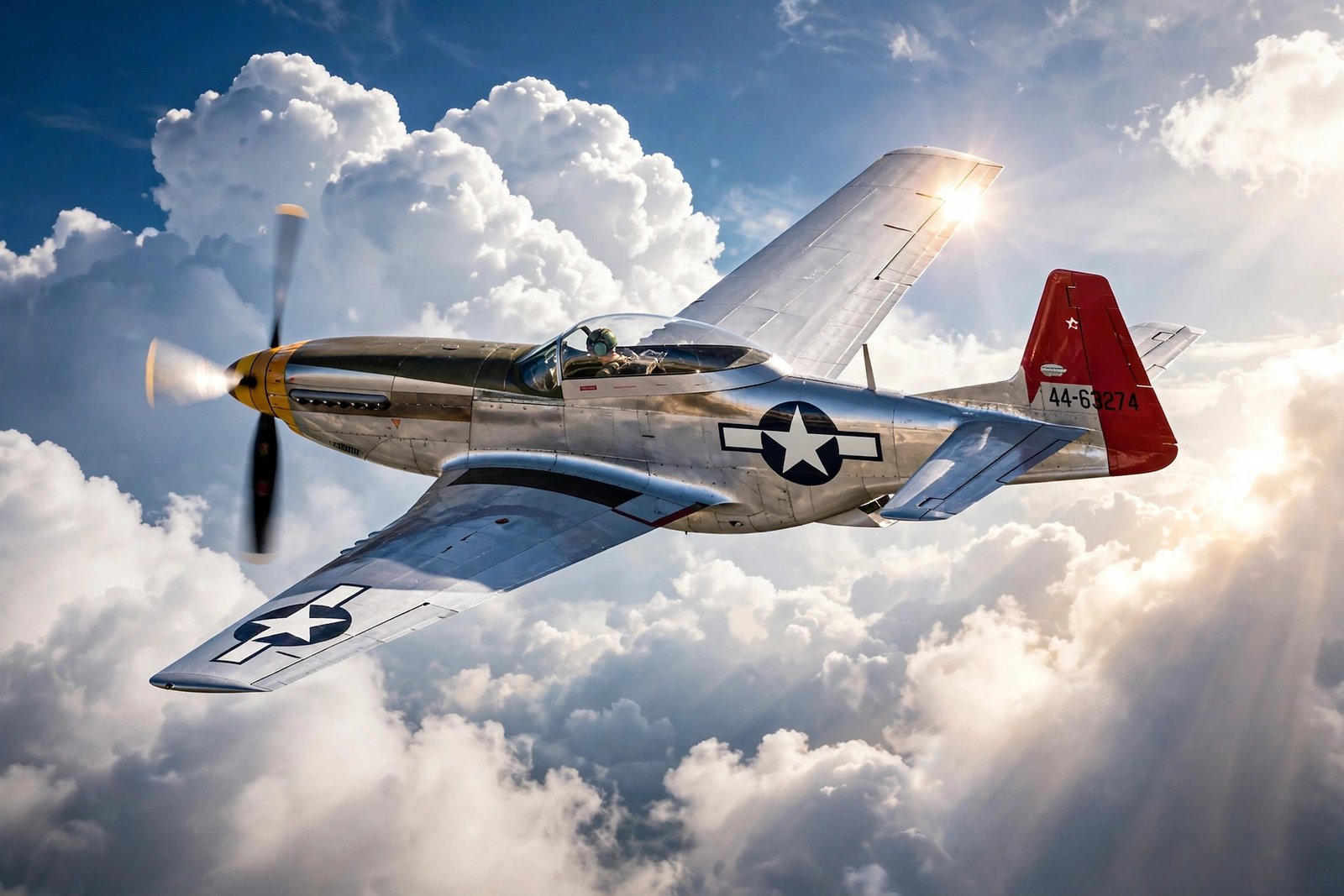
They were called the Red Tails because of the bright red paint on the tails of their fighter planes. To the bomber crews they protected over Europe, they were known as guardian angels. To the segregated America they came home to, they were proof that courage has no color. The Tuskegee Airmen, the first Black military aviators in the U.S. Army Air Corps, fought two wars at once: one against the Axis powers abroad, and one against racism at home. They won distinction in both.
Between 1941 and 1946, more than 1,000 pilots graduated from the Tuskegee program in Alabama, flying over 15,000 sorties in combat over North Africa, Sicily, and Europe. Their record as bomber escorts was among the finest of any fighter group in the war, and their service helped pave the way for the desegregation of the American armed forces. In 2007, more than six decades after their wartime service, the surviving Tuskegee Airmen received the Congressional Gold Medal, one of the highest honors Congress can bestow.
The Tuskegee Experiment
For most of American history, Black men were barred from serving as military pilots. The prevailing prejudice of the time held, falsely, that Black Americans lacked the intelligence, courage, or coordination to fly combat aircraft. When the United States began preparing for war in the late 1930s, civil rights leaders and Black newspapers pressed the government to open pilot training to Black volunteers. In 1941, the War Department finally agreed, creating a segregated training program at the Tuskegee Institute in Alabama, a historically Black school with a civilian pilot training program already in place.
Many officials expected the program to fail. It was, in effect, an experiment designed by skeptics, and its critics waited for proof that Black pilots could not measure up. The young men who volunteered understood exactly what was at stake. They were not just learning to fly. They were carrying the hopes of an entire community, knowing that their performance would be used to judge whether Black Americans deserved a place in the cockpit at all. The pressure was enormous, and so was their determination.
Training at Tuskegee
Training took place at Moton Field, near Tuskegee, Alabama, and at the nearby Tuskegee Army Air Field. The first classes trained as fighter pilots for the 99th Fighter Squadron, which was formed in 1941. The cadets faced the same grueling syllabus as any other Army pilots: classroom study, navigation, gunnery, formation flying, and combat tactics. They also faced segregation in housing, dining, and recreation, even on military bases where they wore the same uniform as their white counterparts.
The program demanded excellence, and the cadets delivered it. Instructors, many of them white officers, pushed the trainees hard, and the washout rate was high, as it was in flight training everywhere. Those who earned their wings were among the most thoroughly trained pilots in the Army Air Forces. Among their leaders was Benjamin O. Davis Jr., who would go on to command the 332nd Fighter Group and later become the first Black general in the U.S. Air Force. His father, Benjamin O. Davis Sr., had been the first Black general in American history.
Into Combat: North Africa and Italy
The 99th Fighter Squadron shipped out to North Africa in 1943, flying ground-attack and patrol missions in support of Allied troops. At first, some commanders doubted the squadron and assigned it limited roles. But the pilots proved themselves in combat again and again, strafing enemy positions, escorting bombers, and flying patrols over hostile territory. Their performance earned the respect of fellow pilots and the attention of senior commanders.
In early 1944, the 99th joined three other Black fighter squadrons, the 100th, the 301st, and the 302nd, to form the 332nd Fighter Group in Italy. At the same time, a second Tuskegee unit, the 477th Bombardment Group, was training bomber crews back in the United States. The 332nd’s arrival in Italy marked a turning point. The group soon began flying the missions that would make it famous: long-range escort for the heavy bombers of the Fifteenth Air Force, deep into enemy territory.
The Red Tails and the P-51 Mustang
By mid-1944, the 332nd was flying the P-51 Mustang, one of the finest fighter aircraft of the war, with the range to escort bombers all the way to their targets and back. The group’s aircraft were painted with bright red tails so that bomber crews and fellow fighters could identify them quickly in a crowded sky. The paint scheme gave the group its enduring nickname: the Red Tails.
The Red Tails took their escort duty seriously, and their discipline set them apart. While some fighter groups chased enemy aircraft for personal victories, leaving the bombers exposed, the 332nd stayed close to the bombers it was assigned to protect. Bomber crews noticed. They began requesting the Red Tails by name, and a reputation grew that the safest place in the sky over Europe was under a red-tailed escort. The bond between the fighter pilots and the bomber crews they guarded became one of the war’s great stories of trust earned in combat.
The Escort Record, Honestly Told
For years after the war, a popular story held that the Tuskegee Airmen never lost a single bomber they escorted. That claim, repeated in books, films, and speeches, turned out to be too good to be true. Detailed later research found that enemy fighters did shoot down bombers under the group’s escort, with at least 25 such losses documented. Historians now tell the story straight, and the honest version is impressive enough on its own.
Across more than 1,500 missions and 15,000 sorties, the Tuskegee Airmen destroyed well over 100 enemy aircraft in the air and many more on the ground, while suffering one of the lowest bomber-loss rates of any fighter escort group in the war. They were in constant demand from bomber units, and their record stood comparison with any group in the Fifteenth Air Force. The real achievement needs no exaggeration: a group that was expected to fail became one of the most reliable escort units in the entire war.
Fighting Two Wars
While the Red Tails fought over Europe, they also fought a quieter battle against segregation within their own military. Black officers were denied entry to officers’ clubs, assigned inferior facilities, and treated as second-class servicemen even as they risked their lives in combat. The injustice was not lost on the airmen, and their dignified persistence became part of their legacy. They argued, by example, that a nation fighting for freedom abroad could not justify denying it at home.
Their record helped change minds at the highest levels. In 1948, President Harry S. Truman signed Executive Order 9981, ordering the desegregation of the armed forces. The order did not end discrimination overnight, but it was a decisive step, and it rested in large part on the proof the Tuskegee Airmen had provided: that Black Americans could fly, fight, and lead as well as anyone. The military became one of the first major American institutions to desegregate, years before the broader civil rights movement transformed civilian life.
Honors: The Congressional Gold Medal
The Tuskegee Airmen’s decorations fill a long list. Collectively, they earned hundreds of Air Medals, nearly 100 Distinguished Flying Crosses, multiple Distinguished Unit Citations, Bronze Stars, Purple Hearts, and a Silver Star. But the honor that meant the most came late. In 2006, Congress voted to award the Tuskegee Airmen the Congressional Gold Medal, the highest civilian award Congress can give. On March 29, 2007, surviving airmen gathered in the rotunda of the U.S. Capitol to receive it, in recognition of what Congress called their unique military record, which inspired revolutionary reform in the armed forces.
The ceremony was a moment of national reckoning. Men in their eighties, some in wheelchairs, stood where presidents are honored, receiving the thanks of a country that had once doubted them. President George W. Bush presented the medal, and the airmen’s story reached a new generation. A few years later, surviving Tuskegee Airmen were invited to the presidential inauguration in 2009, another public acknowledgment of how far the country had traveled since the days of segregated training fields.
The Legacy of the Red Tails
The legacy of the Tuskegee Airmen lives on in many places. The Tuskegee Airmen National Historic Site at Moton Field in Alabama preserves the hangars and training grounds where the pilots learned to fly. The story has inspired books, documentaries, and the feature film Red Tails, which brought their exploits to a new audience. More importantly, it lives on in the generations of Black military aviators, astronauts, and airline pilots who followed the trail the Red Tails blazed.
For American readers today, the Tuskegee Airmen offer a story that is both inspiring and honest. It is a story about skill and courage under fire, about a group of young men who refused to accept the limits others placed on them, and about a country that slowly, imperfectly, learned to live up to its own ideals. The red tails in the sky over Europe are gone now, but what they stood for has never faded.
Frequently Asked Questions
Who were the Tuskegee Airmen?
The Tuskegee Airmen were the first Black military aviators in the U.S. Army Air Corps during World War II. Trained at Tuskegee, Alabama, they served as fighter pilots in the 99th Fighter Squadron and the 332nd Fighter Group, and as bomber crews in the 477th Bombardment Group.
Why were they called the Red Tails?
The pilots of the 332nd Fighter Group flew P-51 Mustangs with their tail sections painted bright red for identification in combat. The nickname Red Tails stuck, and bomber crews also called them Red-Tail Angels because of their reputation for staying close to the bombers they escorted.
Did the Tuskegee Airmen really never lose a bomber?
No, not literally. The popular claim that they never lost an escorted bomber is a myth. Later research documented at least 25 bombers shot down while under their escort. Even so, their bomber-loss rate was among the lowest of any fighter escort group in the war, which is why bomber crews requested them by name.
What was the Tuskegee Airmen’s role in desegregating the military?
Their outstanding combat record undermined the racist argument that Black Americans could not serve as combat pilots. Their service helped pave the way for President Harry S. Truman’s 1948 executive order desegregating the armed forces.
When did the Tuskegee Airmen receive the Congressional Gold Medal?
Congress voted to award the medal in 2006, and the surviving Tuskegee Airmen received the Congressional Gold Medal at a ceremony in the U.S. Capitol rotunda on March 29, 2007.
Related Reading
Keep exploring American military history on Trending 4: Ghost Army WWII Inflatable Tanks Gold Medal, Sergeant Stubby WWI Hero Dog, and Statue of Liberty Dedication October 28, 1886. Learn more from the U.S. Department of Veterans Affairs, the U.S. Army’s Red Tails tribute, and the Congressional Gold Medal legislation (govinfo).