
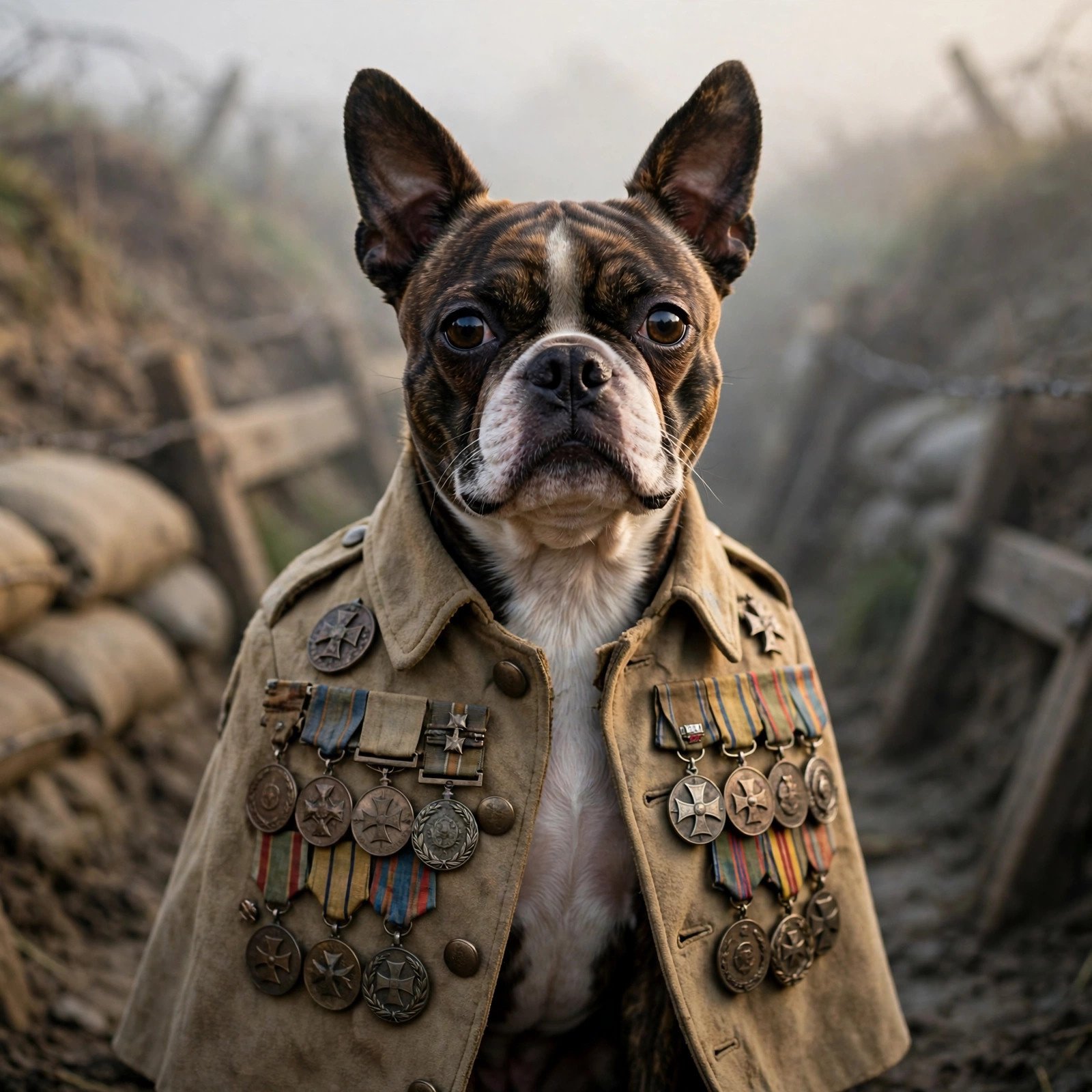
He was a stray with a stubby tail, probably part Boston terrier, found wandering a college campus. Within a year he was in the trenches of France, warning soldiers of poison gas, finding the wounded in no man’s land, and — in the story that made him immortal — holding a German spy by the seat of his pants. Within five years he had met three American presidents and received a gold medal from the commanding general of the American Expeditionary Forces himself. And more than a century later, you can still visit him: Sergeant Stubby, the most decorated dog of World War I, rests today in the Smithsonian, in the national exhibition on Americans at war.
Every part of that paragraph is true, or as true as the contemporary newspaper record allows — and the careful telling matters, because Stubby’s story has attracted legend the way his uniform attracted medals. Here is the real story of America’s original hero dog: what he did, what we know, what we merely cherish, and why a small brindle stray still means so much.
A Stray at Yale
In the summer of 1917, the men of the 102nd Infantry Regiment, part of the 26th “Yankee” Division, were training on the grounds of Yale University in New Haven, Connecticut. A young dog began hanging around the drills — friendly, fearless, and quick to learn. One soldier in particular, Corporal John Robert Conroy, adopted him in all but paperwork. The dog was named for his short tail: Stubby. He learned the bugle calls, the drill formations, and, most fatefully, a trick the men taught him for fun: at the command to present arms, Stubby would sit up and raise a paw in an approximate salute.
When the regiment shipped out for France aboard the transport USS Minnesota, dogs were not on the manifest. Conroy smuggled Stubby aboard, hidden under his coat. The inevitable discovery by the commanding officer might have ended the adventure — except that Stubby, on cue, saluted. As the story has been told ever since, the officer was charmed enough to let the stowaway stay. It is the first recorded instance of Stubby’s central military skill: morale. An army runs on it as surely as on ammunition, and this dog manufactured it wherever he went. A fuller telling of his service is at Sergeant Stubby’s encyclopedia entry.
Eighteen Months, Seventeen Battles
Stubby entered combat on February 5, 1918, at Chemin des Dames, north of Soissons, and spent the better part of eighteen months in and around the trenches, serving in seventeen battles and four major offensives. Conditions that broke men did not spare dogs. For over a month at the front, Stubby was under fire day and night. What he gave the regiment went well beyond companionship, valuable as that was in the mud and terror of trench warfare.
The Nose and Ears That Saved Lives
Dogs hear and smell a world humans cannot. Stubby learned to recognize the faint whine of incoming artillery shells before the men could hear them, and his reactions became an early-warning system: when Stubby ducked, the 102nd ducked. More important still was gas. After being exposed to mustard gas himself and recovering, Stubby became acutely sensitive to it, and on at least one famous occasion he roused sleeping men in time for them to get their masks on — Stubby had his own specially made mask — before a surprise gas attack. In the trenches, where gas crept silently into dugouts at night, a dog’s nose was not a curiosity. It was a perimeter alarm that never slept deeply.
Between the lines, Stubby worked no man’s land, locating wounded American soldiers by sound and scent and staying with them, barking until stretcher-bearers could find them in the dark. Men who could not move and could not be seen could be heard by a dog. In an era before reliable battlefield radios, that mattered more than any decoration.
Wounded in Action
In April 1918, during a raid on the German-held town of Schieprey, Stubby was wounded in the foreleg by shrapnel from a German grenade. He was evacuated to the rear, convalesced — reportedly lifting the spirits of wounded men in hospital just as he had at the front — and, upon recovery, returned to the trenches. He earned a wound stripe for it, the era’s equivalent of what we now call the Purple Heart; later accounts credit him with two Purple Hearts. Gas and grenades, front-line service, a return to duty after wounds: strip away the species, and that is simply the record of a soldier of the Great War.
The Spy in the Bushes
The exploit that sealed Stubby’s fame came in the Argonne. On patrol, Stubby’s barking led American soldiers to a German soldier concealed in brush near their lines — a scout or spy who had been mapping the American positions. The man, trying to run or fight his way clear, ended up on the ground with Stubby’s jaws clamped firmly to the seat of his trousers, holding him until the patrol arrived. The Americans took the prisoner, confiscated his Iron Cross — which, legend holds, was pinned to Stubby’s blanket as a trophy — and, in the telling repeated by the Smithsonian and contemporary papers, the commanding officer of the 102nd promoted the dog to sergeant on the spot.
Stubby has been called the only dog promoted to sergeant through combat, and the Smithsonian describes him as the first dog given rank in the United States Army; scrupulous historians note there is no surviving paperwork for the promotion, formal rank for animals being an informal business in 1918. What is not in doubt is the capture itself, reported in the press of the day, or the regiment’s devotion. After American forces retook Château-Thierry, the grateful women of the town sewed Stubby a chamois coat, and onto it the men pinned his accumulating medals, campaign bars, and insignia — the uniform he still wears in the Smithsonian today. The Defense Media Network’s detailed account, “Sgt. Stubby: American War Dog,” walks through these episodes and their sourcing.
Home a Hero
Conroy smuggled Stubby home the way he had smuggled him out — some rules the Army chose not to enforce twice — and the dog returned to a country hungry for heroes with four legs. Stubby led parades, appeared at bond drives and American Legion events, and met Presidents Woodrow Wilson, Warren G. Harding, and Calvin Coolidge. On July 6, 1921, at a ceremony in Washington honoring veterans of the 102nd, General John J. Pershing — commander of all American forces in France — personally pinned a gold medal on Stubby’s coat, an award from the Humane Education Society honoring his heroism. Photographers recorded the small dog enduring the flashbulbs with what the New York Times called nervous excitement; the general’s praise was ungrudging.
Stubby received lifetime membership in the American Legion and the YMCA — the latter reportedly entitling him to three bones a day and a place to sleep for life, a pension any sergeant would envy. When Conroy enrolled in law school at Georgetown University, Stubby went along as a campus celebrity and football mascot, delighting crowds by nosing a football around the field at halftime. The stray from Yale Field had become, by any measure, one of the most famous animals in America.
Death, the Smithsonian, and an Animated Afterlife
Sergeant Stubby died in his sleep on March 16, 1926, aged about nine or ten. His obituary ran in newspapers across the country — a half-page farewell in the New York Times among them — an honor few sergeants of any species have received. His remains were preserved, and in 1956 his mounted figure, still wearing the famous medal-covered coat, was presented to the Smithsonian Institution. He is displayed in “The Price of Freedom: Americans at War” at the National Museum of American History in Washington, D.C., where schoolchildren meet him daily at roughly their own eye level — which seems right.
In 2018, a century after his service, Stubby reached a new generation as the star of the animated film Sgt. Stubby: An American Hero, which retold his story for family audiences. Military working dogs today — highly trained animals with official roles Stubby could never have imagined — descend culturally from his example: he demonstrated to a mass audience, for the first time, what a dog could do in war, and what a dog could mean to the men who fought it.
Why Stubby Still Matters
It is tempting to treat Stubby as a mascot story, a bit of sweetness in a bitter war. Resist that. The First World War consumed a generation: the 26th Division alone suffered thousands of casualties, and the men of the 102nd lived with gas, bombardment, and loss for eighteen months in Stubby’s company. They pinned their medals on a dog because he had genuinely shared their danger, genuinely saved some of their lives, and genuinely gave them something to love in a place built to destroy love. Every decoration on that chamois coat was a man’s judgment about what had kept him going.
That is why the story survives its legends. Some details — the exact salute, the Iron Cross trophy, the paperwork of a sergeant’s stripes — belong to the affectionate record of newspapers and comrades, and honest storytellers label them as such. But the core is documented and sufficient: a stray dog crossed an ocean under a soldier’s coat, served seventeen battles, was gassed and wounded, warned his regiment of gas and shells, found its wounded in the dark, caught an enemy scout, and came home to have a general pin gold on his chest. America has had many war dogs since. It has never had another first one.