
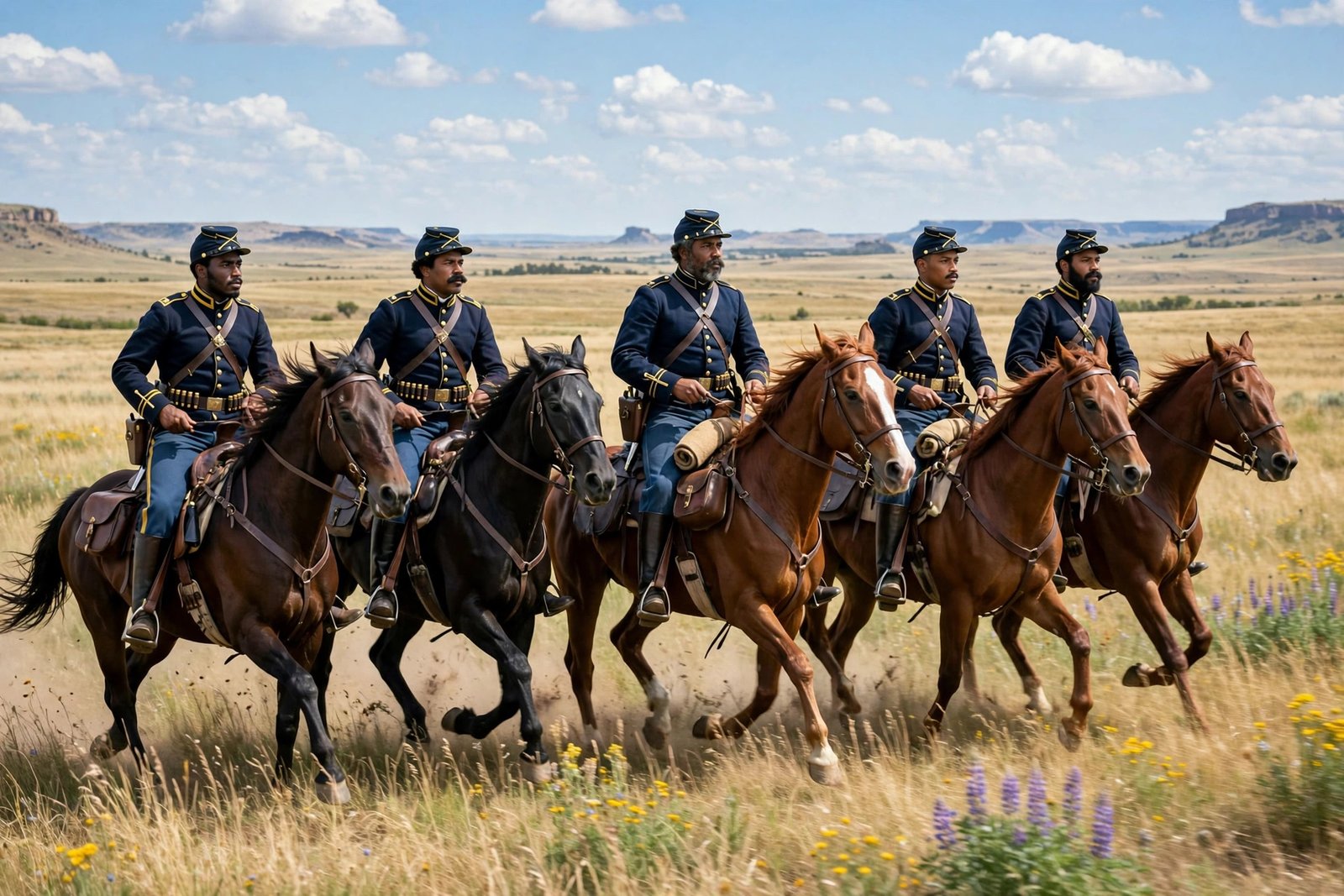
They were called Buffalo Soldiers, a name given to them by the Native American warriors they fought on the Western frontier — a tribute, by most accounts, to their dark, curly hair, which resembled a buffalo’s coat, and to their fierce courage in battle. The name stuck, and it came to stand for all the Black regiments created by Congress in 1866: the first African American soldiers to serve in the regular peacetime United States Army. Their story runs from the aftermath of the Civil War through the Spanish-American War and into the twentieth century, and it is a story of extraordinary service performed under segregation, at remote frontier posts, for a nation that did not yet grant them full equality at home.
This article follows the Buffalo Soldiers from their creation to their legacy, drawing on the National Park Service, which preserves their history at sites across the West. It is a story that includes famous names like Cathay Williams and Charles Young, hard duty on the frontier, service as America’s first national park rangers, and a long fight for recognition that continues today.
From Civil War to Regular Army
African Americans had fought for the United States since the Revolution, and nearly 200,000 Black soldiers served in the Union Army during the Civil War. But when the war ended, there was no place for them in the peacetime Regular Army — until Congress acted. On July 28, 1866, Congress passed the Army Reorganization Act, officially titled An Act to Increase and Fix the Military Peace Establishment of the United States, which created six all-Black regiments: the 9th and 10th Cavalry and the 38th, 39th, 40th, and 41st Infantry.
Three years later, in 1869, Congress consolidated the infantry regiments into two, the 24th and 25th Infantry, leaving the four regiments — the 9th and 10th Cavalry, the 24th and 25th Infantry — that would carry the Buffalo Soldier name through most of their history. The enlisted ranks were Black; the officers were, with rare exceptions, white, a reflection of the segregated Army of the era. The men who enlisted were often Civil War veterans, formerly enslaved people, and freemen seeking steady pay, education, and a measure of dignity that civilian life in the postwar South rarely offered. The National Park Service traces this founding in its account of forming the Buffalo Soldier regiments.
Why Buffalo Soldiers?
The origin of the nickname is one of the most retold stories in American military history, and the National Park Service gives the most widely accepted version: Plains Indians who fought the Black cavalry troops called them buffalo soldiers because of their dark, curly hair, resembling a buffalo’s coat, and because of their fierce fighting nature. The name began with the 10th Cavalry and soon became synonymous with all the African American regiments formed in 1866.
Whatever its exact origin, the name was embraced by the soldiers themselves as a badge of honor. The buffalo was a powerful, respected animal on the Plains, and to be compared to it was a compliment, not an insult. The regiments adopted buffalo imagery in their insignia, and the name has endured far longer than the regiments themselves, becoming shorthand for Black military service in the West. It is a rare case in which a nickname given by an adversary became a source of pride for the soldiers who bore it.
Life on the Western Frontier
For their first decades, the Buffalo Soldiers served mostly on the Western frontier, garrisoning isolated forts across Texas, New Mexico, Arizona, Kansas, and the Dakotas. Their duties were relentless and unglamorous: protecting settlers and railroad crews, escorting mail and stagecoaches, building roads and forts, stringing telegraph lines, and keeping the peace across vast territories. They served at some of the most remote and harsh posts in the Army, often with cast-off supplies and equipment passed down from white regiments.
The frontier wars — the long, painful conflicts between the expanding United States and Native American nations — were the Buffalo Soldiers’ principal combat experience in this period. The National Park Service notes that the regiments took part in many engagements with American Indian tribes, as well as pursuing outlaws and border raiders. It was difficult, dangerous work, performed by soldiers who knew that the nation they served had not yet extended to them the rights they were defending for others. Their desertion rates were notably low and their reenlistment rates high, facts that commanders of the era attributed to discipline, pride, and the limited opportunities available to Black men in civilian life.
Cathay Williams: A Soldier in Disguise
Among the most remarkable Buffalo Soldiers was Cathay Williams, the only woman on record to enlist in the regiments. Born enslaved, Williams enlisted in the 38th Infantry on November 15, 1866, under the name William Cathay. She served for nearly two years before a post surgeon discovered her identity during a hospital visit, and she was honorably discharged because women were prohibited from serving at the time.
Williams’s story, preserved in her own later account and in Army records, is a reminder of how many different motives drew people to the regiments: freedom, pay, adventure, and escape from the constraints of postwar life. After her discharge, Williams lived in Colorado and New Mexico, working as a cook and laundress, and she later applied for a disability pension based on her service. Her application was denied, but her place in history is secure: she remains the only documented woman to have served as a Buffalo Soldier.
Charles Young and the Path to Leadership
If Cathay Williams represents the regiments’ hidden stories, Charles Young represents their highest aspirations. Young, born enslaved in Kentucky, graduated from West Point in 1889 — only the third Black graduate in the academy’s history — and went on to a distinguished career in the 9th and 10th Cavalry. He served as a military attache, commanded troops in the Philippines and Mexico, and became the first Black man to reach the rank of colonel in the Regular Army.
Young’s most famous assignment came in 1903, when Captain Young led a company of Buffalo Soldiers in Sequoia and General Grant National Parks, where the soldiers built roads, including a road to the Giant Forest and a road to the base of Moro Rock. Young later served as superintendent of Sequoia, one of the first Black national park superintendents in American history. His career embodied both the promise and the limits of the era: extraordinary achievement within a segregated system that ultimately denied him, on the eve of World War I, the general’s star many believed he had earned. Today, his home in Wilberforce, Ohio, is preserved as the Charles Young Buffalo Soldiers National Monument.
America’s First Park Rangers
One of the Buffalo Soldiers’ least-known legacies is also one of their most enduring: they were, in effect, America’s first national park rangers. Between 1891 and 1913, before the National Park Service existed, the U.S. Army administered Yosemite and Sequoia National Parks. Buffalo Soldiers stationed at the Presidio of San Francisco during the winter served in the Sierra during the summer, fighting wildfires, curbing poaching, ending illegal grazing on federal lands, and building roads, trails, and other infrastructure.
Their work shaped the parks visitors enjoy today. Trails, roads, and ranger traditions in Yosemite and Sequoia trace directly to Buffalo Soldier labor, and the soldiers’ presence in the parks is now commemorated in exhibits and programs. The National Park Service’s overview of the regiments describes these duties in detail; see the National Park Service Buffalo Soldiers overview and its regiment histories. When the National Park Service was created in 1916, it inherited a ranger tradition that Buffalo Soldiers had helped invent.
War in Cuba, the Philippines, and Beyond
The Buffalo Soldiers’ service was not confined to the frontier. In the Spanish-American War of 1898, the 9th and 10th Cavalry fought in Cuba, including in the famous charge up San Juan Hill, where Black troops fought alongside Theodore Roosevelt’s Rough Riders — a contribution that went largely unrecognized in the popular accounts of the battle that followed. The regiments also served in the Philippines during the Philippine-American War, and later along the Mexican border during the Punitive Expedition.
Through all of it, the pattern repeated: distinguished combat service, followed by a return to segregated garrisons and a civilian society that offered little recognition. Eighteen Buffalo Soldiers received the Medal of Honor, the nation’s highest military decoration, and the regiments’ record in combat earned the respect of commanders across the Army. But respect within the Army did not translate into equality outside it, and the soldiers’ story is inseparable from that contradiction.
The End of the Regiments and the Legacy
The Buffalo Soldier regiments endured, in various forms, for nearly nine decades. The last of the original regiments was disbanded in 1951, and the broader story of Black service in a segregated Army came to an end with President Harry Truman’s Executive Order 9981 in 1948, which ordered the desegregation of the armed forces, and the integration that followed during the Korean War. The Buffalo Soldiers’ lineage continues today in units that trace their heritage to the 9th and 10th Cavalry, and their story is preserved at national parks, monuments, and museums across the country.
Their legacy is complex, and honest history should say so. The Buffalo Soldiers served their country with distinction while participating in campaigns against Native American nations whose land and sovereignty were being taken — a contradiction that modern historians and the National Park Service itself now present openly. To remember the Buffalo Soldiers is not to simplify their story, but to hold both truths at once: that they were pioneers who opened the Regular Army to Black Americans, and that they did so in an era of conquest and segregation whose costs are still being reckoned with. That complexity is precisely why their story still matters.
Frequently Asked Questions
Who were the Buffalo Soldiers? The Buffalo Soldiers were the African American regiments of the U.S. Army created by Congress in 1866 — the 9th and 10th Cavalry and, after consolidation, the 24th and 25th Infantry — the first Black soldiers in the regular peacetime Army.
Why were they called Buffalo Soldiers? According to the National Park Service, Plains Indians called the Black cavalry troops buffalo soldiers because of their dark, curly hair, resembling a buffalo’s coat, and their fierce fighting nature. The soldiers embraced the name with pride.
When were the Buffalo Soldier regiments created? July 28, 1866, when Congress passed the Army Reorganization Act establishing six all-Black regiments, later consolidated to four.
Did Buffalo Soldiers serve as park rangers? Yes, in effect. Between 1891 and 1913, Buffalo Soldiers administered Yosemite and Sequoia National Parks for the Army, fighting fires, stopping poaching, and building roads and trails before the National Park Service existed.
Who was Charles Young? Charles Young was a Buffalo Soldier officer, West Point graduate, and the first Black colonel in the Regular Army, who led troops in Sequoia National Park and later served as its superintendent.
Who was Cathay Williams? Cathay Williams was the only woman on record to enlist as a Buffalo Soldier, serving in the 38th Infantry under the name William Cathay before her identity was discovered.