
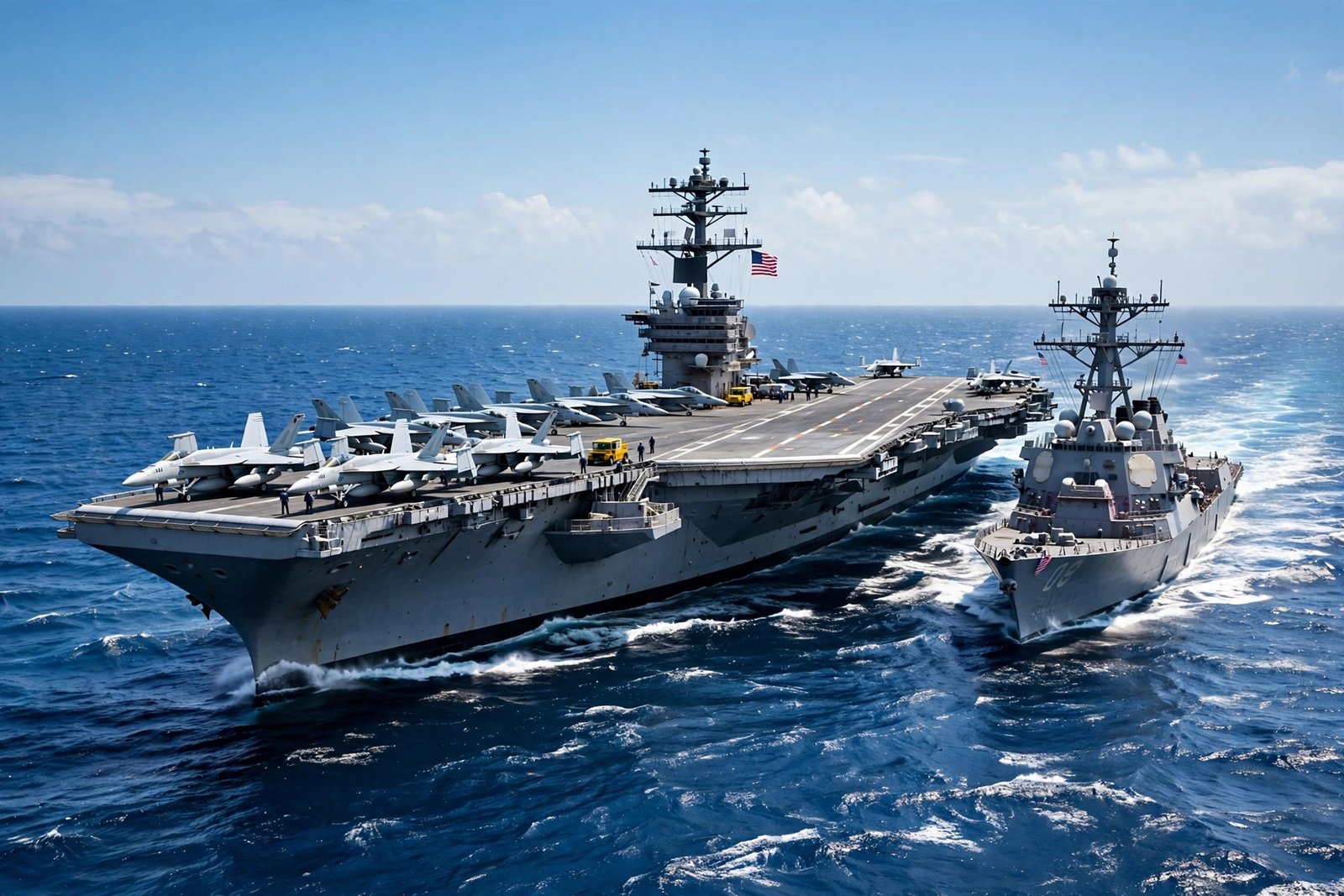
There is no symbol of American power more recognizable than an aircraft carrier cutting through open ocean. From the deck of one of these floating cities, fighter jets launch into the sky, helicopters ferry supplies ashore, and thousands of sailors keep a small American town running around the clock. To many people around the world, the sight of a U.S. carrier on the horizon sends a simple message: America is present, America is capable, and America can respond.
But a carrier is much more than a warship. It is a mobile airfield, a command center, a hospital, and a humanitarian lifeline all rolled into one. It can deter conflict without firing a shot, reassure allies with a port visit, or rush aid to a disaster zone when roads and airports are gone. Understanding how carriers work is understanding a central piece of how the United States has shaped the world for more than eighty years.
What Is an Aircraft Carrier, Really?
An aircraft carrier is a warship designed to carry, launch, and recover military aircraft far from land. Unlike a land-based air base, which is fixed in one place and depends on permission from a host nation, a carrier moves. It can sail into international waters and operate from the sea, giving American leaders options in places where no friendly runway exists nearby.
The flight deck is the heart of the ship. It is longer than three football fields, and it functions as a runway, a parking lot, and a workshop at the same time. Aircraft are launched with the help of catapults that accelerate them to flying speed in a very short distance, and they land by catching arresting wires stretched across the deck. It is one of the most demanding and dangerous jobs in the military, performed day and night, in rough weather and total darkness.
Below deck, the ship is a self-contained world. There are kitchens serving thousands of meals a day, medical facilities, workshops, fuel stores, munitions magazines, and berthing spaces for a crew that numbers in the thousands when the air wing is embarked. A carrier can stay at sea for months at a time, resupplied by support ships that bring fuel, food, and spare parts while the carrier keeps moving.
The Carrier Strike Group: Power in Numbers
A carrier almost never sails alone. It travels as the centerpiece of a carrier strike group, a formation of ships that protect it and extend its reach. Guided-missile cruisers and destroyers screen against air, surface, and submarine threats. Attack submarines scout ahead beneath the waves. Supply ships keep the whole group fueled and fed.
This teamwork matters because a carrier’s greatest strength is also its greatest vulnerability: it is big, valuable, and impossible to hide completely. The strike group exists to make sure no single threat can get close enough to do it harm. Each ship has a job, and together they form a layered defense that is far stronger than any one vessel on its own.
The strike group also multiplies what the carrier can do. Its escort ships carry missiles, radars, and sonar systems of their own, and they can patrol, intercept, and support operations across a wide area while the carrier’s aircraft focus on missions overhead. The result is a force that can control the sea and the sky around it, project power inland, and sustain itself far from home.
Nimitz and Ford: Two Generations of American Carriers
For decades, the backbone of the American carrier fleet has been the Nimitz class. These nuclear-powered giants entered service beginning in the 1970s and have served in every major American operation since, from the Cold War to the conflicts of the twenty-first century. They are known for their endurance, their large air wings, and their ability to operate anywhere on the planet.
The newest generation is the Ford class, named for President Gerald R. Ford. These ships build on the Nimitz design with new technologies intended to make launching and recovering aircraft faster and more efficient, to reduce the size of the crew needed to run the ship, and to generate more electrical power for future systems. The first ship of the class represents a major step forward, even as the Navy continues to learn from operating it and refining the design.
What both classes share is the feature that makes American carriers unique: nuclear propulsion. A nuclear-powered carrier does not need to refuel for years at a time, which means it can stay on station far longer than a conventionally powered ship and can sprint across oceans at high speed without worrying about fuel. That endurance is a strategic advantage in itself, because it lets the United States keep a carrier where it is needed, for as long as it is needed.
The Carrier Air Wing: Eyes, Fists, and Lifelines
A carrier without its aircraft is just a very large ship. The carrier air wing is what turns it into a complete fighting and helping force. Fighter jets provide air defense and strike capability. Electronic warfare aircraft jam enemy radars and protect friendly forces. Early-warning aircraft, with their distinctive radar domes, watch the skies and seas for hundreds of miles in every direction.
Helicopters do work that is easy to overlook but impossible to replace. They rescue downed pilots, hunt submarines, ferry supplies between ships, and carry relief workers and medicine ashore after disasters. Transport and support aircraft keep the whole operation supplied. Every member of the air wing, from pilots to mechanics to ordnance handlers, plays a part in keeping the ship’s aircraft flying safely around the clock.
The air wing also gives American leaders flexibility. The same carrier that provides air cover for troops ashore one week can pivot to disaster relief the next, launching helicopters loaded with food and water instead of weapons. That ability to switch missions without returning to port is one reason carriers remain so valuable.
From World War II to Today: A Brief History
Aircraft carriers first proved their decisive value in World War II. In the Pacific, carrier battles replaced battleship duels as the defining naval engagements of the war, and carriers carried American air power across vast ocean distances to island after island. By the end of the war, the carrier had become the centerpiece of naval power, a position it has never given up.
During the Cold War, carriers were America’s floating answer to a global challenge. They patrolled the Mediterranean, the Atlantic, and the Pacific, reassured allies, and kept sea lanes open. In Korea, Vietnam, and later conflicts, carrier aircraft flew combat missions far from American shores, often as the first American air power to arrive and the last to leave.
In recent decades, carriers have served in the Middle East, the Indo-Pacific, and beyond, supporting combat operations, deterring aggression, and responding to crises. They have also become fixtures of American diplomacy: a carrier port visit can be a powerful show of friendship, and a carrier’s presence in troubled waters can calm tensions without a shot being fired. For more on the Navy’s own account of this history, see the resources at the Naval History and Heritage Command and the U.S. Navy’s official site at navy.mil.
More Than War: Humanitarian Missions
Some of the most important work carriers do involves no fighting at all. After earthquakes, tsunamis, and hurricanes, carriers have arrived off devastated coastlines with helicopters, medical teams, fresh water, and supplies. When ports are destroyed and airports are flooded, a carrier’s flight deck can become the only working airfield for miles.
These missions save lives, and they also shape how America is seen. For people in a disaster zone, the arrival of an American carrier often means the arrival of help: clean water, emergency surgery, and a way to reach isolated communities. It is soft power delivered by hard power, and it is a reminder that military capability can serve humanitarian ends.
Carriers also support evacuations, medical assistance, and partnership missions with allied navies, training together and building the relationships that matter when a real crisis arrives. In all of these roles, the carrier’s size, endurance, and self-sufficiency are what make the mission possible.
Why Carriers Still Matter in a Missile Age
Critics sometimes ask whether carriers are too big, too expensive, or too vulnerable in an age of long-range missiles and drones. It is a fair question, and naval planners take it seriously. Carriers are protected by layered defenses, they move constantly, and they operate with escorts precisely because threats exist.
Supporters answer that no other platform offers the same combination of mobility, endurance, and versatility. A carrier brings its own airfield, its own defenses, and its own supply chain to any coastline on Earth, without needing anyone’s permission. Satellites, missiles, and land bases all have roles, but none can replace a sovereign piece of American territory that can move, adapt, and stay.
The debate will continue as technology changes, and future carriers will surely look different from today’s. But the core idea behind the carrier — bringing air power to wherever it is needed, from the sea — has survived every technological revolution since World War II, and there is little sign it is going away.
Related Reading
- Hoover Dam: Engineering Power That Built America
- The U.S. Dollar as the World’s Reserve Currency, Explained
- Surprising Facts About the Interstate Highway System
Frequently Asked Questions
How many aircraft carriers does the United States have? The United States operates the world’s largest carrier fleet, with multiple nuclear-powered carriers in active service and more under construction or in maintenance at any given time. Exact numbers shift as ships enter service, deploy, or undergo refueling and overhaul, so the fleet is best described as the largest and most capable in the world rather than by a single fixed figure.
Why are American carriers nuclear-powered? Nuclear propulsion lets a carrier operate for years without refueling, giving it extraordinary endurance and range. It can cross oceans quickly and remain on station for extended periods, which is essential for a navy with global responsibilities.
What is a carrier strike group? A carrier strike group is the carrier plus its escorts: cruisers, destroyers, submarines, and supply ships that protect it and extend its capabilities. Together they form a self-contained naval force that can operate independently anywhere in the world.
Have carriers been used for humanitarian missions? Yes, many times. Carriers have delivered aid after earthquakes, tsunamis, and hurricanes, using their helicopters, medical facilities, and fresh-water production to help communities when local infrastructure was destroyed.
What is the difference between the Nimitz and Ford classes? The Nimitz class has been the backbone of the fleet for decades, while the Ford class is the newer generation, designed with updated launch and recovery systems, greater electrical power, and a smaller crew requirement. Both are nuclear-powered and carry a full carrier air wing.