
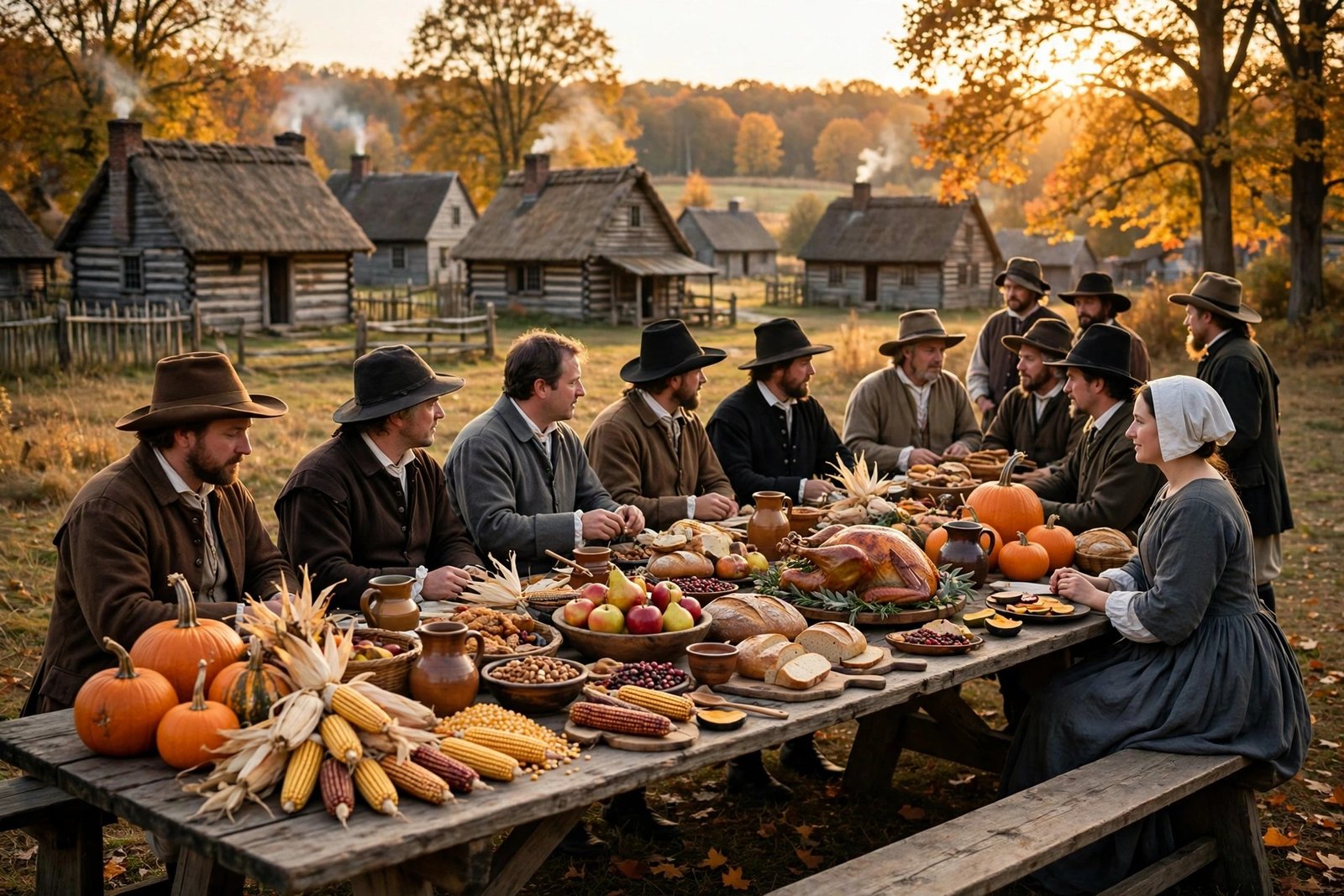
Every November, American families gather around a table, carve a turkey, and tell the story of the first Thanksgiving. The version most of us learned as children is simple and comforting: Pilgrims and Native Americans sat down together in harmony, shared a feast, and gave thanks. The real story is richer, more complicated, and in many ways more interesting. It involves a struggling colony, a powerful Native leader making a strategic decision, a harvest that meant survival, and a feast that lasted three days.
The first Thanksgiving took place in the autumn of 1621 at Plymouth, in what is now Massachusetts. It was not a holiday as we understand the term today, and nobody at the time called it Thanksgiving. It was a harvest celebration, held after the colonists had finally gathered a successful crop, and it brought together English settlers and members of the Wampanoag people. Understanding what actually happened, and what came later, means setting aside the myths and looking at the evidence that survives.
That evidence is thin but precious. Only two firsthand accounts of the 1621 feast survive, one in a letter and one in a history written years later. From those accounts, along with what historians know about seventeenth-century English and Wampanoag life, a clearer picture emerges. It is a story of diplomacy and hunger, of gratitude and uncertainty, and of two peoples whose futures would soon diverge in painful ways.
Plymouth Colony in 1621
The English settlers who arrived at Plymouth in December 1620 had endured a terrible first winter. They had sailed from England aboard the Mayflower, seeking religious freedom and a new life, but they arrived late in the year, with little shelter and dwindling supplies. Disease swept through the colony during those cold months, and roughly half of the original settlers died before spring. The survivors were weak, hungry, and dependent on help from the Native people already living in the region.
That help came from the Wampanoag, the Indigenous people of the coastal region that includes present-day Massachusetts and Rhode Island. Two men in particular changed the colony's fate. Squanto, also known as Tisquantum, had lived in England and spoke English, and he taught the settlers how to plant corn, where to fish, and how to survive in the new land. Samoset, an Abenaki man, had first approached the settlers in the spring of 1621 and helped open communication between the colony and the Wampanoag leadership.
The Wampanoag themselves had suffered devastating losses in the years before the Mayflower arrived, as European diseases spread through their communities. Their leader, Massasoit, faced difficult choices about how to deal with the newcomers. In the spring of 1621, he negotiated a treaty of mutual assistance with the Plymouth settlers, a practical alliance between two peoples who each needed allies. That treaty, and the relationship behind it, set the stage for the autumn feast.
The Harvest That Made a Feast Possible
By the autumn of 1621, the colonists had reason to celebrate. With guidance from their Wampanoag neighbors, they had planted corn, beans, and squash, the crops that Native farmers had grown in the region for centuries. They had also learned to fish and to gather food from the surrounding land and sea. The harvest was not abundant by later standards, but it was enough. After a winter of starvation, a successful crop meant the colony might survive.
In seventeenth-century England, a good harvest was traditionally marked with a celebration. The settlers at Plymouth followed that custom, organizing a feast to mark the gathering of their crops. They invited Massasoit and his people, honoring the alliance that had helped them survive. What followed was not a single afternoon dinner but a gathering that stretched across three days, filled with food, games, and demonstrations of skill.
The scale of the event surprised even the hosts. According to the surviving accounts, Massasoit arrived with around ninety men, far more guests than the settlers had expected. The colonists' own stores would not have fed so many people for three days, and the Wampanoag guests contributed significantly to the feast, bringing deer and other provisions. The celebration was, from the start, a shared effort rather than a one-sided act of hospitality.
What the Eyewitnesses Actually Wrote
Our knowledge of the 1621 feast rests on two brief but invaluable sources. The first is a letter written by Edward Winslow, one of the Plymouth leaders, in December 1621. Winslow described the harvest, the arrival of Massasoit with his men, and three days of feasting and recreation. He noted that the English exercised their arms, a display of military skill, while the Wampanoag men joined in the festivities. His letter was published in England the following year as part of a promotional account of the colony, intended to attract new settlers.
The second source is William Bradford, the colony's longtime governor, who wrote a history of Plymouth in later years. Bradford recorded that after the harvest, the governor sent men out to hunt fowl, and that Massasoit came with his people and brought deer. His account is shorter than Winslow's, but it confirms the essential details: a harvest celebration, a large Wampanoag presence, and food contributed by both sides. Together, the two accounts are the foundation of everything historians can say with confidence about the event.
What the accounts do not say is almost as important as what they do. Neither Winslow nor Bradford called the gathering a Thanksgiving, and neither described a formal religious service as the centerpiece of the feast. The settlers did give thanks to God in their daily lives, and a harvest celebration naturally carried religious meaning for them, but the event itself was a secular harvest festival in the English tradition, not a church service. Later generations would reshape it into something more solemn and symbolic.
What Was Really on the Table?
The foods at the 1621 feast were very different from the menu most Americans serve today. Turkey was probably present, since wild turkeys lived in the region and the colonists hunted fowl, but it was not the centerpiece we imagine. Venison, the deer brought by Massasoit's people, was certainly a major part of the meal, and the accounts mention it explicitly. Waterfowl such as ducks and geese were also likely served, along with fish and shellfish from the nearby coast.
Corn was another staple, prepared in Native styles as well as English ones. The settlers had grown corn with Wampanoag guidance, and it would have appeared in various forms, including cornmeal dishes. Beans and squash, the other crops of the traditional Native planting system, were also available. Cranberries grew wild in the region, but they would not have been served as the sweetened sauce we know today, since the settlers had little sugar. Potatoes, which are native to South America, had not yet become a common food in New England, and pumpkin pie as we know it did not exist, since the settlers lacked the butter, flour, and ovens needed for a modern pie crust.
Understanding the real menu matters because it corrects a common myth: that the first Thanksgiving looked like a modern holiday dinner. It did not. It was a feast of the foods available in coastal New England in 1621, prepared by two peoples with different cooking traditions, eaten outdoors over three days. The modern menu, with its turkey, stuffing, mashed potatoes, and pumpkin pie, developed much later, as Thanksgiving became a national holiday with its own traditions.
The Myths That Grew Around the Feast
Over the centuries, the story of the first Thanksgiving was simplified, sentimentalized, and sometimes invented outright. School pageants and storybooks turned a complex diplomatic gathering into a simple tale of friendship, with Pilgrims in tall hats and Native people in feathers sharing a peaceful meal. The reality was more nuanced. The 1621 feast was genuine, and the alliance behind it was real, but it was also temporary and strategic, shaped by the needs of both sides in a dangerous time.
Within a generation, the relationship between English settlers and Native peoples in New England had deteriorated dramatically. As more colonists arrived and English settlements expanded, conflicts over land and power grew, culminating in King Philip's War in the 1670s, a devastating conflict that shattered the Wampanoag and their allies. The peaceful image of 1621, so often presented as the beginning of a harmonious relationship, was in fact a brief moment before a much harder history. Historians and museums today work to tell both parts of the story: the feast itself, and what came after.
Another myth concerns the clothing and customs of the day. The Pilgrims did not wear the tall black hats with buckles shown in popular illustrations; those images came from later artistic imagination. Nor did they sit down to a single orderly dinner in the modern sense. The feast was an outdoor, multi-day event with activities, contests, and large groups of people coming and going. Stripping away these myths does not diminish the event. If anything, it makes the real story more human and more worth remembering.
How Thanksgiving Became a National Holiday
For more than two centuries after 1621, Thanksgiving remained a regional and irregular observance. Individual colonies and later states proclaimed days of thanksgiving at various times, often in response to a good harvest, a military victory, or another notable event. There was no fixed national date and no uniform tradition. That changed in the middle of the nineteenth century, during the Civil War.
In 1863, President Abraham Lincoln proclaimed a national day of Thanksgiving, to be observed on the last Thursday in November. Lincoln's proclamation came in the midst of a brutal war, and it called on Americans to give thanks even as the nation was divided. The idea had been championed for years by Sarah Josepha Hale, the influential editor of a popular women's magazine, who had campaigned tirelessly for a national holiday. Lincoln's proclamation made her campaign a reality, and Thanksgiving became an annual national observance.
The holiday's date was later fixed by law. In 1941, Congress established Thanksgiving as the fourth Thursday in November, the timing Americans still follow today. By then, the holiday had acquired many of its modern customs: the turkey dinner, the family gathering, the football games, and the parades. The story of 1621 remained at its heart, but the holiday itself was very much a nineteenth- and twentieth-century creation, shaped by the needs and imagination of later Americans.
How Plymouth Is Remembered Today
Visitors to Plymouth today can explore the story of 1621 at Plimoth Patuxet Museums, a living history museum that recreates the seventeenth-century English village and a Wampanoag homesite. The museum's approach has changed significantly over the years. Where earlier exhibits focused almost entirely on the Pilgrim experience, modern interpretation gives equal weight to the Wampanoag perspective, with Native staff presenting their own history, culture, and continuing presence in the region.
This shift reflects a broader change in how Americans understand the first Thanksgiving. Historians, educators, and Native communities have worked to replace a one-sided story with a fuller account, one that honors the Wampanoag as active participants and survivors rather than as background figures in someone else's story. The result is a more honest commemoration, and a more meaningful one. The feast of 1621 can still be celebrated as a moment of gratitude and cooperation, but it is now understood within the longer and more difficult history that followed.
That honesty is worth carrying into our own celebrations. Thanksgiving today is, for most Americans, a day of family, food, and gratitude. Remembering what actually happened in 1621, and what happened after, does not take away from that gratitude. It deepens it, by reminding us that the story of America began with encounters between peoples, with generosity and diplomacy, and also with loss and conflict. The first Thanksgiving deserves to be remembered in full.
Frequently Asked Questions
When was the first Thanksgiving?
The feast remembered as the first Thanksgiving took place in the autumn of 1621 at Plymouth, in present-day Massachusetts. It followed the colonists' first successful harvest and lasted three days. Nobody at the time called it Thanksgiving; that name came much later.
Who attended the first Thanksgiving?
The feast brought together English settlers from Plymouth Colony and members of the Wampanoag people, led by Massasoit. The Wampanoag guests numbered around ninety men, according to Edward Winslow's letter, and they contributed deer and other provisions to the shared meal.
What foods were served at the first Thanksgiving?
Venison was certainly served, along with fowl such as wild turkey, ducks, and geese, plus fish, shellfish, corn, beans, and squash. Cranberries grew in the region but would not have been sweetened sauce, and modern dishes like mashed potatoes and pumpkin pie were not part of the 1621 meal.
Did Abraham Lincoln create Thanksgiving?
Lincoln did not invent Thanksgiving, but his 1863 proclamation made it a national annual holiday, observed on the last Thursday in November. The campaign for a national Thanksgiving had been led for years by magazine editor Sarah Josepha Hale. Congress later fixed the date as the fourth Thursday in November in 1941.
Is the traditional first Thanksgiving story accurate?
Parts of it are, but much of the popular version is simplified. The 1621 feast was real, and the alliance behind it was genuine, but it was a three-day harvest celebration, not a single dinner, and the peaceful relationship it symbolized did not last. Within a generation, English expansion led to devastating conflict with Native peoples in New England.
Related Reading
- The Thanksgiving Table: Regional Dishes Across America
- The Lewis and Clark Expedition: America's Journey West
- How Abraham Lincoln Created Thanksgiving in 1863
To explore the history further, visit Plimoth Patuxet Museums at plimoth.org, and see the Smithsonian and Library of Congress collections on early American history.