
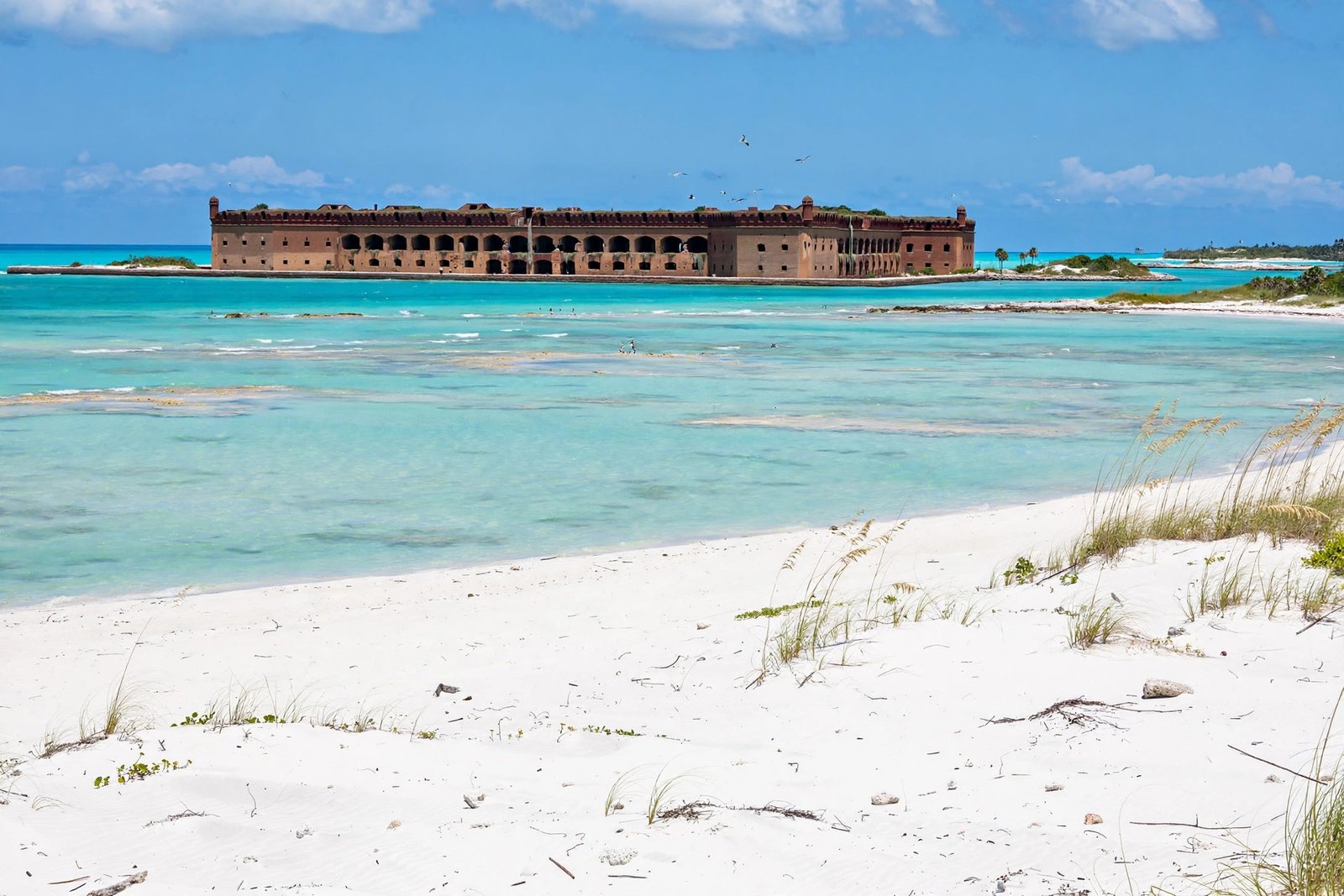
Some places in America feel far away because the drive is long. Dry Tortugas National Park feels far away because there is no drive at all. There are no roads leading here, no cars, no bridges, and no towns waiting at the end of the highway. About 70 miles west of Key West, Florida, out in the open Gulf of Mexico, seven small islands rise out of turquoise water — and one of them holds a fortress so large it seems impossible that it was ever built here at all.
This is the most remote national park in the contiguous United States, and it is also one of the least visited. That combination is exactly what makes it special. The crowds that fill Florida’s beaches and theme parks simply do not make it this far. What waits instead is quiet water, wide sky, a 19th-century fort, coral reefs alive with fish, and the strange, wonderful feeling of standing at the edge of the country.
If you love hidden gems, wild places, and trips that feel like a real adventure, Dry Tortugas belongs at the top of your list. Here is everything you need to know before you go.
Where Is Dry Tortugas National Park?
Dry Tortugas National Park sits about 70 miles west of Key West, Florida, in the Gulf of Mexico. It is part of the Florida Keys island chain, but it sits far beyond the last island connected by road. The park covers roughly 100 square miles, and almost all of it is open water. The land itself is just seven small, low-lying islands, ringed by sand, coral, and sea grass.
The name comes from history. Early Spanish explorers called the islands Las Tortugas, meaning “the turtles,” for the sea turtles they found here. The word “Dry” was added later as a warning: there is no fresh water on these islands. That fact shaped everything that followed, from the fort built here to the way visitors still have to plan today. You bring your own drinking water, or you do not have any.
The park is managed by the National Park Service, and the official source for current conditions, ferry information, and alerts is the park’s website at nps.gov/drtu. Because this is such a remote park, checking that site before you travel is not just a good idea — it is essential.
Why Dry Tortugas Is So Remote — and Why That Matters
Most national parks can be reached by car. You drive in, park, and start walking. Dry Tortugas breaks that pattern completely. The only ways to reach it are by boat or by seaplane. Day trips run from Key West by ferry and by seaplane, and private boats can make the crossing too, though the open-water trip demands experience and careful weather planning.
That journey is part of the experience. As Key West fades behind you, the water changes color, deepening and then brightening into the clear turquoise that makes this part of Florida famous. By the time the brick walls of Fort Jefferson appear on the horizon, you understand why people call this place America’s most remote national park.
The remoteness also protects the park. The reefs here are healthier and less crowded than many of the reefs closer to shore, the birds nest with less disturbance, and the water is clearer. Visiting Dry Tortugas feels less like visiting an attraction and more like stepping into a place that is still mostly wild.
Fort Jefferson: A Fortress in the Middle of the Sea
The first thing you see when you arrive at Garden Key is Fort Jefferson, and it is hard to overstate how striking it is. This is one of the largest masonry structures in the Americas — a massive, six-sided coastal fortress built from millions of bricks, rising out of the sea on a tiny island with nothing else around it.
Construction began in 1846. The United States built the fort to guard the shipping lanes through the Gulf of Mexico and the Straits of Florida, a strategic spot where trade routes and naval traffic converged. Workers labored here for decades in brutal heat, with fresh water and supplies shipped in from the mainland, and the fort was never fully completed. Even unfinished, it is enormous, with towering walls, arched casemates, and a moat of seawater surrounding it.
During the Civil War, Fort Jefferson served as a military prison for Union deserters and other prisoners. Its most famous prisoner was Dr. Samuel Mudd, the physician who treated John Wilkes Booth after the assassination of President Abraham Lincoln. Mudd was convicted of conspiracy and imprisoned at the fort, and his story remains one of the most haunting chapters in the park’s history. Walking the fort’s corridors today, past empty gun rooms and weathered brick, it is easy to imagine how isolated life here must have felt for soldiers and prisoners alike.
Today, visitors can explore much of the fort on their own. Climb to the upper levels for sweeping views across the water. Walk the moat wall and watch fish swim in the shallow water below. Stand in the parade ground and look up at walls that seem to go on forever. Rangers offer programs when staffing allows, and the fort’s exhibits help tell the story of the people who lived, worked, and were imprisoned here.
Snorkeling and Diving on Living Coral Reefs
For many visitors, the water is the main reason to come. The Dry Tortugas are part of the Florida Keys reef system, and the coral reefs and shallow waters around the islands are home to a remarkable variety of marine life. Sea turtles glide past snorkelers. Schools of tropical fish flash through the shallows. Rays, barracuda, and reef sharks patrol the deeper water.
The most popular snorkeling spots are right around Garden Key. The moat wall around Fort Jefferson is a favorite: the water is shallow and calm, and fish gather along the wall in large numbers. The old coaling docks and pilings nearby also attract marine life. You do not need to be an expert swimmer to enjoy it, but you do need to be comfortable in open water and aware of currents.
Divers head for deeper reefs farther out, where the water is clearer.
Bring your own snorkel gear if you can, though day-trip operators typically provide equipment. A rash guard or reef-safe sun protection is a smart addition, because the Florida sun over open water is intense, and there is very little shade on the islands.
Birdwatching: A Paradise for Bird Lovers
Dry Tortugas is one of the best birdwatching destinations in the southeastern United States, and serious birders plan trips here specifically for the spring migration. The islands sit along major migratory flyways, and exhausted songbirds drop out of the sky onto the islands to rest and refuel on their way across the Gulf.
The star attraction is Bush Key, where sooty terns nest in large numbers during the breeding season. The sight and sound of thousands of terns wheeling over the island is unforgettable. Bush Key is closed to visitors during nesting season to protect the colony, but the birds can be watched and heard from Garden Key and from the water.
Other species seen here include magnificent frigatebirds, brown noddies, masked boobies, and a wide variety of warblers and other songbirds during migration. Even casual visitors often find themselves pausing to watch the frigatebirds soar overhead, their long wings barely moving as they ride the wind.
Camping on Garden Key: Sleeping Under the Stars
For the truly adventurous, Dry Tortugas offers primitive camping on Garden Key, near Fort Jefferson. This is not car camping with hookups and a camp store. There are no shops, no restaurants, and no fresh water. Campers bring everything they need — tent, food, water, and supplies — and pack everything out again.
What you get in return is extraordinary. After the day-trippers leave, the island belongs to a small number of campers. The sun sets over open water in every direction. The stars come out in a sky untouched by city lights. In the morning, you can snorkel before anyone else arrives and explore the fort in the quiet of early light.
Camping here requires planning and self-reliance. Campsites are first-come, first-served, and space is limited. You need to arrange your own transport to and from the island, and you need to carry enough water for your entire stay. It is not for everyone — but for those who do it, it is often the trip they talk about for years.
Loggerhead Key and the Park’s Lighthouse
Loggerhead Key, the largest island in the park, sits a few miles west of Garden Key and is home to the Dry Tortugas Light, a historic lighthouse that has guided ships through these waters for generations. The island is named for the loggerhead sea turtles that nest on its beaches.
Loggerhead Key is open to visitors during the day, though reaching it requires your own boat, as the ferry and seaplane trips go to Garden Key. Its beaches and reefs are quieter than those at Garden Key, and the lighthouse itself is a striking landmark against the open sky. Like the rest of the park, it is a place where the wild and the historic sit side by side.
How to Get There: Ferry and Seaplane From Key West
Most visitors reach Dry Tortugas on a day trip from Key West. The ferry, operated by Yankee Freedom, makes the crossing daily and includes time on Garden Key to explore the fort, snorkel, and relax on the beach. The crossing takes a couple of hours each way, and the boat ride itself is part of the adventure — keep an eye out for dolphins, sea turtles, and flying fish along the way.
Seaplane trips offer a faster and even more spectacular option. Flying low over the turquoise water and the reef, then landing on the water near Garden Key, is an experience in itself, and the aerial view of Fort Jefferson from above is something you will never forget. Seaplane trips typically allow several hours on the island, and some offer half-day options.
Whichever way you go, book in advance. Space is limited, and trips fill up, especially during the busy winter and spring months. Check the National Park Service website at nps.gov/drtu for current operator information and any alerts before you book.
What to Bring — and What Not to Expect
Dry Tortugas rewards good preparation and punishes poor planning. There are no shops or restaurants on the islands, so you must bring your own food and water for the day. Day-trip operators typically provide a meal, but campers and anyone staying longer need to be fully self-sufficient.
- Plenty of drinking water — more than you think you will need, because there is no fresh water on the islands.
- Food and snacks for the full day, plus a way to keep them cool.
- Sun protection: sunscreen, a hat, sunglasses, and a light long-sleeved shirt. Shade is scarce.
- Snorkel gear, a swimsuit, and water shoes for the rocky shoreline.
- A camera or binoculars for the fort, the birds, and the views.
- Cash or card for the ferry or seaplane, and a small dry bag for electronics.
Do not expect cell service to be reliable, Wi-Fi, or any of the conveniences of a developed park. That is the point. The quiet is the attraction.
When to Visit Dry Tortugas
The park is open year-round, but conditions vary with the seasons. Winter and spring bring the calmest seas and the most comfortable temperatures, and they are also the peak season for birdwatching, as migrants pass through in spring. Summer brings warmer water and excellent snorkeling, but also heat, humidity, and the possibility of storms.
Because every trip depends on the sea and the sky, flexibility matters. Ferry and seaplane operators may cancel for rough water or storms, and there is no alternative route. Build a buffer day into your Key West trip if Dry Tortugas is a must-see.
A Park With a Long History
Dry Tortugas became a national monument in 1935, protecting the fort and the islands, and it was designated a national park in 1992. That upgrade recognized what visitors had long known: this is not just a historic site or a pretty beach, but a nationally significant landscape where history, wildlife, and wilderness meet.
Why Dry Tortugas Deserves a Spot on Your List
Florida is full of beautiful places, but very few of them feel like this. Dry Tortugas is not a roadside attraction or a quick stop. It is a commitment — a boat ride across open water to a place with no roads, no shops, and no crowds. That commitment is repaid with a fortress rising out of the sea, reefs full of life, birds overhead, and the rare feeling of being somewhere genuinely remote.
Plan carefully, bring water, book early, and check nps.gov/drtu before you go. Dry Tortugas has been waiting out there in the Gulf for a very long time. It is worth the trip.
Related reading
If you enjoyed this guide to Dry Tortugas, you may also like these hidden gems from across America:
- Channel Islands National Park: California’s Hidden Gem
- Cumberland Island: Georgia’s Wild Horses
- Great Sand Dunes: Colorado’s Hidden Gem
FAQ
How far is Dry Tortugas National Park from Key West?
Dry Tortugas National Park is located about 70 miles west of Key West, Florida, in the Gulf of Mexico. It is reachable only by boat or seaplane, and there are no roads or bridges connecting it to the mainland.
Can you drive to Dry Tortugas National Park?
No. There are no roads to Dry Tortugas, and no cars on the islands. Visitors arrive by ferry or seaplane from Key West, or by private boat. Day trips from Key West are the most common way to visit.
What is Fort Jefferson?
Fort Jefferson is a massive 19th-century coastal fortress on Garden Key, and one of the largest masonry structures in the Americas. Construction began in 1846, and during the Civil War it served as a military prison, most famously holding Dr. Samuel Mudd, who treated John Wilkes Booth. Visitors can explore much of the fort today.
What can you do at Dry Tortugas National Park?
Popular activities include exploring Fort Jefferson, snorkeling and diving on coral reefs, birdwatching (especially the sooty tern colony on Bush Key), swimming, and primitive camping on Garden Key. The park is also known for sea turtles, tropical fish, and the historic lighthouse on Loggerhead Key.
Do you need to bring food and water to Dry Tortugas?
Yes. There are no shops or restaurants on the islands, and there is no fresh water. Day-trip operators typically provide a meal, but visitors should bring plenty of drinking water and any extra food they need. Campers must be fully self-sufficient and pack out everything they bring in.