
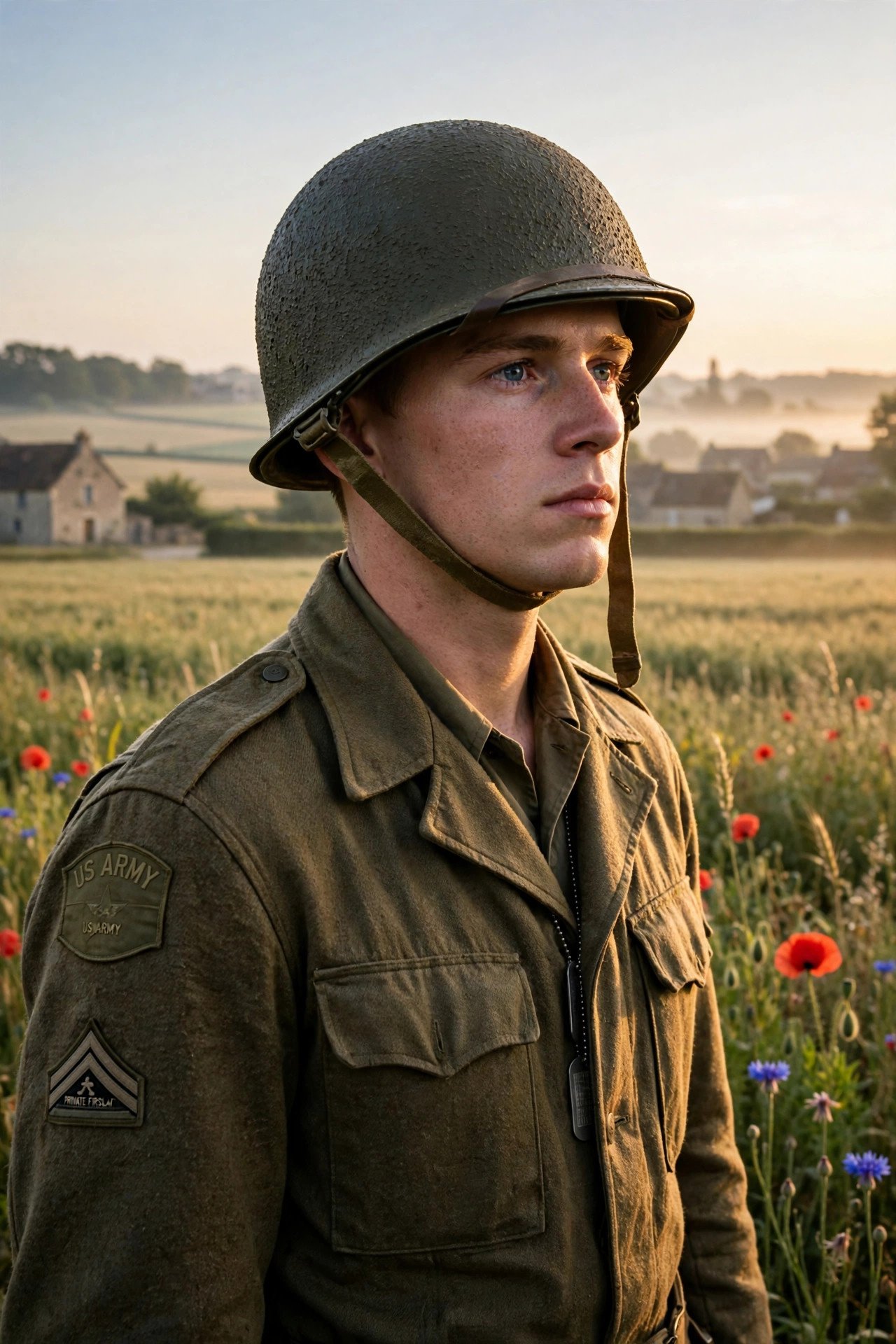
On a cold January afternoon in 1945, in a small village in northeastern France, a 19-year-old American lieutenant stood alone on a burning tank destroyer and held off an army. His company had been ordered to fall back. German tanks were rolling forward. With enemy infantry closing in and the ammunition in the burning vehicle cooking off around him, Second Lieutenant Audie Murphy kept firing the tank destroyer’s .50-caliber machine gun for nearly an hour, then led a counterattack on foot while wounded. The action earned him the Medal of Honor — and it was only one chapter in a war record that made him the most decorated American combat soldier of World War II.
Audie Leon Murphy was a farm boy from Texas who had been turned away from the Marines and the paratroopers because he was too small. He went on to earn every combat award for valor the United States Army offered, including the Medal of Honor, the Distinguished Service Cross, two Silver Stars, and three Purple Hearts — 33 awards, citations, and decorations in all, along with French and Belgian honors. He came home to become a movie star, played himself in the film of his own life story, and spent his later years speaking out about the invisible wounds of war long before anyone had a name for them.
A Texas Farm Boy
Audie Leon Murphy was born on June 20, 1925, near Kingston, Texas, a small farming community northeast of Dallas. He was one of twelve children in a sharecropper family, and life was hard from the start. His father drifted in and out of the family’s life, and his mother, Josie, held the household together on very little. The children worked the cotton fields alongside their parents, and Audie left school after the fifth grade to help support the family, picking cotton and working whatever jobs he could find.
He grew up hunting to put food on the table, and he became a skilled marksman with a rifle — a skill that would later save his life and the lives of the men around him. When his mother died in 1941, Audie was sixteen, and the family scattered. His younger siblings were placed in an orphanage. The attack on Pearl Harbor that December changed everything for him, as it did for millions of young Americans. He wanted to serve.
It was not easy for him to get in. Murphy was small — about five feet five inches tall and barely over a hundred pounds — and the Marines and the paratroopers both turned him away. The Army took him. He enlisted on June 30, 1942, after adjusting his age to meet the requirements, and went through basic training at Camp Wolters, Texas, before shipping out for advanced infantry training.
Baptism of Fire: Sicily and Italy
Murphy arrived in North Africa in early 1943 as a replacement in Company B, 15th Infantry Regiment, 3rd Infantry Division. His first combat came in July 1943, in the invasion of Sicily, where the 3rd Division landed at Licata and fought its way across the island. It was in Sicily that his fellow soldiers began to notice something about the quiet young private from Texas: he was calm under fire, a crack shot, and utterly unwilling to leave a job unfinished.
The division moved on to mainland Italy, landing at Salerno in September 1943 and fighting north through some of the hardest terrain of the war — the Volturno River crossings, the mountains around Cassino, and the bitter winter fighting of 1943 and 1944. Murphy was promoted to corporal, then sergeant, and earned his first decorations for valor. At Anzio, where the division was trapped in a beachhead under constant German artillery and counterattack for months, he won a Bronze Star and a battlefield commission. His commanders kept promoting him because men followed him and because he kept doing the dangerous work himself rather than ordering others into it.
The cost of the Italian campaign was written on his body. He was wounded more than once, and he collected Purple Hearts the way other men collected souvenirs. He also collected something less visible: the memories of friends killed beside him, and the strain of months without rest under fire.
Southern France and the Distinguished Service Cross
In August 1944, the 3rd Division landed in southern France as part of Operation Dragoon, the invasion of the French Riviera. The division moved north fast, chasing the retreating Germans up the Rhone Valley. On August 15, 1944, near Ramatuelle, France, Murphy earned the Distinguished Service Cross — the Army’s second-highest award for valor — for extraordinary heroism in leading his men against a German position. It was the kind of action that became his signature: he went forward himself, under fire, and his men followed.
By the autumn of 1944, the division was fighting through the Vosges Mountains toward the German border. The weather turned cold and wet, the fighting slowed to a grind, and the men were exhausted. Murphy, now a second lieutenant after his battlefield commission, had been wounded again and was sent back to recover. He rejoined his platoon in mid-January 1945, as the division moved into the Colmar Pocket, a German-held bulge in Alsace around the city of Colmar.
January 26, 1945: Holtzwihr
On January 24, 1945, the 3rd Division moved into position near the village of Holtzwihr, in the Colmar Pocket. Two days later, on January 26, Murphy was commanding Company B of the 15th Infantry when the Germans launched a powerful counterattack. Six tanks and waves of infantry came at the company’s position, trying to retake a wooded area the Americans held. Murphy ordered his men to withdraw to prepared positions in the woods, where they could fight from cover. He stayed behind alone to direct artillery fire by field telephone.
What happened next is recorded in his Medal of Honor citation and in the accounts of the men who watched it. As the German tanks and infantry advanced, Murphy climbed onto a burning M10 tank destroyer — an American vehicle that had been knocked out and set on fire — and took over its .50-caliber machine gun. He fired on the advancing Germans for nearly an hour, alone, while the tank destroyer burned beneath him and its ammunition exploded in the heat. He was wounded in the leg during the fight, and he kept firing. The citation credits him with killing or wounding about fifty enemy soldiers in that single action, and his fire broke the attack.
When his ammunition ran out, Murphy climbed down, refused medical attention, and organized his men for a counterattack. Despite his wound, he led them forward and drove the Germans back, retaking the ground the company had given up. The 3rd Infantry Division was later awarded the Presidential Unit Citation for its actions in the Colmar Pocket, and Murphy’s stand at Holtzwihr became one of the most famous individual actions of the war.
The Medal of Honor and the End of the War
Murphy’s war did not end at Holtzwihr. He fought on with the 3rd Division through the final months of the war, advancing into Germany and Austria. He had already received more than twenty awards for valor before the Medal of Honor — including the Distinguished Service Cross, two Silver Stars, and two Bronze Stars for valor in Italy and France. In June 1945, on an airfield near Salzburg, Austria, Lieutenant General Alexander M. Patch presented Murphy with the Medal of Honor and the Legion of Merit for his actions at Holtzwihr.
By the end of the war, Murphy had earned 33 awards, citations, and decorations — every combat award for valor available from the United States Army, plus French and Belgian decorations for heroism, including the French Legion of Honor and the Croix de Guerre. He had risen from buck private to first lieutenant, had been wounded three times, and had spent roughly 400 days in combat. He was 19 years old when he performed the action that won him the Medal of Honor, and Life magazine put him on its cover.
Hollywood: To Hell and Back
After the war, Murphy went to Hollywood. The actor James Cagney had seen his photograph on the cover of Life and invited him west, and Murphy began a film career that would last for more than two decades. He appeared in more than 40 films, most of them Westerns, and became a familiar face to moviegoers across America. He also wrote songs, including country hits recorded by other artists, and he appeared on television.
His most famous film was “To Hell and Back,” released in 1955, in which he played himself in the story of his own war service. The film was based on his 1949 autobiography of the same name. It was a box-office success and, for years, was one of Universal’s highest-grossing films. Audiences watched a real war hero reenact the battles he had actually fought — including the stand at Holtzwihr — and the film fixed his image in the American imagination: the small, quiet Texan who had become a legend.
Hollywood made him famous, but it did not make him rich or happy. He struggled with the business side of the movie industry, and he took roles that paid the bills rather than roles that challenged him. He remained, by all accounts, a modest man who was uncomfortable with the attention his war record brought him. He often said that the real heroes were the men who did not come home.
The Wounds You Couldn’t See
What the movie cameras never showed was the price Murphy paid for his war. He suffered from what we would now call post-traumatic stress disorder — then known as battle fatigue or combat stress. He had trouble sleeping, suffered nightmares, and kept a loaded pistol under his pillow. He spoke openly about these struggles at a time when few veterans did, and he became an early and important voice for veterans’ mental health, urging the government to do more for men coming home from war.
He also fought a very public battle with sleeping pills. He had become dependent on a prescription sleep aid and, in the 1960s, locked himself in a motel room for a week to break the addiction on his own — cold turkey, without medical help. He came out of it clean and talked about it publicly, hoping his experience would help other veterans.
His advocacy was ahead of its time. Decades before PTSD was formally recognized and before veterans’ mental health became a national conversation, Audie Murphy was saying out loud that the war did not end when the shooting stopped — that the men who came home carried it with them, and that they deserved help. It may be the most important part of his legacy, and it is the one that speaks most directly to veterans today.
A Sudden End and a Lasting Resting Place
On May 28, 1971, Audie Murphy was killed in a plane crash near Roanoke, Virginia, when the small aircraft he was riding in flew into the side of a mountain in heavy fog. He was 45 years old. The country mourned him as it had celebrated him, and he was buried with full military honors at Arlington National Cemetery.
His gravesite at Arlington has become one of the most visited in the cemetery, second only to the grave of President John F. Kennedy. Visitors leave medals, photographs, and small stones at the headstone. The headstone itself carries a small detail that tells a story: it gives his birth year as 1924, the year he claimed when he enlisted, though he was actually born in 1925. He was 19, not 20, when he won the Medal of Honor.
Murphy’s legacy lives on in more ways than one. The Army’s Sergeant Audie Murphy Club, an elite organization for noncommissioned officers, carries his name and his example — leadership, courage, and care for soldiers. His story is taught to young soldiers as an example of what one person can do under the worst possible conditions. But the real lesson of his life is simpler than medals or movies. He was a poor farm boy who left school in the fifth grade, who was told he was too small to be a Marine, and who went to war and did the hardest thing over and over again — not once, in a single famous hour at Holtzwihr, but day after day for nearly two years. He came home and spent the rest of his life trying to help other veterans carry what he carried. That is why his story still matters: not because he was larger than life, but because he was not — and he stood up anyway.
Related Reading
Want more stories of American courage in World War II? Read about the flag raising at Iwo Jima and the story behind the famous photograph, the Navajo Code Talkers and the unbreakable code they carried into battle, and the 442nd Regimental Combat Team, the most decorated unit of its size in the war.
Frequently Asked Questions
Why is Audie Murphy called the most decorated soldier of World War II?
Murphy earned 33 awards, citations, and decorations during the war, including every combat award for valor the United States Army offered — the Medal of Honor, the Distinguished Service Cross, two Silver Stars, two Bronze Stars, and three Purple Hearts — plus French and Belgian decorations for heroism. He is widely described as the most decorated American combat soldier of World War II.
What did Audie Murphy do to earn the Medal of Honor?
On January 26, 1945, near Holtzwihr, France, in the Colmar Pocket, then-Second Lieutenant Murphy ordered his company to withdraw to prepared positions while he stayed behind alone. He climbed onto a burning American tank destroyer and fired its .50-caliber machine gun at advancing German tanks and infantry for nearly an hour, killing or wounding about fifty enemy soldiers, then led a counterattack while wounded.
How old was Audie Murphy when he won the Medal of Honor?
He was 19 years old. Murphy was born on June 20, 1925, near Kingston, Texas. His headstone at Arlington National Cemetery gives his birth year as 1924, the year he claimed when he enlisted in 1942, but he was actually 19 at the time of the Holtzwihr action.
Did Audie Murphy really play himself in a movie?
Yes. In 1955, Murphy starred as himself in “To Hell and Back,” the film version of his 1949 autobiography of the same name. The film recreated his wartime service, including the stand at Holtzwihr, and became a major box-office success. He went on to appear in more than 40 films, mostly Westerns.
Learn more from the National WWII Museum, the Texas State Historical Association, the Smithsonian Magazine, and the U.S. Department of War.