
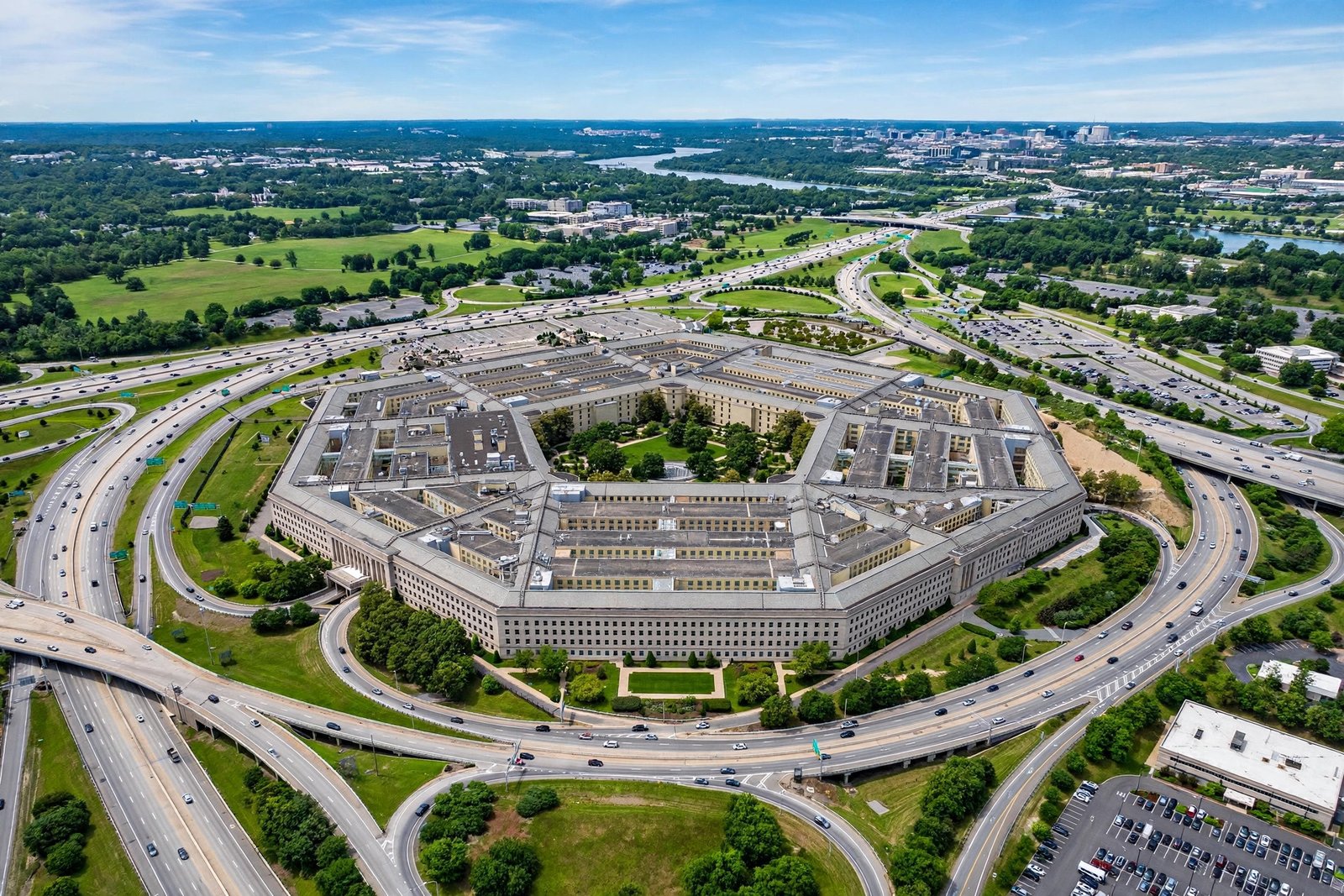
From the air, it looks like a geometry lesson. Five straight sides, five floors, five rings of corridors, and a five-acre courtyard in the middle. On the ground, it is something else entirely: a small city of hallways and offices where the decisions that shape the United States military are made every day. The Pentagon, headquarters of the Department of Defense, sits in Arlington County, Virginia, just across the Potomac River from Washington, D.C. It is one of the largest office buildings in the world, home to about 23,000 military and civilian employees, and one of the most recognizable symbols of American power.
It was also built in a hurry, in the middle of a world war, on a site that dictated its famous shape. And on September 11, 2001, exactly sixty years after construction began, it became a target itself. This is the story of the building: why it has five sides, how it went up in sixteen months, what happens inside it, and how the nation remembers the day it was attacked.
Why Five Sides? The Story Behind the Shape
The Pentagon is a pentagon because of the land it was built on. The original site, at Arlington Experimental Farms, was bounded by five roads, and the architects fitted the building to the shape of the ground. That is the slightly odd, very practical truth behind one of the most famous silhouettes in the world. The design was drawn up by American architect George Bergstrom, and the building was constructed by contractor John McShain, as recorded in the building’s history.
The five-sided plan turned out to be remarkably practical. Five wings meet at five corners, and five concentric ring corridors, labeled A through E from the center outward, run around each floor, connected by spoke-like hallways. The layout means that no two points in the building are far apart: it takes only a few minutes to walk between any two offices, despite the enormous size. That was not an accident. The building was designed for a War Department that needed thousands of people to work together quickly, and the ring system was the answer.
Built in Sixteen Months: A Wartime Sprint
By the summer of 1941, the War Department had outgrown Washington. It had grown to 24,000 military and civilian employees scattered across 17 buildings in the capital, and the arrangement was slow, wasteful, and confusing. With war already raging in Europe and Asia, the United States needed a single headquarters, and it needed one fast.
Ground was broken on September 11, 1941. What followed was one of the fastest large-scale construction projects in American history. The workforce grew past 13,000, and crews worked in three shifts a day, around the clock. The pace was so aggressive that the first 1,500 employees moved into the building on April 30, 1942, less than eight months after groundbreaking, while pile drivers were still pounding elsewhere on the site. The building was dedicated on January 15, 1943, about sixteen months after work began. During the Second World War, the building’s working population peaked at around 35,000 people.
The construction also carries a complicated piece of history. The Pentagon was built under Virginia state law, and Virginia law in 1941 required segregated workplaces, so the architects designed separate dining facilities and separate lavatories for white and Black workers. In the end, the Pentagon became the only building in the state of Virginia where segregation laws were not enforced. It is a reminder that the building’s story is not only about concrete and corridors. It is also about the country that built it, with all of its contradictions.
Inside the Building: Rings, Corridors, and a Small City
The numbers are hard to grasp until you walk the halls. The Pentagon has about 6.5 million square feet of total floor space, of which about 3.7 million square feet are used as offices. It has five sides, five floors above ground, two basement levels, and five ring corridors per floor, with a total of about 17.5 miles of corridors. In the middle sits a central five-acre pentagonal courtyard, a quiet patch of green where workers eat lunch, hold ceremonies, and take a break from the hallways. The building covers 29 acres on the ground.
Inside, it functions like a small city. About 23,000 military and civilian employees work in the Pentagon, along with about 3,000 non-defense support personnel. There are offices, briefing rooms, corridors lined with portraits and displays, places to eat, and the everyday machinery of a headquarters: mail, security, maintenance, and communications. The five services, the Army, Navy, Air Force, Marine Corps, and Space Force, all have senior offices inside this one building, along with the civilian leadership of the Department of Defense. The famous corridor system keeps it all connected. A worker can cross from one side of the building to the other in minutes, and the rings mean there is always a direct route, even in a building this size.
What the Pentagon Does: The Heart of the Department of Defense
The Pentagon is the headquarters of the United States Department of Defense. That makes it the nerve center of the American military: the place where the Secretary of Defense and the Joint Chiefs of Staff work, where budgets are drawn up, where strategy is debated, and where orders flow out to commands around the world. It is not a base in the usual sense, with runways and barracks. It is an office building, but it is the office building from which the largest military establishment in the world is run.
That role is why the building matters far beyond its architecture. Decisions made in its briefing rooms affect troops serving on every continent, alliances with dozens of countries, and the defense budget, one of the largest single items of federal spending. The building has also become a symbol in its own right. When Americans say “the Pentagon,” they usually do not mean the concrete and limestone structure in Arlington. They mean the military leadership itself, the institution, the way people say “the White House” to mean the presidency. The building and the institution have become the same thing in the public mind.
A Building That Became a Symbol
Part of the Pentagon’s power as a symbol comes from its shape. A pentagon is simple, strong, and instantly recognizable, and the building has been photographed, drawn, and filmed so often that its outline is familiar to people who have never been to Washington. It has appeared in countless films, news broadcasts, and documentaries as shorthand for American military power, usually in an aerial shot that shows the five sides and the courtyard in the middle.
But symbols can also become targets, and that is the darker half of the building’s story. On September 11, 2001, the Pentagon was attacked precisely because of what it represents. The day changed the building, the military, and the country, and the memorial outside its walls is now as much a part of the site as the building itself.
September 11, 2001
On the morning of September 11, 2001, five al-Qaeda hijackers took control of American Airlines Flight 77, a Boeing 757 en route from Washington Dulles International Airport to Los Angeles. At 9:37 a.m., they deliberately crashed the airliner into the western side of the Pentagon. The date was a coincidence that still startles: it was the 60th anniversary of the day construction began on the building.
The attack killed 184 people: 125 people inside the Pentagon and 59 aboard the plane, in addition to the five hijackers. The impact and the fire that followed heavily damaged the western side of the building, collapsing a section of the rings and trapping workers inside. Firefighters, soldiers, and civilian employees worked through the day to rescue survivors and recover the dead, and the damaged section was later rebuilt, with a small indoor memorial and chapel added at the point of impact.
The Pentagon was the first significant foreign attack on federal facilities in the capital area since the Burning of Washington during the War of 1812, and it was one of three attacks that day, alongside the strikes on the World Trade Center in New York and the crash of United Airlines Flight 93 in Pennsylvania. Nearly 3,000 people were killed in the terrorist attacks of September 11, 2001. The Pentagon attack is remembered with particular gravity inside the Department of Defense, because the victims were colleagues: service members, civilian employees, and contractors, people who came to work that morning in the headquarters they served.
The Pentagon Memorial
Outside the building, on the grounds near where the jetliner struck, stands the National 9/11 Pentagon Memorial. It was dedicated on September 11, 2008, seven years to the day after the attacks, and it honors the 184 people who died at the Pentagon and aboard American Airlines Flight 77.
The memorial sits on two acres of land and holds 184 illuminated benches, one dedicated to each victim, arranged along a line according to the victims’ ages, from three-year-old Dana Falkenberg to 71-year-old Navy veteran John D. Yamnicky. A curved Age Wall rises in height to reflect those ages, starting at three inches tall and growing to 71 inches. The site also holds 85 crape myrtle trees and a black granite marker at the entrance commemorating the moment Flight 77 struck at 9:37 a.m. The memorial was built with $22 million in funding, and in 2026 the National Park Service designated it as an Affiliated Area of the National Park System, formally recognizing its national significance.
There is also a smaller, earlier memorial. The America’s Heroes Memorial, with its chapel, opened in September 2002 after Pentagon repairs were completed, at the point of impact inside the building. A separate memorial at Arlington National Cemetery, dedicated in September 2002, honors the five victims for whom no identifiable remains were found. Together, the memorials make the Pentagon grounds a place of remembrance as well as a place of work.
Visiting the Pentagon and the Memorial
The Pentagon itself is a secure working headquarters, so public access inside the building is limited. The outdoor memorial, by contrast, is open to the public and is designed for quiet visiting. It is a peaceful and moving space, set among the trees and benches, and it is the only one of the three September 11 attack sites without a dedicated visitor education center, though a center is planned. Visitors should come prepared for a reflective experience rather than a tour: the memorial is a place to walk slowly, read the names, and remember the 184 people it honors. The site is also a stop on the 9/11 National Memorial Trail, which connects the three attack sites in New York City, Arlington, and Pennsylvania.
For anyone interested in the building itself, the best introduction is the view from the memorial grounds, where the scale of the five-sided structure is easiest to appreciate. From there, the Pentagon looks less like an office building and more like what it is: a fortress of paperwork and planning, built in a wartime hurry, still doing the job it was built for more than eighty years later.
Frequently Asked Questions
Where is the Pentagon located?
The Pentagon is in Arlington County, Virginia, across the Potomac River from Washington, D.C. It is the headquarters of the United States Department of Defense.
When was the Pentagon built?
Ground was broken on September 11, 1941, and the building was dedicated on January 15, 1943. Construction took about sixteen months, an extraordinary pace for a building of its size.
How big is the Pentagon?
The Pentagon has about 6.5 million square feet of total floor space, including about 3.7 million square feet of office space. It has five sides, five floors above ground, two basement levels, and about 17.5 miles of corridors. About 23,000 military and civilian employees work there, along with about 3,000 support personnel.
What happened at the Pentagon on September 11, 2001?
American Airlines Flight 77 was hijacked and crashed into the western side of the Pentagon at 9:37 a.m., killing 184 people: 125 inside the building and 59 aboard the plane. The National 9/11 Pentagon Memorial, dedicated on September 11, 2008, honors those victims with 184 benches arranged by age.
Can the public visit the Pentagon Memorial?
Yes. The outdoor National 9/11 Pentagon Memorial is open to the public. The Pentagon itself is a secure working headquarters, so access inside the building is limited.
Related reading
- US Navy Submarines: The Silent Service Explained
- US Air Force: The World’s Most Powerful Explained
- Hoover Dam: Engineering Power That Built America
The Pentagon is a building of contradictions: a wartime rush job that has lasted more than eighty years, a maze of corridors that is easy to cross, an office building that became a symbol, and a workplace that became a memorial. Its five sides were drawn to fit a piece of land, and they ended up defining the way America pictures its military power. To understand the Pentagon is to understand something about the country itself: practical, enormous, and still carrying the memory of the day it was attacked.