
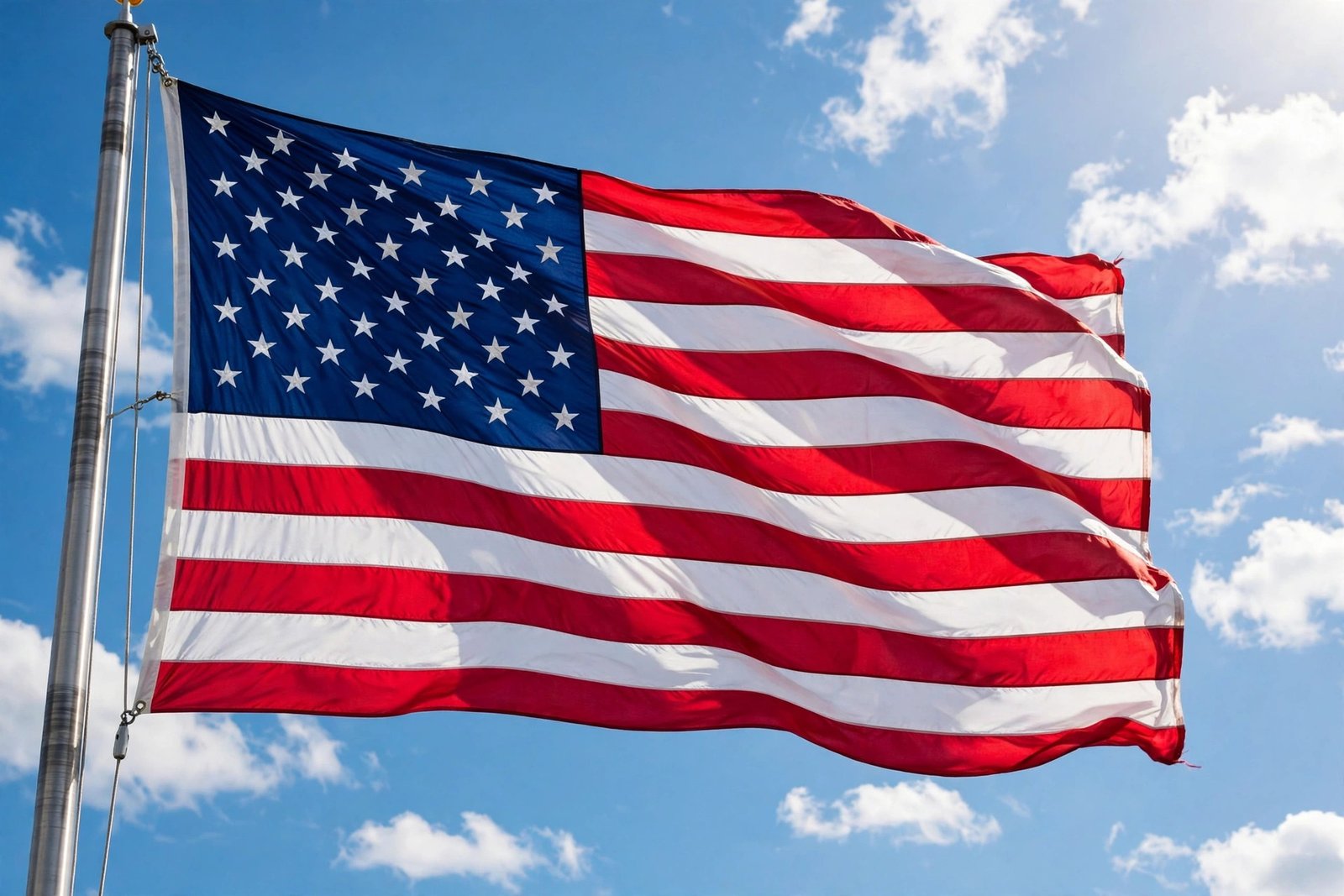
It flies over schools, front porches, military bases and the Moon. The American flag — the Stars and Stripes, Old Glory — is one of the most recognized symbols on Earth. Yet most Americans who salute it every day know surprisingly little about it: why it has thirteen stripes, why the stars took more than a century to settle into neat rows, and why the story of who designed it is still argued about nearly 250 years later.
This is the story behind the flag: the resolution that created it, the seamstress legend and the rival claim, the year it briefly had fifteen stripes, the 27 official versions, what its colors do and do not mean, and the rules — the Flag Code — that govern how it should be flown. Where the history is uncertain, we say so.
What the Flag Looks Like Today
The flag most Americans know has thirteen horizontal stripes — seven red and six white, with red at the top and bottom — and a blue canton in the upper corner holding fifty white stars. The thirteen stripes stand for the thirteen original colonies that became the first states. The fifty stars stand for the fifty states of the present-day Union, one star for each state.
The design is fixed by law and by executive order. Title 4, Section 1 of the United States Code sets the thirteen stripes and the stars, and Executive Order 10834, signed by President Dwight D. Eisenhower on August 21, 1959, fixed the proportions and the arrangement of the fifty stars: nine rows, alternating six and five. The flag’s official proportions are 1.0 by 1.9. The current fifty-star design became official on July 4, 1960, and has now flown longer than any earlier version.
June 14, 1777: The Resolution That Created the Flag
The flag was born in the middle of the Revolutionary War. On June 14, 1777, the Second Continental Congress adopted the Flag Resolution, which read in full: “Resolved, That the flag of the thirteen United States be thirteen stripes, alternate red and white; that the union be thirteen stars, white in a blue field, representing a new constellation.” That date — June 14 — is why Flag Day is celebrated on June 14 each year.
Notice what the resolution does not say. It sets the number of stripes and stars, but nothing about the arrangement of the stars, the exact shades of red, white and blue, or what the colors mean. For more than a century, flag makers arranged the stars however they liked — in circles, in rows, in the shape of a larger star. It was not until 1912 that President William Howard Taft standardized the arrangement of the stars and the flag’s proportions by executive order.
Who Designed the First Flag? The Betsy Ross Legend vs. Francis Hopkinson
Ask most Americans who designed the first American flag and they will answer Betsy Ross. The story is famous: in 1776, George Washington visited the Philadelphia seamstress Elizabeth “Betsy” Ross and asked her to sew a flag, and she suggested the five-pointed star — demonstrating that it could be cut with a single snip of folded cloth. It is a wonderful story. The trouble is that no document from 1776 or 1777 confirms it.
The story first reached the public in 1870, nearly a century after the events it describes, when her grandson William Canby presented a paper to the Historical Society of Pennsylvania based on family accounts. Ross herself had died in 1836. No record in Washington’s papers mentions such a meeting, and the records of Congress say nothing about ordering a flag from her. That does not prove the story false — Ross was a real Philadelphia upholsterer who sewed flags for the Pennsylvania navy. But as history it is an unverified legend, and the Smithsonian describes it as tradition rather than documented fact.
The strongest rival claim belongs to Francis Hopkinson, a signer of the Declaration of Independence and a delegate to the Continental Congress from New Jersey. Hopkinson was a talented designer who worked on official devices for the new government, including elements of the Great Seal. In 1780, he sent Congress a bill asking to be paid for designing the flag, among other work. Congress did not pay him, but his claim is the only one made by a participant at the time. We do not have an original, signed Hopkinson drawing of the flag, so his case also carries an asterisk. But if you want a single name next to the word “designed,” Francis Hopkinson is the responsible answer — with the honest caveat that the design was likely a collaborative effort.
The Fifteen-Stripe Detour
The flag has not always had thirteen stripes. After Vermont joined the Union in 1791 and Kentucky followed in 1792, Congress passed a law in 1794 that added a star and a stripe for each new state — producing a flag with fifteen stars and fifteen stripes. That fifteen-star, fifteen-stripe flag is the one that flew over Fort McHenry in Baltimore in 1814 and inspired Francis Scott Key to write “The Star-Spangled Banner.” It is the flag preserved today at the Smithsonian.
But the 1794 approach had an obvious problem: if every new state added a stripe, the flag would eventually become a crowded blur. The Flag Act of 1818 fixed it, restoring the stripes to thirteen permanently to honor the original colonies, and setting the rule that still applies today: one star is added for each new state, taking effect on the Fourth of July following that state’s admission.
Twenty-Seven Versions — and the Longest-Lived Flag of All
By the standard count, there have been 27 official versions of the American flag since 1777 — one for each change in the number of stars, from thirteen up to fifty. In one fifty-year stretch in the early 1800s, as the nation expanded westward, the flag went through seventeen different versions.
The pace slowed in the twentieth century. The 48-star flag, standardized by President Taft in 1912 into six rows of eight stars, flew from 1912 until 1959 — the longest run of any version up to that point. Then Alaska joined the Union, and a 49-star flag was created in 1959. Hawaii followed: admitted on August 21, 1959, the same day President Eisenhower signed Executive Order 10834 fixing the fifty-star design. The fifty-star flag took effect on July 4, 1960, and has now flown longer than any version before it.
There is a famous story about the fifty-star design. Robert Heft, a seventeen-year-old student at Lancaster High School in Ohio, said he designed the fifty-star pattern in 1958 as a class project and earned a B-minus from his teacher. Heft did make a fifty-star flag. But a later investigation found that his larger claims — including that his design was the one officially chosen — do not hold up; the official design was settled by the Army’s heraldic specialists under Executive Order 10834. The Heft story survives as charming folklore, but it should be told with that caveat attached.
What Do the Colors Mean?
Here is another surprise: the 1777 Flag Resolution gives no meaning to the colors at all. The red, white and blue were chosen without any official explanation attached. The meanings most Americans learn in school actually come from a different document — Charles Thomson’s explanation of the Great Seal of the United States, adopted in 1782. Thomson wrote that white signifies purity and innocence, red signifies hardiness and valor, and blue signifies vigilance, perseverance and justice.
Because the flag and the seal share the same three colors, Thomson’s meanings are routinely applied to the flag and repeated in countless classrooms. That is a reasonable tradition, but the meanings were written for the seal, not the flag, and the flag’s own founding document is silent on the question. The colors likely drew on the British Union Jack and on the Continental Colors, the striped flag American forces used before independence.
Old Glory and the Star-Spangled Banner
The flag’s nickname, “Old Glory,” has a story of its own. It was first applied to the flag by Captain William Driver of Salem, Massachusetts. On his twenty-first birthday, March 17, 1824, Driver was presented with a large American flag by his mother and a group of Salem women, and he reportedly exclaimed, “Old Glory!” The flag remained in the Driver family until 1922, when it was sent to the Smithsonian Institution, where it is preserved today.
The most famous single flag in American history is the Star-Spangled Banner itself. It was a huge garrison flag — originally 30 feet by 42 feet — sewn in Baltimore in July and August 1813 by the professional flagmaker Mary Young Pickersgill, under a commission from Major George Armistead, the commander of Fort McHenry. It had fifteen stars and fifteen stripes, one for each of the then-fifteen states. On the morning of September 14, 1814, after a twenty-five-hour British bombardment during the Battle of Baltimore, Francis Scott Key saw the flag still flying over the fort “by the dawn’s early light” and was inspired to write the poem later set to music as “The Star-Spangled Banner.” Congress designated the song as the national anthem in 1931. The flag was first loaned to the Smithsonian in 1907, formally donated in 1912, and has been on exhibit at the National Museum of American History since 1964. Today it measures about 30 feet by 34 feet — it lost pieces over the years, including one star cut out as a souvenir and never found.
The Flag Code: How to Fly It Right
The rules for displaying the flag are set out in the Federal Flag Code, first codified by Congress in 1942 and now found in Title 4 of the United States Code. The code is a guide to custom and respect, not a criminal law, but its customs are widely followed. The basics are simple and worth knowing.
It is the universal custom to display the flag only from sunrise to sunset. When a patriotic effect is desired, it may be displayed twenty-four hours a day, but only if properly illuminated during the hours of darkness. The flag should be hoisted briskly and lowered ceremoniously, and not displayed in inclement weather except when an all-weather flag is flown. It should never touch the ground, and never be used as clothing, bedding or drapery. When flown at half-staff, it should first be hoisted to the peak for an instant, then lowered — and raised to the peak again before it is lowered for the day. On Memorial Day, the flag is flown at half-staff until noon, then raised to full staff. When a flag is worn out, the code says it should be destroyed in a dignified way, preferably by burning — and veterans’ groups and Scout troops across the country hold flag retirement ceremonies for exactly that purpose. The full text of the code is published at ushistory.org — the United States Flag Code.
Flag Day, the Pledge, and the Flag in American Life
Flag Day, June 14, commemorates the adoption of the flag by the Second Continental Congress in 1777. The idea was promoted for decades by schoolteacher Bernard Cigrand and others, and the first national observance came in 1916, when President Woodrow Wilson issued a proclamation designating June 14 as Flag Day. It was not until August 3, 1949, that President Harry Truman signed an act of Congress designating June 14 as National Flag Day. Flag Day is not an official federal holiday, though Pennsylvania and New York observe it as a state holiday.
The Pledge of Allegiance is the flag’s companion in American civic life. It was written in August 1892 by Francis Bellamy, a Baptist minister, for a magazine campaign to put flags in public schools. Congress adopted the pledge into the Flag Code in 1942. The words “under God” were not in the original: they were added on June 14, 1954 — Flag Day — when President Dwight D. Eisenhower approved a congressional resolution adding the phrase.
From the thirteen-star flag of 1777 to the fifty-star flag of today, the Stars and Stripes has changed twenty-seven times and never changed its meaning: thirteen stripes for the colonies that started it all, and a star for every state that has joined since. It is a design that grows with the country — exactly what its creators intended when they wrote, in 1777, that the stars would represent “a new constellation.”
Frequently Asked Questions
Why does the American flag have 13 stripes?
The thirteen stripes represent the thirteen original colonies that became the first states. The number was fixed permanently at thirteen by the Flag Act of 1818, after a brief period when the flag had fifteen stripes.
What do the 50 stars on the American flag represent?
Each white star on the blue canton represents one state in the Union. The current fifty-star design was fixed by Executive Order 10834 and became official on July 4, 1960, after Hawaii became the fiftieth state.
Did Betsy Ross really design the first American flag?
There is no document from 1776 or 1777 that confirms it. The story first became public in 1870, when her grandson William Canby told it to the Historical Society of Pennsylvania. Francis Hopkinson, a signer of the Declaration of Independence, is the only person who claimed design credit at the time, in a bill he sent Congress in 1780 — though his claim also has gaps.
How many versions of the American flag have there been?
By the standard count, 27 official versions since 1777 — one for each change in the number of stars. The current 50-star flag has flown since July 4, 1960, longer than any earlier version.
When is Flag Day, and why June 14?
Flag Day is June 14, the anniversary of the Flag Resolution adopted on June 14, 1777. President Woodrow Wilson proclaimed it a national observance in 1916, and President Harry Truman signed it into law on August 3, 1949.
Related reading
Want more American history? Read how the nation grew state by state in How America Got Its 50 States, the story of why the White House is white, and the history of Lincoln’s Gettysburg Address in 272 words.