
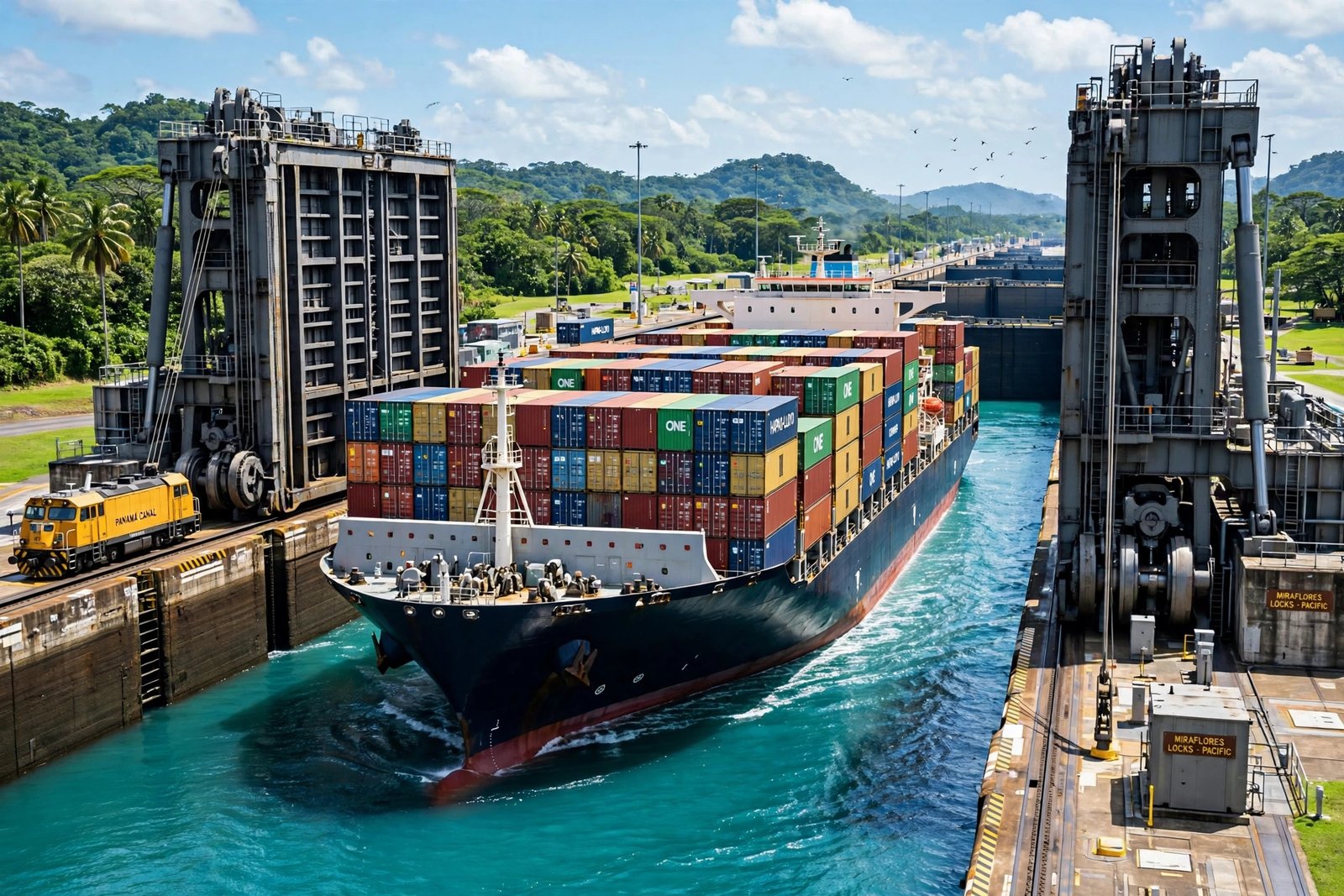
Before the Panama Canal opened in 1914, a ship sailing from New York to San Francisco had to travel all the way around South America, a voyage of thousands of miles through some of the most dangerous waters on earth. After the canal opened, that same journey was cut to a passage of about 51 miles across a narrow strip of land in Central America. It was one of the greatest engineering feats ever attempted, and it was built by the United States.
The Panama Canal is more than a shortcut. It is a story about American ambition, engineering, medicine, and power at the moment the United States was becoming a world force. It took a decade of digging, a revolution in disease control, and the labor of tens of thousands of workers to carve a waterway through jungle and mountain. It reshaped world trade, transformed the U.S. Navy’s ability to move between two oceans, and stood as proof that American engineering could do what others had tried and failed to do.
The Dream of a Shortcut
The idea of a canal across Central America is older than the United States itself. Explorers and merchants had dreamed of it since the 1500s, when Spanish colonists realized that the narrow isthmus of Panama separated two oceans by only a few dozen miles of land. For centuries, goods crossed the isthmus by mule train and later by railroad, but a waterway that let ships sail straight through remained a fantasy.
The French tried first. Beginning in 1881, a French company led by Ferdinand de Lesseps, the builder of the Suez Canal, attempted to dig a sea-level canal across Panama. The project collapsed into disaster. The terrain was nothing like the flat desert of Suez: it was jungle, mountain, and torrential rain. Disease, above all yellow fever and malaria, killed workers in large numbers, and the company went bankrupt after years of effort and enormous loss of life. By the time the French abandoned the work, the canal was a byword for impossible ambition.
When the United States took an interest, the debate was not only about whether a canal could be built, but where. Many in Congress favored a route through Nicaragua, which seemed longer but easier. President Theodore Roosevelt, who took office in 1901, pushed for Panama. The French company’s equipment and excavations were for sale, the route was shorter, and Roosevelt believed the moment had come. In 1902, Congress passed the Panama Canal Act, authorizing the United States to buy the French rights and equipment.
There was one obstacle: Panama was then a province of Colombia, and Colombia refused the terms the United States offered. In November 1903, Panama declared independence from Colombia, with American support, and within weeks the new Panamanian government signed the Hay-Bunau-Varilla Treaty, signed on November 18, 1903. The treaty gave the United States the right in perpetuity to build, operate, and defend a canal across the isthmus, and control over a strip of land ten miles wide that became known as the Panama Canal Zone. The United States paid France 40 million dollars for its equipment and excavations, and Panama 10 million dollars, according to the U.S. House of Representatives’ historical account. On May 4, 1904, the United States formally took control of the French property, and the American era of the canal began.
Theodore Roosevelt’s Great Gamble
No president is more closely tied to the Panama Canal than Theodore Roosevelt. He saw the canal as essential to American power. A country with coasts on two oceans needed a way to move its navy and its commerce between them without the long voyage around South America. In an age of battleships and expanding trade, that was not a luxury. It was a strategic necessity.
Roosevelt drove the project with a force of will that became legendary. He appointed the Isthmian Canal Commission to oversee construction, and he backed his chief engineers even when the work seemed impossible. The first chief engineer, John Findley Wallace, resigned in 1905. His successor, John Frank Stevens, rebuilt the project’s infrastructure, railroads, housing, and supply lines, and convinced Roosevelt that the canal should be built with locks rather than as a sea-level channel. In February 1906, Roosevelt sent a message to Congress supporting the lock design, arguing that it would be cheaper, faster to build, and easier to enlarge later. Congress authorized the lock canal on June 29, 1906.
Beating Disease: The Battle Nobody Sees
The French failure had taught the Americans one hard lesson: the canal could not be built until disease was beaten. Yellow fever and malaria had killed workers by the thousands during the French attempt, and they threatened to do the same to the American effort.
The man who changed that was Colonel William C. Gorgas, appointed chief sanitation officer in 1904. Gorgas acted on the then-recent discovery that mosquitoes carried yellow fever and malaria. His teams drained standing water, oiled ponds, screened windows, fumigated houses, and cleared the jungle around workers’ housing. It was unglamorous, relentless work, and it was the difference between success and failure. Within a few years, yellow fever was effectively eliminated from the Canal Zone, and malaria was sharply reduced.
How the Locks Work
The Panama Canal is 82 kilometers, about 51 miles, long, and it works by lifting ships up and over the spine of Panama rather than cutting a channel at sea level. The key is Gatun Lake, a vast artificial lake created by damming the Chagres River. The lake sits about 85 feet, or 26 meters, above sea level, and ships are raised to it by locks at each end, cross the lake, and are lowered back to sea level on the other side.
On the Atlantic side, the Gatun Locks lift ships in three steps to the level of the lake. On the Pacific side, the Pedro Miguel Locks lift ships a single step, and the Miraflores Locks lift them two more steps. Each of the original lock chambers is about 1,000 feet of usable length and 110 feet wide, with steel gates that are several feet thick and more than 60 feet tall. The locks work entirely by gravity: water flows from Gatun Lake into the chambers to raise a ship, and drains out to lower it. No pumps lift the ships. The water itself does the work.
The work was finished ahead of the darkest predictions. The locks were completed in 1913, and the first ship to make a full transit, the French crane boat Alexandre La Valley, crossed on January 7, 1914. Construction was officially completed that spring, and on August 15, 1914, the canal opened to commercial traffic with the transit of the SS Ancon. The First World War, which had begun weeks earlier, canceled the planned grand opening ceremony, but the canal was open, and the world had changed.
An American Waterway at the Center of the World
For the United States, the canal was transformative. The U.S. Navy could now move warships between the Atlantic and the Pacific in days rather than weeks, without rounding Cape Horn. American trade with Asia and with the west coast of South America became faster and cheaper. The canal strengthened the United States as a two-ocean power, and it gave the country a strategic asset no rival could match.
The Handover: 1977 to 1999
The turning point came with the Torrijos-Carter Treaties, signed in Washington on September 7, 1977, by President Jimmy Carter and Panamanian leader General Omar Torrijos. The two treaties replaced the 1903 agreement and set a timetable for the transfer of the canal to Panama.
The first treaty, the Neutrality Treaty, declared that the canal would remain permanently neutral and open to peaceful transit by the ships of all nations. The second, the Panama Canal Treaty, provided for a gradual transfer of control, with the Canal Zone ceasing to exist on October 1, 1979, and full control passing to Panama at noon on December 31, 1999. The U.S. Senate ratified both treaties in 1978, each by a vote of 68 to 32, just one vote more than the two-thirds majority required.
The 2016 Expansion: Bigger Ships, Bigger Stakes
By the early 2000s, the canal faced a problem its builders could not have foreseen: ships had outgrown it. The original locks, built for the ships of 1914, could handle vessels up to about 965 feet long and 106 feet wide, a size class known as Panamax. Modern container ships, gas carriers, and bulk carriers were far larger, and they were forced to take longer routes or unload and reload around the canal.
Panama’s answer was a massive expansion. Voters approved the project in a 2006 referendum, construction began in September 2007, and the new locks opened for commercial operation on June 26, 2016. The expansion added a third lane of locks, with new lock complexes at Agua Clara on the Atlantic side and Cocoli on the Pacific side. The new chambers are about 1,400 feet long and 180 feet wide, and they can handle Neopanamax ships up to about 1,200 feet long and 160 feet wide, carrying roughly 14,000 containers compared with about 5,000 for the largest Panamax vessels.
The expansion cost more than 5 billion dollars, and it was built with water-saving basins that recycle much of the water used in each transit, a crucial feature in a country where the canal depends on rainfall to keep Gatun Lake full. The new locks doubled the canal’s capacity for many types of cargo and kept it competitive in an age of ever-larger ships. It was the largest project at the canal since the original construction, and it was carried out by Panama, a century after the United States built the waterway.
The Canal Today: Drought, Recovery, and Record Trade
The canal’s recent history has been a lesson in how much it depends on water. Gatun Lake is filled by rain, and a severe drought in 2023 and 2024 forced the Panama Canal Authority to limit the number of daily transits and the draft of ships using the canal. In fiscal year 2024, transits fell to 11,240, and tonnage dropped with them.
The recovery came fast. In fiscal year 2025, which ended September 30, 2025, the canal recorded 13,404 transits, a 19.3 percent increase on the year before, according to the Panama Canal Authority. Of those, 3,342 transits used the Neopanamax locks and 10,062 used the original Panamax locks. The canal handled 489.1 million tons of cargo measured in Panama Canal Universal Measurement System tons, up 15.6 percent from fiscal year 2024. Total revenues reached about 5.7 billion dollars, up 14.4 percent, and the Authority reported a net profit of about 4.1 billion dollars. The figures were preliminary and unaudited when the Authority announced them in October 2025, but the direction was clear: the drought’s grip had loosened, and traffic had bounced back.
The Neopanamax locks now carry a striking share of the canal’s business. In fiscal year 2025, Neopanamax vessels accounted for only about a quarter of transits but more than half of the tonnage, because the ships using the expanded locks are so much larger. Container ships and liquefied petroleum gas carriers were among the strongest segments, while liquefied natural gas traffic lagged. The Authority has said it plans investments beginning in 2026 to strengthen the canal’s water supply and competitiveness, including work on water capacity that will matter more as the climate changes and rainfall grows less predictable.
Why the Panama Canal Still Defines American Power
The Panama Canal is a monument to a particular kind of American power: not the power of armies alone, but the power to build things that change the map. The United States did not merely win a war or sign a treaty in Panama. It moved mountains, tamed disease, and built a machine of water and steel that still works, more than a century later, every single day.
But the engineering achievement stands apart from the politics. The locks still lift ships 85 feet to Gatun Lake. The lake still carries them across the isthmus. The canal still saves ships a voyage around a continent. It was built by American engineers, American doctors, and American determination, and it remains one of the seven wonders of the modern world, as the American Society of Civil Engineers has ranked it. When Americans look for proof of what their country can build, the Panama Canal is still the first place to look.
Frequently Asked Questions
When was the Panama Canal built?
The United States built the canal between 1904 and 1914, after taking over the failed French effort. The locks were completed in 1913, and the canal officially opened to commercial traffic on August 15, 1914.
How do the Panama Canal locks work?
Locks at each end lift ships about 85 feet to Gatun Lake, an artificial lake created by damming the Chagres River. Ships cross the lake, then locks on the other side lower them back to sea level. The locks work by gravity, with water flowing from the lake into the chambers.
When did the United States hand the Panama Canal to Panama?
Under the Torrijos-Carter Treaties, signed on September 7, 1977, full control passed to Panama at noon on December 31, 1999. The Panama Canal Authority has operated the canal ever since, under a treaty that keeps it permanently neutral.
What is the Panama Canal expansion of 2016?
The expansion added a third lane of larger Neopanamax locks at Agua Clara and Cocoli, which opened on June 26, 2016. The new locks handle ships up to about 1,200 feet long, roughly doubling the canal’s capacity for large container ships and gas carriers.
How much traffic uses the Panama Canal today?
In fiscal year 2025, the canal recorded 13,404 transits and 489.1 million tons of cargo, with total revenues of about 5.7 billion dollars, according to the Panama Canal Authority. The figures were preliminary and unaudited when announced, and they marked a strong recovery from drought-restricted fiscal year 2024.
Related Reading
Keep exploring American engineering and power with these stories from Trending 4: Hoover Dam: Engineering Power of America, The Transcontinental Railroad: How America Connected in 1869, and US Aircraft Carriers: Sea Power Explained.
Sources: U.S. House of Representatives, History, Art & Archives; U.S. Department of State, Office of the Historian; Panama Canal Authority.