
You used all three of them before breakfast. When your phone found its location this morning, it was listening to American military satellites. When it pulled up the news, the weather, or this article, it rode a network architecture designed with United States defense funding. And the computing tradition that put a supercomputer in your pocket was turbocharged by a race to put Americans on the Moon — a goal the country announced, pursued, and achieved in a single decade. GPS, the internet, and Apollo 11 are usually filed under separate subjects: navigation, technology, history. Together, they tell one story — how American inventions, most of them built for war or prestige, quietly became the operating system of everyday life for the entire planet.
GPS: Lighthouses in the Sky
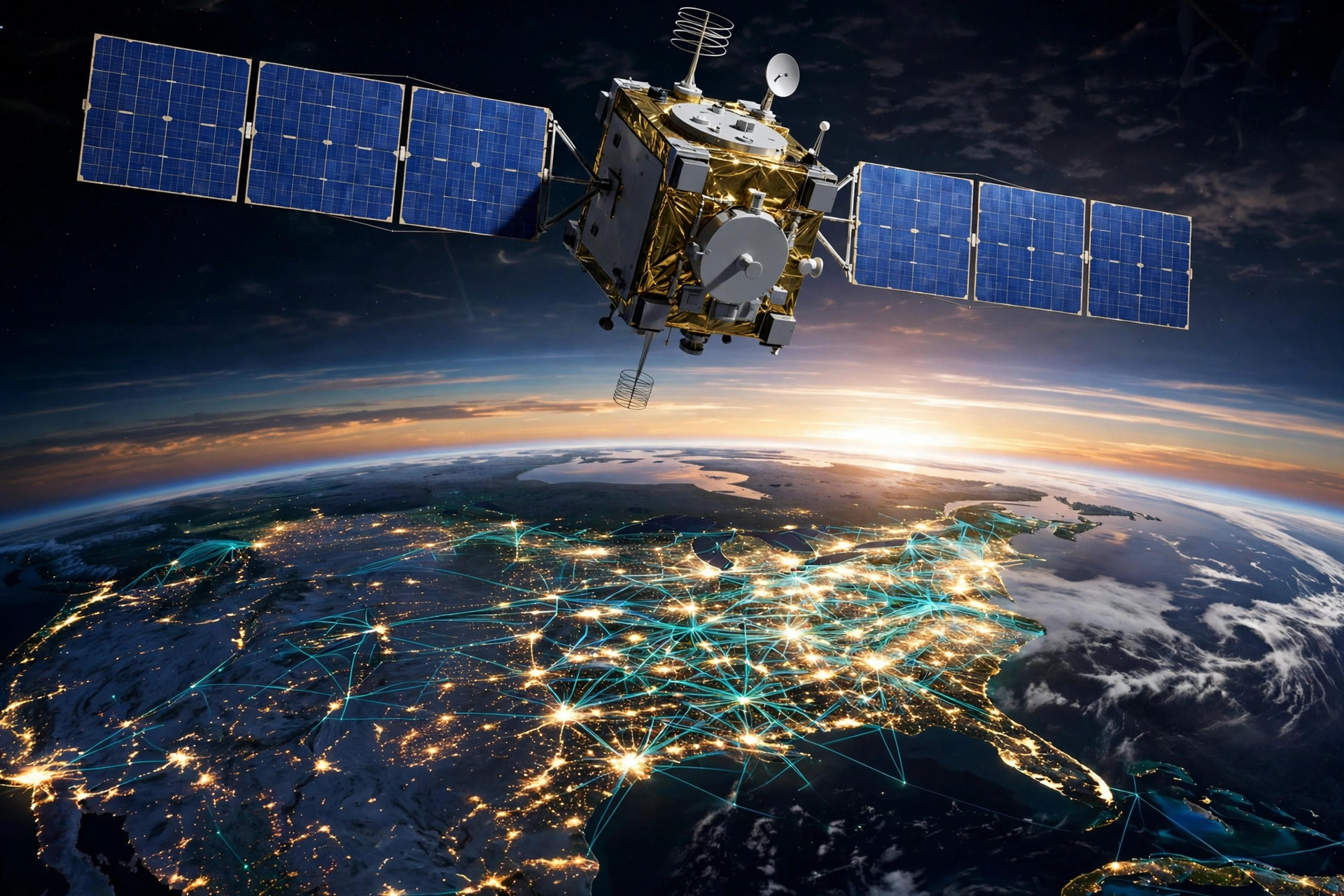
The Global Positioning System began as a military problem. Submarines, ships, aircraft, and ground forces all needed to know exactly where they were, anywhere on Earth, in any weather. Earlier navigation systems were slow or imprecise. The answer, developed by the Department of Defense through the 1970s and led by program manager Bradford Parkinson, was a constellation of satellites carrying atomic clocks, broadcasting precise timing signals. A receiver comparing the arrival times of signals from at least four satellites could calculate its position — in effect, measuring distance by measuring time, at the speed of light. Engineers involved in the early work described the satellites as lighthouses in the sky.
The first Navstar satellite launched in 1978. The full constellation of 24 satellites reached full operational capability in 1995. Along the way, tragedy opened the system to the world: after a Soviet fighter shot down Korean Air Lines Flight 007 in September 1983, killing all 269 people aboard a civilian airliner that had strayed into Soviet airspace, President Ronald Reagan announced that GPS would be made available for civilian use once complete. For years, civilian signals were deliberately degraded under a policy called Selective Availability, limiting public accuracy to roughly 100 meters. On May 1, 2000, President Bill Clinton ordered Selective Availability switched off. Overnight, civilian GPS became about ten times more accurate — and the modern location economy began.
Today GPS is maintained by the United States Space Force and provided free to the entire world, a fact so familiar it escapes notice. It guides aircraft and container ships, timestamps financial transactions (GPS timing signals help synchronize global markets and power grids), routes delivery trucks, steers tractors planting in straight rows, tracks earthquakes, and tells your phone when to say "turn left." Europe, Russia, and China have all built their own constellations — the surest compliment to the original. A fuller timeline of the program is available in this history of GPS in the United States.
The Internet: A Network Built to Share
The internet’s roots run through the Cold War too, but its founding idea was scholarly as much as strategic. In the 1960s, the Defense Department’s Advanced Research Projects Agency — ARPA — funded an experiment in connecting expensive, far-flung computers so researchers could share resources. The result, ARPANET, sent its first host-to-host message on October 29, 1969, between UCLA and the Stanford Research Institute. The first attempt crashed the system after two letters: the intended word was LOGIN; history got "LO."
ARPANET pioneered packet switching — chopping data into small blocks that travel independently and reassemble at their destination — and in 1971 one of its engineers, Ray Tomlinson, sent the first network email and chose the @ symbol to separate user from machine. The decisive breakthrough came in 1974, when Vint Cerf and Robert Kahn published the design for TCP/IP, the protocol suite that lets separate networks interconnect as one network of networks. On January 1, 1983 — a date often called the internet’s birthday — ARPANET switched entirely to TCP/IP. The National Science Foundation’s NSFNET then linked universities nationwide through the late 1980s, ARPANET was retired in 1990, and in 1989 British computer scientist Tim Berners-Lee, working at CERN in Europe, proposed the World Wide Web, which rode the American-built internet into every home on Earth. The Wikipedia history of ARPANET traces the network’s growth node by node.
The pattern is worth pausing on. The United States did not invent everything — Berners-Lee’s Web is the obvious example — but American public investment built the foundation layers: the network itself, its common protocols, and the open standards culture that let anyone build on top. Email, e-commerce, social media, streaming, cloud computing, and the smartphone app economy all stand on that foundation. Economists measure the internet’s contribution to U.S. output in the trillions of dollars; its contribution to daily life is simply total.
Apollo 11: The Decade America Went to the Moon
On May 25, 1961, three weeks after the first American reached space, President John F. Kennedy asked Congress to commit the nation to landing a man on the Moon and returning him safely to Earth before the decade was out. At its peak, the effort employed some 400,000 people across NASA, universities, and 20,000 industrial firms — arguably the largest peacetime mobilization of science and engineering ever attempted.
Eight years later, on July 16, 1969, Apollo 11 lifted off from Florida. On July 20, the lunar module Eagle touched down in the Sea of Tranquility, and Neil Armstrong stepped onto the surface, followed by Buzz Aldrin, while Michael Collins kept the command module Columbia in orbit. An estimated 600 million people — about a fifth of humanity — watched or listened live. Armstrong and Aldrin spent roughly two and a half hours on the surface, collected 47.5 pounds of lunar rock and soil, and splashed down safely in the Pacific on July 24. Carnegie Mellon University’s library preserves a concise anniversary account of the mission and its legacy.
Apollo’s spinoffs are sometimes oversold — NASA did not invent Tang or Velcro — but the real legacy is deeper than gadgets. The program drove early integrated circuits (Apollo’s guidance computer was among the first major customers for the young chip industry), created modern software engineering as a discipline, pioneered systems management for vast technical projects, and trained a generation of engineers who then built the personal computer and internet industries. Five more landings followed through 1972; no human has left Earth orbit since, which makes Apollo read today less like the first chapter of lunar settlement and more like a demonstration of what concentrated national will can do on a deadline.
The Quiet Infrastructure You Never Think About
Part of what makes these inventions remarkable is how completely they have disappeared into the background. GPS is the clearest case. The system costs the United States roughly a billion dollars a year to operate, yet no user on Earth pays a cent to use it, and most could not say who runs it. (The answer, since 2019, is the U.S. Space Force, which inherited the mission from the Air Force.) Every smartphone contains a receiver that listens to those Cold War-era satellites alongside newer ones, and every one of those phones is also, without anyone noticing, a precision clock synchronized to atomic time — which is why GPS timing, as much as GPS location, underpins cell networks, banking systems, and the electrical grid.
The internet hides even deeper. The protocols Cerf and Kahn published in 1974 still route the overwhelming majority of the world’s data, through fiber-optic cables, undersea lines, and satellite links that none of the ARPANET pioneers could have pictured. Apollo’s legacy hides in plain sight too: the discipline of writing mission-critical software — tested, documented, and verified to a standard commercial software rarely meets — was essentially invented for the Apollo Guidance Computer by Margaret Hamilton’s team at MIT, and Hamilton herself coined the term "software engineering" to describe the work. The modern world’s most reliable systems still run on habits formed in the race to the Moon.
The Common Thread
Three inventions, one recipe. Each began with the federal government funding something the private market would not: too expensive (a satellite constellation), too unproven (a network of networks), or too audacious (a Moon landing in nine years). Each was built by a partnership of government labs, universities, and contractors. And each escaped its original purpose — military navigation became a free global utility; a research network became the world’s town square and marketplace; a Cold War race produced the defining shared moment of the television age and the seed corn of Silicon Valley.
That recipe is also the live question of American innovation policy now, as the country invests in semiconductors, artificial intelligence infrastructure, and a return to the Moon under NASA’s Artemis program. GPS took twenty years from first satellite to everyday utility; the internet took twenty-five. The lesson of all three stories is that the payoff for foundational investment is enormous, diffuse, and slow — and that it tends to arrive in forms the original funders never imagined. The satellites were for submarines. Now they are for finding your keys.