
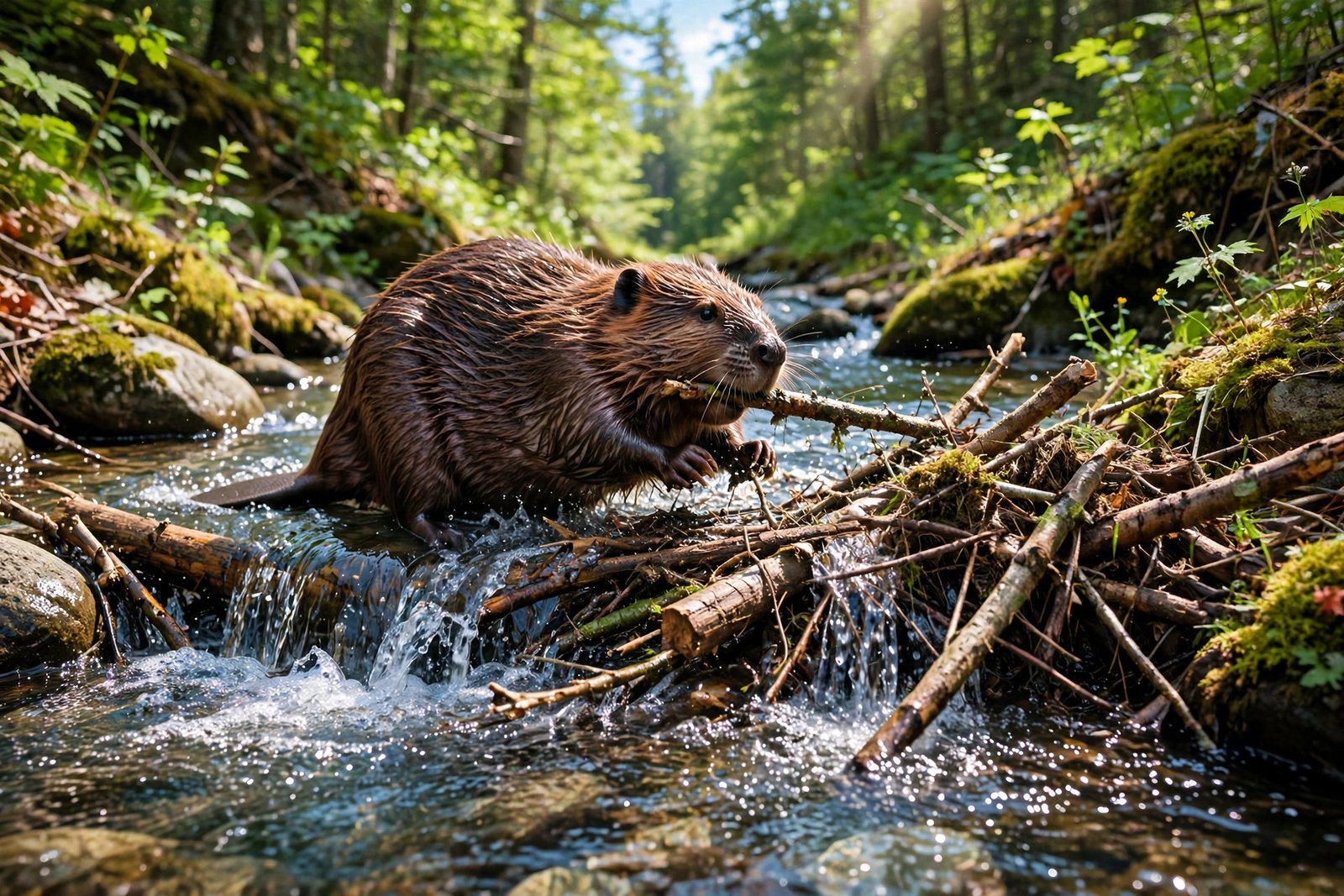
Somewhere along a quiet creek in the American West, a flat-tailed rodent is doing something no other animal on the continent can do. Working mostly at night, with nothing but teeth, paws, and patience, it is felling trees, dragging branches through the water, and packing mud between the sticks until a stream stops behaving like a stream. By morning, the water has slowed, spread, and deepened into a pond — a new home for frogs, herons, and young salmon. And the animal that built it all will slip back into its lodge, dry and safe, behind walls it made itself.
That animal is the American beaver, and it is one of the great comeback stories in American wildlife. Hunted to the edge of extinction for its fur, it has returned to nearly every corner of North America — and wherever it returns, the landscape changes. Wetlands reappear, streams run cooler and steadier, and even wildfires burn differently around beaver ponds.
Meet North America’s Largest Rodent
The American beaver, Castor canadensis, is the largest rodent in North America. Adults typically weigh around 40 to 44 pounds, though big ones can reach 60 pounds or more, and they measure three to four feet long including the tail. That tail is the beaver’s most famous feature: broad, flat, and covered in scales, it works as a rudder when swimming, a prop when the animal sits upright to gnaw, and a warning drum — a loud slap on the water that tells the whole family danger is near.
Beavers are built for life split between land and water. Their hind feet are webbed for swimming, and their front paws are small and dexterous, almost like hands, able to grip and carry sticks and stones. Their orange front teeth never stop growing — just as well, since gnawing wood wears them down constantly — and iron in the enamel keeps the cutting edge sharp. A beaver can fell a tree several inches thick in a single night, and the tree becomes food, building material, and eventually part of a dam.
Despite their size and teeth, beavers are peaceful herbivores. They eat bark, twigs, leaves, and aquatic plants, with a special fondness for aspen, willow, birch, and cottonwood. In autumn they stash branches underwater near the lodge, creating a food cache they can draw on all winter beneath the ice. They mate for life, live in family groups, and both parents raise the kits together. A typical colony holds five or six animals: the parents, the yearlings, and the new kits. Young beavers stay with their parents for about two years before striking out to find their own stretch of stream — which is how new ponds get started.
How a Beaver Builds a Dam
A beaver dam starts with a sound. Beavers are triggered by the noise of running water, and when they hear it they are driven to plug the leak. Working at night, they drag sticks and branches into the stream and anchor them into the streambed, then weave in smaller twigs and pack the gaps with mud, stones, and grass. The result is not a solid wall but a permeable one: water seeps through slowly, which is exactly the point. The dam does not stop the stream. It slows it down.
The pond behind the dam is the heart of the beaver’s world. Deep, still water protects the lodge entrance, which sits underwater, out of reach of coyotes, bears, and other predators. The pond also gives the beaver a safe highway for floating heavy branches to the lodge, and a pantry of underwater food. Beavers even dig canals — shallow channels from the pond into the woods — so they can float timber back to the water without hauling it over dry land.
The scale can be astonishing. Most dams are a few feet high and tens of feet long, but the longest beaver dam ever recorded stretches about 850 meters — more than half a mile — through a remote part of Wood Buffalo National Park in Alberta, Canada. First spotted on satellite imagery in 2007, it had likely been growing, dam upon dam, for decades. A dam is maintained, repaired, and extended year after year, generation after generation.
Inside the Lodge
If the dam is the beaver’s public works project, the lodge is its home. Built from the same sticks and mud, a lodge is a dome that can stand six feet high and stretch 40 feet across, with a dry chamber inside, above the waterline, reached through underwater tunnels. The chamber is lined with shredded bark and grass, and in winter the whole structure is sealed with mud that freezes hard — a fortress no predator can chew through.
Life inside the lodge is family life. Kits are born in spring, usually two to four of them, and they can swim within days of birth. The parents and older siblings groom them, keep them warm, and teach them the trade: how to gnaw, how to dive, how to read the water. Beavers are famously industrious, but also famously social — they groom each other, play together, and work side by side on the dam.
Not every beaver lives in a lodge. Where banks are high and steep, beavers dig a burrow into the riverbank instead, with the entrance underwater and a dry chamber above. Either way, the home is reachable only from below the waterline, because water is the beaver’s best defense.
A Keystone Species That Builds Wetlands
Ecologists call the beaver a keystone species — and the term fits. A keystone species is one whose impact on its ecosystem is far larger than its numbers would suggest, and the beaver’s impact is enormous. When a beaver dams a stream, it creates a wetland — and wetlands are among the most productive habitats on Earth.
The pond slows the water, letting sediment settle and improving water quality downstream. The raised water table recharges groundwater and keeps streams flowing through dry summers, when undammed creeks might run dry. The still, shallow edges become breeding grounds for frogs, salamanders, and dragonflies, while young salmon and trout find cool, sheltered water to grow in — beaver ponds provide critical winter rearing habitat for juvenile coho salmon. Herons, ducks, kingfishers, otters, mink, muskrats, and deer all follow the water, and studies have found that beaver sites support significantly higher species richness than unmodified stretches of stream.
The effect extends to the land itself. A beaver meadow — the rich, flat ground left behind when an old pond finally silts up and drains — becomes some of the most fertile soil in a valley, packed with wildflowers, grasses, and young trees. It is a cycle that has shaped North American valleys for millions of years.
The Fur Trade Nearly Erased Them
For all their skill, beavers were nearly destroyed by a fashion trend. When Europeans arrived in North America, beavers were everywhere. Estimates of the population before the fur trade vary widely — commonly cited figures run from 60 million to 400 million animals — but the scale was vast. There were beaver ponds on nearly every stream on the continent, and the animals had been shaping the landscape for thousands of years.
Then came the market for beaver felt. The beaver’s dense underfur made the finest felt hats in Europe, and the demand was bottomless. Between the 1500s and the 1800s, trappers pushed across the continent, following the rivers and emptying them, while Native peoples were drawn into the trade for guns, tools, and goods. By the mid-1800s, beavers had been effectively wiped out across most of the United States, and by around 1900 the population had collapsed to roughly 100,000 animals — a fall of more than 99 percent from its historic abundance.
The loss was not just a loss of beavers. It was a loss of wetlands. As the dams rotted away and the ponds drained, streams that had run steady and clear for centuries became fast, eroding channels. Meadows dried out. Fish and waterfowl lost their nurseries. The continent’s water system, in a very real sense, had been dismantled — one pelt at a time.
The Great Comeback
The beaver’s return began slowly, and it began with people deciding the animal was worth more alive than dead. In the late 1800s and early 1900s, states began to protect beavers with trapping seasons and bag limits, and the federal government created wildlife refuges where the animals could recover. Laws like the Lacey Act, which banned the transport of poached wildlife across state lines, gave the protections teeth. Then came one of the most successful wildlife restoration efforts in American history: live-trapping beavers from places where they were abundant and releasing them into streams where they had vanished.
Beavers are made for this kind of recovery. They breed readily, adapt to many kinds of streams, and once a pair settles in, the pond builds itself. In Washington’s Methow Valley, beavers released into degraded headwater streams built dozens of dams within a few years, raising groundwater levels and cooling streams enough to help juvenile salmon survive hot summers. Today the North American population is estimated at 10 to 15 million animals — still a fraction of the historic numbers, but a recovery of more than a hundredfold from the low point around 1900.
Why Beavers Matter More Than Ever
The beaver’s comeback arrives at a moment when America needs what beavers do. In the drought-prone West, beaver ponds store water on the land, releasing it slowly through dry months and keeping streams alive when rain is scarce. In fire country, the wet, green valleys around beaver complexes resist burning: research has found that landscapes with active beaver dams suffer only about a third as much fire damage as similar landscapes without them. Beaver ponds can also soften floods — during small flood events, studies have measured peak flow reductions of up to 13 percent, with water arriving later and lower downstream.
That is why land managers increasingly work with beavers rather than against them. Some projects install beaver dam analogues — simple posts and woven branches that mimic a dam and invite beavers to take over. Others relocate problem beavers to streams that need restoration. The idea is simple and radical at once: the cheapest, most durable wetland restoration crew in America is a family of beavers, and it works for free.
When Beavers and People Collide
Of course, a beaver does not know where your property line is. The same dam that creates a wetland can flood a road, a driveway, or a farmer’s field. Beavers love culverts, because a road crossing has already done half the damming work for them, and a blocked culvert can wash out a road in a single storm. They fell trees that people planted, and they raise water tables under septic fields. For a landowner watching a favorite oak drown, the beaver is not an ecosystem engineer. It is a pest.
The good news is that coexistence has gotten much smarter. The best-known tools are flow devices — pipes run through the dam that let water drain quietly at a set level. Because the intake sits underwater and upstream, the beaver cannot hear or feel the leak, so it does not try to plug it. The pond stays, smaller and controlled, and the beaver stays too. A related device, the beaver deceiver, is a trapezoidal fence around a culvert’s upstream opening that forces beavers to build farther away, where the current is weaker. Programs like the National Wildlife Federation’s Montana Beaver Conflict Resolution Program help landowners install these devices, often sharing the cost. The goal is not to win a fight with the beaver. It is to negotiate a water level both sides can live with.
Where to See Beavers in the Wild
Beavers are most active at dawn and dusk, which is when your chances are best. Look for the signs even if the animal stays hidden: a pointed stump, a pile of freshly gnawed sticks, a dome of branches in the middle of a pond, or a V-shaped wake crossing still water at sunset. Bring binoculars, sit quietly, and give them space.
Some of the most reliable places to watch beavers include Yellowstone National Park, where ponds can be seen along the Lamar River Valley and at Willow Park between Mammoth Hot Springs and Norris Junction, and Grand Teton National Park, where beavers keep lodges near Schwabacher Landing and Oxbow Bend on the Snake River. Voyageurs National Park in northern Minnesota is another premier destination, and Cuyahoga Valley National Park in Ohio has more than 30 active lodges visible from its paved trails. In Canada, Algonquin Provincial Park in Ontario is famous for one of the densest beaver populations on the continent. Wherever you go, keep a respectful distance and never disturb a dam or lodge — a beaver’s home is its life.
Frequently Asked Questions
Are beavers dangerous to people?
Beavers are not aggressive toward people and will almost always flee into the water when approached. They can bite if cornered or handled, so admire them from a distance and never try to touch one. The real risk from beavers is to property — flooded roads and felled trees are the usual complaints.
How long do beavers live?
In the wild, beavers typically live 10 to 12 years, though some reach their late teens. Kits stay with their parents for about two years before leaving to establish their own territory, and a mated pair will usually stay together for life.
Do beavers really build dams with their teeth?
Yes, in the sense that their teeth are the cutting tool. Beavers gnaw through trees with their iron-strengthened incisors, then carry the branches in their mouths or drag them along the ground. The dam itself is assembled with their front paws, which are surprisingly dexterous, and sealed with mud carried in those same paws.
What is the largest beaver dam in the world?
The longest beaver dam ever recorded is about 850 meters long — more than half a mile — in Wood Buffalo National Park in Alberta, Canada. It was discovered on satellite imagery in 2007 and is believed to have been built up over decades by successive generations of beavers.
Can beavers help with drought and wildfire?
Yes. Beaver ponds store water and raise groundwater levels, keeping streams flowing during drought. Around the ponds, wet soils and green vegetation resist burning, and research has found that beaver-influenced landscapes suffer only about a third as much wildfire damage as comparable areas without beavers.
Related reading
If you enjoyed this look at one of America’s great wildlife comebacks, keep exploring: the American bison’s own return from near-extinction, how the American alligator came back from the brink, and our guide to grizzly bears in Yellowstone.