
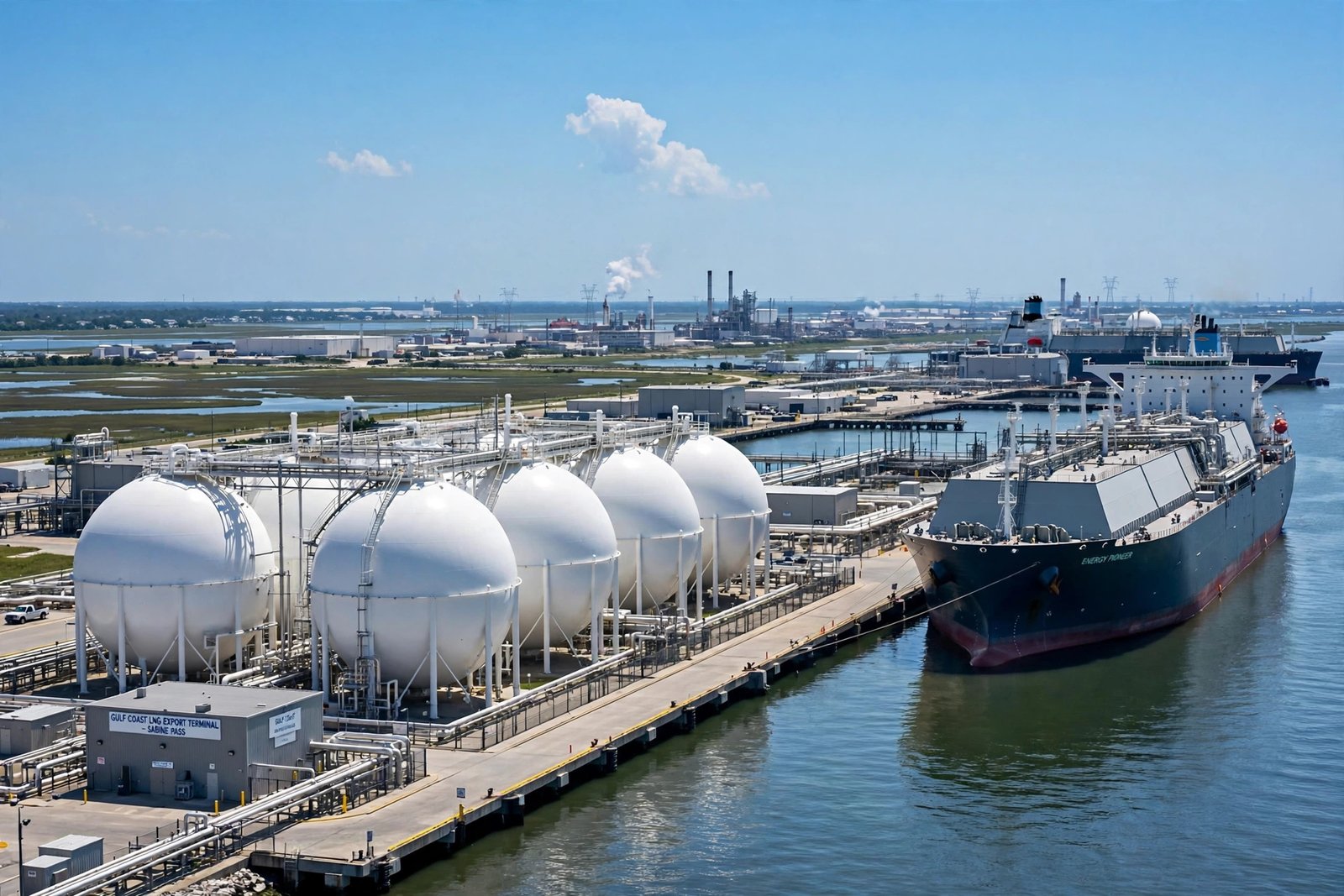
Ten years ago, the United States shipped almost no liquefied natural gas to the rest of the world. Today, America is the world’s largest LNG exporter — ahead of Qatar and Australia, the two countries that dominated the trade for decades. It is one of the fastest and most complete reversals in the history of global energy, and it happened in about a decade. How did a country that was building terminals to import gas end up supplying the world with it?
The short answer is shale. The longer answer involves a technological revolution, billions of dollars of investment along the Gulf Coast, a war in Europe that redrew the map of energy trade, and a set of export terminals that turned American natural gas into a global commodity. This is the story of how the United States became an LNG superpower — and what comes next.
From Importer to Exporter in a Decade
The numbers tell the story plainly. In 2016, US LNG exports averaged just 0.5 billion cubic feet per day. By 2025, they had surged to a record 15.1 billion cubic feet per day, according to the US Energy Information Administration (EIA). That is a thirty-fold increase in nine years. Along the way, the United States passed Australia and Qatar to become the world’s largest LNG exporter in 2023, a title it has held ever since.
The growth has not slowed. During the first half of 2026, US LNG exports averaged 17.4 billion cubic feet per day, up 23 percent from the same period a year earlier. The EIA now forecasts that exports will average about 17.4 to 17.6 billion cubic feet per day for the full year of 2026, and 18.6 billion cubic feet per day in 2027. In the agency’s February Short-Term Energy Outlook, it projected exports would exceed 18.1 billion cubic feet per day in 2027.
To put those figures in perspective, a single billion cubic feet of natural gas holds roughly enough energy to supply tens of thousands of homes for a day. Fifteen billion cubic feet a day is an enormous flow — enough to heat and power entire countries — and the United States now sends that much gas abroad every day, on top of what it uses at home.
The Shale Revolution That Made It Possible
None of this would have been possible without the shale revolution. In the early 2000s, American energy companies perfected two techniques — hydraulic fracturing and horizontal drilling — that unlocked vast quantities of natural gas trapped in shale rock formations across Texas, Pennsylvania, Louisiana, and other states. Production soared. Prices fell. And by the middle of the 2010s, the United States had more natural gas than it knew what to do with.
That abundance created both an opportunity and a problem. The opportunity was obvious: gas that was cheap in Texas was expensive in Tokyo, Seoul, and Rotterdam, and the gap between those prices was large enough to justify the enormous cost of liquefying gas, shipping it across oceans, and turning it back into gas at the other end. The problem was infrastructure. Liquefying natural gas requires cooling it to around minus 260 degrees Fahrenheit, at which point it shrinks to about one six-hundredth of its original volume and can be loaded onto specially built ships. Building the plants that do this — called liquefaction trains — costs billions of dollars each and takes years.
The EIA points to several reasons US LNG exports kept rising: abundant natural gas supply and reserves, flexible LNG export contracts, and relatively low feedgas costs. That last point matters more than it sounds. American gas is cheap because there is so much of it, and because the shale fields that produce it are close to the Gulf Coast terminals that ship it. The combination of cheap feedstock and flexible contracts — many US deals let buyers redirect cargoes to wherever prices are highest — made American LNG attractive to buyers around the world in a way that gas from more rigid suppliers was not.
There is also a simple geographic advantage. The Gulf Coast, where most US export terminals sit, offers a short shipping route to both Europe and Latin America, and a workable one to Asia through the Panama Canal. When European buyers suddenly needed gas in 2022, American cargoes could reach them in about two weeks. That speed turned out to matter enormously.
Sabine Pass: Where It All Started
Every revolution has a starting point, and for American LNG it was a terminal in Cameron Parish, Louisiana. The Sabine Pass LNG terminal, operated by Cheniere Energy, began operations as an import terminal in 2008 — built, ironically, to bring foreign gas into the United States at a time when experts expected America to need imports for decades.
Then shale changed everything. Cheniere reversed course, added liquefaction trains to the import terminal, and on February 24, 2016, the first large-scale LNG cargo from the Lower 48 states left Sabine Pass bound for overseas markets. It was the first shipment of its kind, and it marked the beginning of the American LNG era. The terminal has since shipped more than 3,300 cargoes worldwide, representing about 39 percent of all US export cargoes through November 2025, according to the US Department of Energy’s LNG export data.
Sabine Pass remains the largest US export terminal, with a nominal capacity of about 3.6 billion cubic feet per day. Its success proved that the model worked: build liquefaction trains on the Gulf Coast, feed them with cheap shale gas, and sell the output into a global market hungry for supply. Other developers watched, learned, and followed.
Cheniere, the company behind Sabine Pass, is now the dominant player in American LNG. It operates both Sabine Pass and its Corpus Christi terminal in Texas, and it holds roughly half of total US export capacity. Its scale gives it a weight in global gas markets that few energy companies of any kind can match — and it makes the company’s decisions about new trains and new contracts a matter of interest well beyond Houston.
The Terminals Behind the Boom
As of early 2026, the United States had eight operational LNG export terminals, according to the EIA, with more on the way. The roster spans the Gulf Coast and beyond: Sabine Pass and Calcasieu Pass in Louisiana; Corpus Christi, Freeport, and Golden Pass in Texas; Cove Point in Maryland; and Elba Island in Georgia, among others. Each terminal is a small industrial city in its own right, with storage tanks the size of stadiums, jetties for giant carriers, and pipelines feeding gas in from shale fields hundreds of miles away.
The newest addition is Golden Pass LNG, a joint venture between QatarEnergy, which holds a 70 percent stake, and ExxonMobil, which holds the remaining 30 percent. The terminal, at Sabine Pass in Texas, shipped its first cargo on April 22, 2026 — loaded onto the carrier Al Qa’iyyah, just 23 days after Train 1 achieved first LNG production on March 30. WorkBoat reported that when fully operational, the terminal is expected to export about 18 million tons of LNG per year, making it one of the largest facilities of its kind in North America. Train 2 is expected to start up in the second half of 2026, and Train 3 in the first half of 2027.
The pipeline of new capacity is what makes the EIA’s forecasts so striking. The agency expects US LNG export capacity to nearly double by 2031 compared with the level at the end of 2025. That growth will come from new trains at existing terminals and from entirely new projects now under construction along the Gulf Coast. In 2025 alone, US developers signed sale and purchase agreements for 40 million tons per annum of LNG from planned export facilities — equal to about 5.2 billion cubic feet per day, and the highest volume since 2022, according to the EIA.
Europe: America’s Biggest Customer
No part of the American LNG story is more dramatic than Europe. Before 2022, Europe bought only about a third of its imported gas in liquefied form, and American LNG was a modest share of that. Then Russia’s full-scale invasion of Ukraine upended the continent’s energy supply. European countries that had depended on Russian pipeline gas for decades suddenly needed alternatives — urgently, and in enormous volumes.
American LNG filled much of the gap. Europe received 69 percent of all US LNG exports in 2022, up sharply from 34 percent in 2021, according to the EIA. The share stayed high: from January through November 2025, Europe took about 68 percent of US LNG export volumes. In other words, more than two out of every three shiploads of American LNG now sail to Europe.
That shift turned LNG into a tool of foreign policy. American gas helped European countries keep the lights on and homes heated through winters that might otherwise have brought shortages and blackouts. It gave European governments leverage in negotiations with Moscow, because they no longer depended on Russian pipelines to the same degree. And it deepened the energy relationship between the United States and its allies in a way that will outlast the war itself — new regasification terminals built in Germany, the Netherlands, and elsewhere were designed to receive LNG for decades, not just for one crisis.
But the European market is not guaranteed forever. As the continent builds out renewable energy, its demand for gas may eventually fall, and Asian buyers are competing for the same cargoes — often willing to pay more. The flexibility of US contracts means American LNG goes wherever the price is highest, which is good for exporters but means Europe cannot count on today’s volumes lasting indefinitely.
What LNG Means for America
The export boom has changed the American energy economy in ways that go beyond the trade figures. The terminals themselves employ thousands of people in construction, operations, and maintenance, many of them in Louisiana and Texas communities where good industrial jobs are prized. The shale fields that feed them support drilling crews, truck drivers, pipeline workers, and the service companies that keep the whole system running. And the royalties and taxes paid on gas production flow to landowners and state governments.
That debate is also visible in Washington, where LNG export permits have become a political football. Approvals for new terminals can speed up or slow down depending on who holds the White House, and each administration’s approach sends a signal to developers deciding whether to commit billions to new plants. The current building wave reflects confidence that permits will keep flowing — but the history of the last decade shows how quickly the political weather can change.
For the broader American economy, LNG exports have another effect: they turn the United States from an energy importer into an energy supplier, with all the influence that brings. Energy exports generate revenue, support the trade balance, and give Washington a lever in its relationships with allies and rivals alike. When the United States can offer gas to a friendly country that needs it, that is a form of power — quieter than an aircraft carrier, but real.
What Comes Next
The EIA’s outlook is clear: more growth, for years to come. Export capacity is expected to nearly double by 2031, and export volumes are forecast to keep climbing through 2027 and beyond. If those forecasts hold, the United States will not just remain the world’s largest LNG exporter — it will extend its lead over Qatar and Australia, both of which are also expanding but from a smaller base of growth.
Several forces will shape whether that happens. The first is demand. Asia remains the long-term growth market for LNG, and the question is whether countries like China and India keep building gas-fired power plants and industrial capacity at the pace developers expect. The second is competition. Qatar is expanding its own export capacity, and new suppliers are emerging. The third is price: if global gas prices fall, the economics of new American terminals get harder, and some projects now under construction could be delayed or cancelled.
What is not in doubt is how far the industry has come. A decade ago, the idea that the United States would be the world’s largest LNG exporter sounded like fantasy — the country was building import terminals, not export ones. Today, American LNG heats homes in Berlin, powers factories in Tokyo, and lights cities across Asia and Latin America. The country that once worried about running out of gas now worries about building enough terminals to sell it all. That reversal, achieved in ten years, is one of the great energy stories of our time — and the next chapter is already under construction on the Gulf Coast.
Frequently Asked Questions
When did the US become the world’s largest LNG exporter?
The United States became the world’s largest LNG exporter in 2023, passing Qatar and Australia. It has held the top spot ever since, with exports reaching a record 15.1 billion cubic feet per day in 2025, according to the EIA.
Where does most US LNG go?
Europe is by far the biggest customer. From January through November 2025, Europe received about 68 percent of US LNG export volumes, and the share was 69 percent in 2022. Asia and Latin America take much of the rest.
What was the first US LNG export terminal?
The first large-scale cargo from the Lower 48 states left Cheniere Energy’s Sabine Pass terminal in Louisiana on February 24, 2016. The terminal began life as an import facility in 2008 before being converted to exports after the shale revolution made American gas abundant and cheap.
How many LNG export terminals does the US have?
As of early 2026, the United States had eight operational LNG export terminals, according to the EIA. Golden Pass LNG in Texas shipped its first cargo in April 2026, and more capacity is under construction. The EIA expects US LNG export capacity to nearly double by 2031 compared with the end of 2025.
Who is the biggest US LNG company?
Cheniere Energy is the dominant player. It operates the Sabine Pass terminal in Louisiana and the Corpus Christi terminal in Texas, and it holds roughly half of total US LNG export capacity. Sabine Pass alone has shipped more than 3,300 cargoes, about 39 percent of all US export cargoes through November 2025.
Related reading
How the US Dollar Became the World’s Reserve Currency — the other pillar of American economic power. Also see The Panama Canal: The Waterway America Built and Hoover Dam: The Engineering Marvel That Powered America.