
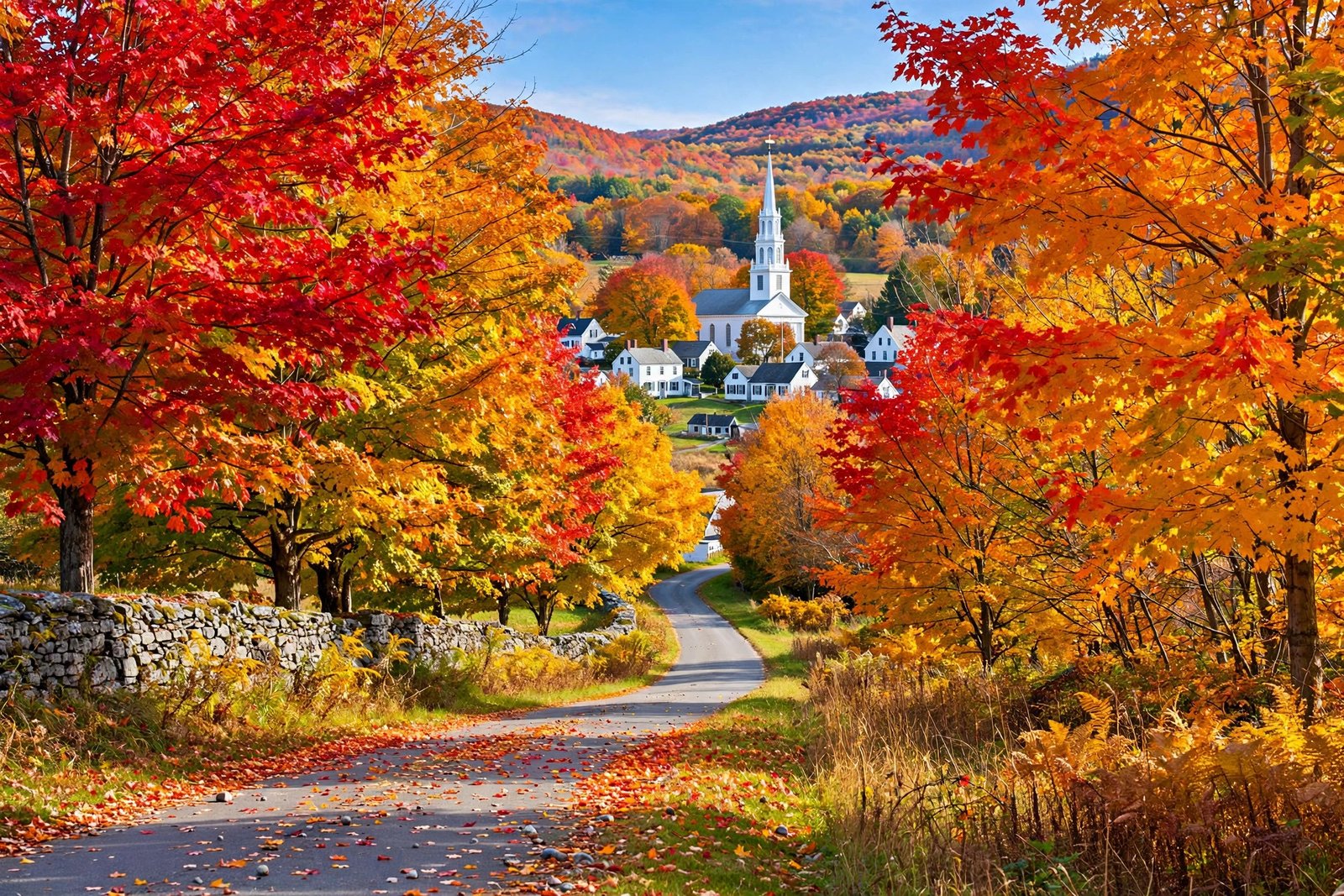
There is a moment every autumn in New England when an ordinary drive becomes a small celebration. A hillside that was green last week turns gold overnight, a sugar maple flames red against a white church steeple, and a farm stand appears around the next bend with pumpkins, cider doughnuts, and a hand-painted sign. Leaf peeping, as New Englanders fondly call it, is not just about pretty trees. It is a road-trip tradition built on winding byways, village greens, covered bridges, diners, and the happy problem of choosing which beautiful road to take next.
In 2026, that tradition followed its familiar north-to-south rhythm, with color arriving first in the far north and at higher elevations, then rolling down through the mountains, valleys, and finally toward the southern coast. By late October, the northern forests had largely passed peak, while lakes, valleys, and southern and coastal areas were still offering color, especially from late-turning oaks. That is the key to planning a New England foliage trip: there is no single perfect weekend for the whole region. There is a moving wave of color, and the best trip is the one that meets the wave where it actually is, using official state reports rather than a single prediction map printed months earlier.
This guide explains why the leaves change, where to drive, which towns make the best bases, and how to plan a trip that stays relaxed even when the most famous roads are busy. It is written for first-time leaf peepers and returning fans alike, with practical tips that work whether you have a long weekend or a full week, and whether you love hiking, photography, small-town browsing, or simply watching the world turn gold from the passenger seat.
Why the Leaves Change Color
The science is simpler — and more beautiful — than the old idea that frost paints the leaves. The United States Forest Service explains that leaves are food factories for much of the year, filled with chlorophyll, the pigment that captures sunlight and gives leaves their green color. As days shorten and nights lengthen in autumn, trees slow down and then stop making chlorophyll. The green fades, and yellow and orange pigments called carotenoids, which were present all summer but hidden beneath the green, finally show through. You can read the Forest Service explanation in its guide to why leaves change color.
Reds and purples come from a different process. Some trees make fresh pigments called anthocyanins in late summer and autumn, and those pigments create the scarlet and crimson that make sugar maples and red maples so famous. The United States Department of Agriculture notes in the science of autumn colors that day length, more correctly the length of nights, is the real trigger for the transition, while frost can actually damage vivid color by rupturing leaf cells. Warm, sunny days followed by cool nights tend to favor bright reds, because sugars made during the day stay trapped in the leaf overnight and help form anthocyanins. Heavy wind, drought, or prolonged cloud can dull the show or bring leaves down early, which is why two autumns in the same town can look quite different.
When to Go: Think in Waves, Not One Weekend
As a general pattern, northern New England and the higher mountains turn earliest, often in late September into early October, while the White Mountains and Green Mountains typically shine in the first couple of weeks of October, and southern New England and coastal areas follow later in October. New Hampshire’s official tourism guidance, published through Visit NH, describes peak beginning in the Great North Woods in the last week of September and moving south through October, with the White Mountains generally reaching peak in the first two weeks of October and southern and coastal regions often peaking in the second half of October. That pattern held in broad terms in 2026, even as local weather shifted individual towns by days.
In late October 2026, the picture had already moved south. New Hampshire’s official foliage report for October 27 described the Great North Woods and the White Mountains as past peak, with scattered rust, copper, and gold lingering around North Conway and the Mount Washington Valley, while the Lakes Region and Merrimack Valley were still at peak. New England’s weekly foliage coverage for October 30 to November 1 pointed to one last beautiful show in southern and coastal New England, courtesy of late-turning oaks, with worthwhile leaf peeping along the coasts of Rhode Island and Connecticut, across Cape Cod, and in Boston’s parks and neighborhoods. The lesson for late-season travelers is encouraging: past peak in the north does not mean the season is over. It means the show has moved.
The Kancamagus Highway, New Hampshire
If New England foliage had a single signature drive, it would be the Kancamagus Highway, known locally as the Kanc. This scenic byway runs through the White Mountain National Forest between Lincoln and Conway in New Hampshire, crossing Kancamagus Pass and following the Swift River for much of its length. There are no gas stations along the route and cell service is minimal in places, so the practical advice from state tourism guides is worth taking literally: fill the tank before you start, download maps in advance, and start early.
The Kanc rewards slow driving. Pullouts along the Swift River offer river views framed by maples and birches, and short walks lead to waterfalls, covered bridges, and overlooks that change character as the light moves. In peak weeks the drive can take far longer than the drive time without stops, because everyone is pulling over for the same golden hillside. That is not a flaw in the trip. It is the trip. Build in extra time, pack snacks and water, and treat a slow crawl past a blazing slope as a feature, not a delay. Conway and North Conway at the eastern end make a lively base, with shops, restaurants, and a classic New England village feel, while Lincoln at the western end puts you close to Franconia Notch and other White Mountain attractions.
Route 100, Vermont: The Long Green Spine
Vermont’s Route 100 is the antidote to rushing. It runs north to south through the heart of the Green Mountains, connecting towns and valleys that each offer a slightly different version of Vermont in autumn. You do not need to drive the whole route in one day, and you probably should not try. Pick a section, stay in one town, and let the road reveal itself in smaller pieces: a general store here, a farm stand there, a hillside of maples catching the morning light somewhere in between.
Stowe is the classic base on Route 100, and for good reason. It sits beneath Mount Mansfield, offers access to Smugglers’ Notch, and pairs mountain scenery with a walkable village center full of shops and restaurants. Smugglers’ Notch itself, a narrow mountain pass with towering cliffs, is spectacular in foliage season, but it is also narrow and winding, so drive it slowly and watch for other cars and cyclists. South of Stowe, Waterbury and the Mad River Valley offer a gentler, more rural rhythm, with covered bridges, country stores, and back roads that are often quieter than the main byway.
Woodstock, in central Vermont, is another wonderful base, with a village green, historic homes, and rolling farmland that turns gold and russet in October. It is a good choice if you prefer strolling, browsing, and long lunches to mountain driving, and it puts you within reach of Quechee Gorge and other central Vermont sights. Farther south, the towns along Route 100 toward the Deerfield Valley offer yet another version of the season, with higher elevations turning earlier and valley towns holding color a little longer. Vermont’s official weekly foliage tracker, prepared by the Department of Forests, Parks and Recreation and published through Vermont Tourism, is the best tool for choosing which section to drive on a given week, because foresters report what they are actually seeing region by region.
The Mohawk Trail, Massachusetts
Massachusetts often surprises first-time leaf peepers, because its foliage season stretches from the Berkshires in the west to the coast in the east, giving travelers a second chance if they miss the northern peak. The Mohawk Trail, a historic scenic byway across northern Massachusetts, is the western star. It winds through the Berkshire hills, past overlooks, small towns, and forests that mix maples, oaks, and birches into a rich autumn palette.
The Mohawk Trail works beautifully as a slower, less crowded alternative to the most famous northern routes, especially on weekdays. Towns along the way offer diners, antique shops, farm stands, and trailheads, and the surrounding Berkshires add museums, music, and historic homes for days when you want a break from driving. Pair the trail with a stay in a Berkshire town such as Williamstown or North Adams, or use it as a day drive from the Pioneer Valley, and you get the classic New England combination of scenery and small-town life without needing to cross three states.
Charming Towns to Base In
Choosing a base town matters as much as choosing a road, because the best foliage trips balance driving with lingering. Stowe, Vermont, offers mountain access and a lively village. Woodstock, Vermont, offers classic village charm and rolling farmland. North Conway, New Hampshire, offers White Mountain access, shopping, and a train ride that is popular in autumn. Smaller towns such as Jackson, New Hampshire, with its covered bridge and village falls, or Manchester, Vermont, with its shops and mountain backdrop, offer quieter evenings after busy days on the road.
Practical Tips for a Foliage Road Trip
First, check official reports, not just social media photos. New Hampshire’s official foliage tracker and foliage report are updated through the season, Vermont’s Department of Forests, Parks and Recreation publishes weekly regional updates through its fall foliage pages, and New England’s weekly coverage at where to see fall foliage this weekend offers a region-wide snapshot. Use those sources to choose a direction each morning, and be willing to change plans when the reports point elsewhere.
Second, plan for crowds on famous roads and quiet on back roads. Start early, especially on weekends, and avoid trying to fit two famous drives and a timed reservation into one day. Bring layers, because mountain mornings can be chilly even when afternoons turn warm, and wear sturdy shoes if you plan to step off the pavement for a better view. Keep the car fueled, carry water and snacks, and download offline maps before heading into mountain areas where service fades.
Third, drive safely and respectfully. Pull fully off the road before stopping for photos, never stop in a travel lane for a picture, and watch for pedestrians, cyclists, and wildlife, especially at dawn and dusk. Stay on marked trails, do not trespass on private land for a better angle, and leave leaves and branches where they are. The trees will be there next year, and so will the farmers and homeowners who live with leaf-peeper traffic every autumn.
Fourth, eat and shop locally when you can. Farm stands, general stores, diners, and village bakeries are part of the foliage experience, not just pit stops. A cider doughnut, a slice of pie, a jar of maple syrup, or a bag of apples from a stand you passed by chance often becomes the story you tell later, long after you forget which overlook was which. Supporting those small businesses also helps keep the villages that make foliage country so charming in good shape for the next season.
A Sample Three-Day Foliage Itinerary
Day one could begin in New Hampshire, driving the Kancamagus Highway from Lincoln to Conway, with stops at Swift River pullouts and a night in North Conway. Day two could cross into Vermont, perhaps by a scenic route through the Connecticut River Valley, and settle in Stowe or Woodstock for a slower day of village walks, a drive along Route 100, and a visit to Smugglers’ Notch or Quechee Gorge depending on your base. Day three could head south through the Berkshires and along the Mohawk Trail, or toward the southern coast if late-season color is strongest there, ending with a harbor walk or a village green at golden hour.
Frequently Asked Questions
When is the best time to see New England fall foliage?
There is no single best weekend for the whole region. Color generally moves north to south and from higher elevations to valleys, with northern areas and mountains typically earliest and southern and coastal areas latest. Check official state reports close to your trip and be ready to shift your route north or south by a day or two.
What is the best scenic drive for first-time leaf peepers?
The Kancamagus Highway in New Hampshire is the classic first choice for its White Mountain scenery and Swift River views, while Vermont’s Route 100 is best for a slower, town-to-town journey. The Mohawk Trail in Massachusetts is a wonderful less-crowded option, especially later in the season or on weekdays.
Where should I check foliage reports before I go?
Use official state sources: New Hampshire’s Visit NH foliage tracker and foliage report, Vermont’s Department of Forests, Parks and Recreation weekly updates, and region-wide weekly coverage from New England. Check about a week before departure and again each morning, because color changes with elevation, weather, and wind.
Is late October too late for New England foliage?
Not necessarily. By late October 2026, northern New Hampshire was largely past peak, but lakes, valleys, and southern and coastal areas still held color, especially from late-turning oaks. Late-season trips can be quieter and still beautiful, particularly along the southern coast and in Boston-area parks.
How can I avoid crowds on famous foliage drives?
Travel on weekdays when possible, start early, choose one famous drive per day rather than stacking several, and mix in back roads and smaller towns. Book lodging early for peak weekends, keep the tank full, download offline maps, and allow extra time so slow traffic feels like part of the experience.
Related reading
Keep exploring small-town America on Trending 4: porch culture and Porchfest in America, how America’s small-town diners endure, and the Apostle Islands’ sea caves and ice caves in Wisconsin.