
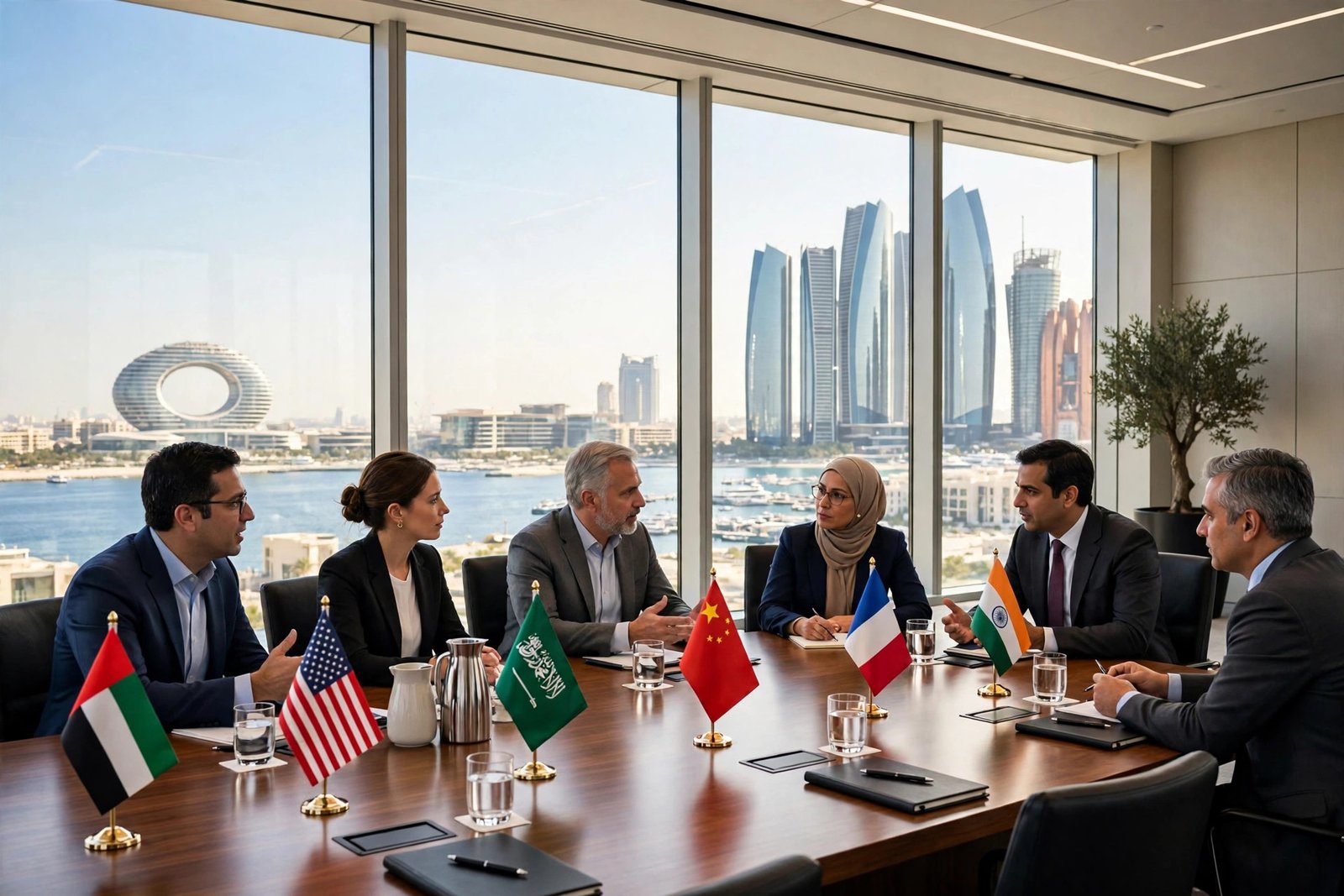
On Tuesday, November 10, 2026, delegations from Russia, Ukraine and the United States sat down together in Abu Dhabi for the first trilateral peace talks in nine months. The meeting lasted nearly four hours, and a second day of talks was scheduled for Wednesday, November 11. It was a modest step, not a breakthrough, but after months of silence in the negotiating room, even getting the three sides back to the same table mattered.
The United States is hosting and mediating the talks as President Donald Trump renews his push to end a war approaching its fifth year. American envoys Steve Witkoff and Jared Kushner are leading the US effort. Nobody involved is promising a deal, but the first day produced a serious conversation about the hardest questions: security guarantees for Ukraine after any ceasefire, lowering the fighting, and the humanitarian fallout.
What happened on the first day
The day began not with the three-way meeting itself, but with a coordination session. The Ukrainian delegation met with the American envoys and representatives from the United Kingdom, France, Germany, Italy, NATO and the European Commission. Only after that did the format narrow to the trilateral table: Ukraine, the United States and Russia.
Rustem Umerov, who leads the Ukrainian delegation, said the first day covered humanitarian questions and steps toward de-escalation. President Volodymyr Zelenskyy described the talks in similar terms, saying the discussions included humanitarian issues and security. US Secretary of State Marco Rubio called the meeting very productive, though he did not give details of what was agreed, if anything. That caution is worth noting. In diplomacy, a productive first day usually means the sides talked seriously and agreed to keep talking, not that they settled anything.
Witkoff had said before the talks that the agenda would cover post-war security arrangements, de-escalation, humanitarian issues and further steps toward a peace agreement. The two-day session was set up at working level, meaning senior officials and negotiators rather than the leaders themselves. Zelenskyy has said one of his priorities is preparing for a possible meeting of the three countries’ leaders, but no such summit has been announced.
Who was in the room
The American side was led by Witkoff, Trump’s special envoy, and Kushner, the president’s son-in-law, both of whom have travelled to Kyiv and Moscow since the last round of talks. Neither Rubio nor Zelenskyy attended the Abu Dhabi sessions in person, according to reporting from the meeting.
Ukraine’s delegation was led by Umerov, the head of Ukraine’s Foreign Intelligence Service and secretary of its National Security and Defense Council. He was joined by Kyrylo Budanov, the head of the President’s Office, parliamentary faction leader Davyd Arakhamia, and other senior officials including Serhii Kyslytsia and Vadym Skibitskyi. Russia’s delegation was led by Vladimir Medinsky, an aide to President Vladimir Putin who has led Moscow’s negotiating team since the first direct talks with Ukraine in Istanbul in March 2022.
The host, the United Arab Emirates, was represented at the opening by Sheikh Abdullah bin Zayed Al Nahyan, the UAE’s deputy prime minister and minister of foreign affairs, who welcomed the hosting of what the UAE Foreign Ministry described as the third round of trilateral talks between the United States, Russia and Ukraine. The UAE has become the regular venue for this diplomacy, and that is no accident. Abu Dhabi offers both sides a neutral setting far from the front lines, and the Emirates have built up credibility as a mediator through years of work on prisoner exchanges.
Security guarantees are at the centre of the talks
If there is one question that will decide whether any deal holds, it is security guarantees: what promises Ukraine gets that Russia will not attack again after a ceasefire or peace agreement. Zelenskyy has sought guarantees modelled on Article 5 of NATO’s founding treaty, the clause under which an armed attack against one member is treated as an attack against all. Ukraine is not a NATO member, so any such promise would have to come from a separate agreement, and its exact terms would matter enormously.
In an interview with the Danish broadcaster DR Nyheder, excerpts of which were published by the Ukrainian presidential press service on November 10, Zelenskyy described a recent exchange with the American side. He said the United States had asked whether Ukraine could trade Donbas for security, and that he had asked in return what that security would actually mean. The Americans answered, in his account, not NATO membership but something similar to NATO. Zelenskyy’s response was that Ukraine was being asked for a clear answer on Donbas, so it needed a clear answer on what the guarantees would be, and what would happen if Russia attacked again under guarantees that fell short of NATO membership.
Zelenskyy has also said he believes the quickest way to end the war is a ceasefire along the current front lines. He has argued that giving up Donbas would not guarantee peace, because Russia could treat a concession as a pause before another attack. That is the heart of Kyiv’s position: territory given away without ironclad guarantees behind it would buy time, not peace.
Rubio has said security guarantees will be central to reaching an agreement, but that any arrangement must be acceptable to both Ukraine and Russia. Moscow, for its part, has said any guarantees must be reciprocal, meaning Russia wants assurances of its own as well. Russian officials have also repeated that European troops stationed on Ukrainian territory after a settlement would be unacceptable to Moscow, and that Ukraine should abandon its bid to join NATO. Those positions have not moved in public, which is why expectations for Abu Dhabi were deliberately low.
Territory remains the hardest question
The gap between the two sides on land is wide, and neither side has shown signs of closing it in public. Russia has demanded that Ukraine withdraw its troops from four regions claimed by Moscow, abandon its ambition to join NATO and accept restrictions on its military capabilities, according to reporting on Moscow’s position. Ukraine refuses to give up land or accept limits on its armed forces, and wants a ceasefire now and a face-to-face meeting between Zelenskyy and Putin to settle the borders.
The dispute over Donbas, the eastern region where much of the heaviest fighting has taken place, is the sharpest part of the argument. Reports ahead of the talks said the American side had raised the idea of Ukraine giving up territory in Donbas in exchange for NATO-like security guarantees, an idea Zelenskyy publicly pushed back on in the DR Nyheder interview. At the same time, reporting citing a US official suggested both sides had shown some flexibility on territory ahead of the talks, though what that flexibility amounts to has not been made public.
One idea reported in the run-up to Abu Dhabi was redrawing internal Ukrainian boundaries so that they matched the realities on the ground, a formula that would let Russia claim a gain while Ukraine argued it had not formally ceded territory. But no such formula has been confirmed by any of the three delegations, so it should be treated as an idea in circulation rather than an agreement.
The sequencing matters too. According to reporting citing a US official, the first day in Abu Dhabi was expected to focus on policing a future ceasefire and the shape of security once the fighting stops, with territory left for the second day. If that plan held, the hardest conversations were still ahead when the delegations returned to the table on Wednesday.
Why Abu Dhabi, and why now
This is not the first time Abu Dhabi has hosted these talks. The first trilateral meeting took place in the UAE capital on January 23 and 24, 2026, the first direct meeting between Russian and Ukrainian delegations in months. A second round followed on February 4 and 5, and ended with an agreement to exchange 314 prisoners of war, 157 from each side. Further negotiations took place in Geneva on February 17 and 18 but failed to produce a significant breakthrough, and the diplomatic process then stalled for months.
The UAE’s role goes back further than this year. The Emirates have mediated prisoner exchanges between Russia and Ukraine since 2022, and the February exchange brought the total number of captives freed through UAE-mediated efforts to 4,955, according to the UAE Foreign Ministry. That record is why both sides trust Abu Dhabi as a venue, and why humanitarian issues, especially prisoner exchanges, are often the first thing the talks can actually deliver. A new exchange would be a tangible result even if the bigger political questions stay stuck.
The timing is driven by the calendar as much as by diplomacy. Winter is approaching, and Moscow has renewed attacks against Ukraine’s energy grid, raising the prospect of another cold season of power cuts for Ukrainian civilians. Zelenskyy has listed an end to strikes on energy infrastructure as one of his priorities for the talks, alongside reopening the Black Sea for grain exports, stepping up prisoner exchanges and preparing for a leaders’ meeting.
Washington’s renewed push also follows months of groundwork. Witkoff met with Putin in St. Petersburg about two weeks before the talks were announced, and the Kremlin confirmed on November 3 that a new trilateral round would take place in Abu Dhabi on November 10 and 11. Kushner said on social media that he and Witkoff would consult Ukrainian and European officials before meeting the Russian representatives, a sequence that matches how the first day actually unfolded.
Where Europe fits in
Europe’s place at the table is one of the more delicate questions in Abu Dhabi. European representatives from Britain, France, Germany and Italy, along with NATO and the European Commission, took part in the coordination meeting on the first morning, but they were not part of the trilateral session itself. Russia has objected to European involvement in the three-way format, though Moscow has said European representatives could join at a later stage.
Rubio has argued that the trilateral format should eventually include European partners as well, saying they are part of solving the problem for the long term. European governments, for their part, insist that no agreement affecting European security can be discussed without them. France’s foreign minister has made that point publicly, and it reflects a basic reality: any security guarantee for Ukraine would almost certainly involve European countries, whether through troops, money, weapons or political commitments.
That tension is not going away in two days. The most likely outcome is that Europe stays consulted before and after each session, with a bigger formal role only if the talks reach the stage of writing down guarantees. For Kyiv, European backing matters because the United States alone cannot provide the long-term commitment it wants. For Moscow, keeping Europe at arm’s length fits its argument that the settlement should be agreed between Moscow, Kyiv and Washington first.
What to watch on the second day
The second day of talks, on Wednesday, November 11, was expected to turn to the territorial questions that were held over from day one. That is where the talks could either find a narrow path forward or stall again. Watch for three things in particular.
First, any statement about a ceasefire, even a limited one. An energy ceasefire, halting strikes on power plants and grid infrastructure, is the most realistic near-term step, and it is one Zelenskyy has explicitly asked for. A broader ceasefire along the front lines would be a much bigger step, and Russia has previously rejected general ceasefire calls, arguing they would let Ukrainian forces regroup.
Second, any announcement on prisoners. Exchanges are the one area where the Abu Dhabi format has a proven record, and another swap would signal that the channel between the two sides is working even when the political talks are not. Umerov has said Ukraine’s priorities include advancing humanitarian efforts, and both sides have described past exchanges as progress toward building trust.
Third, what happens after Abu Dhabi. If the delegations leave with a date for another round, that is itself a result. If they leave with nothing scheduled, the process may drift again. Analysts quoted ahead of the talks cautioned against expecting an immediate breakthrough, and the history of this year supports that caution.
What this means for Americans
For readers in the United States, the talks are worth following because the United States is not a bystander, it is the mediator, and the outcome will shape American foreign policy for years. The Trump administration has made ending this war a stated priority, and Witkoff and Kushner are now the faces of that effort. For now, the honest summary is short: the talks resumed, the first day lasted nearly four hours and was described by Washington as very productive, and the second day was scheduled. Nothing has been agreed in public, and the gaps on territory and security guarantees remain as wide as they were when the year began. The next signal will come from what the delegations say when they leave Abu Dhabi, and whether they leave with a date to meet again.
Frequently asked questions
When did the Abu Dhabi peace talks take place? The latest round opened on Tuesday, November 10, 2026, with a second day scheduled for Wednesday, November 11. It was the first trilateral meeting between Russia, Ukraine and the United States since February 2026.
Who is mediating the talks? The United States is hosting and mediating, with special envoy Steve Witkoff and Jared Kushner leading the American delegation. The United Arab Emirates is hosting the meetings in Abu Dhabi.
What are the talks about? The stated agenda is post-war security arrangements, de-escalation, humanitarian issues and steps toward a peace agreement, with security guarantees for Ukraine at the centre of the discussion.
Has there been a breakthrough? No breakthrough has been announced. The first day ended after nearly four hours with no public agreement, though Secretary of State Marco Rubio described the meeting as very productive. Earlier rounds this year produced a prisoner exchange of 314 captives but no peace settlement.
What happens next? The delegations were scheduled to continue talks on November 11. Any further rounds, a possible ceasefire, or a leaders’ meeting would depend on what the negotiators report back to their capitals.
Related reading
For more on how American diplomacy is shaping world events, see our coverage of the Trump-Putin-Xi meeting at the APEC summit in Shenzhen, our explainer on the US strikes on Iran in November 2026, and our look at the Panama Canal and the waterway America built.