
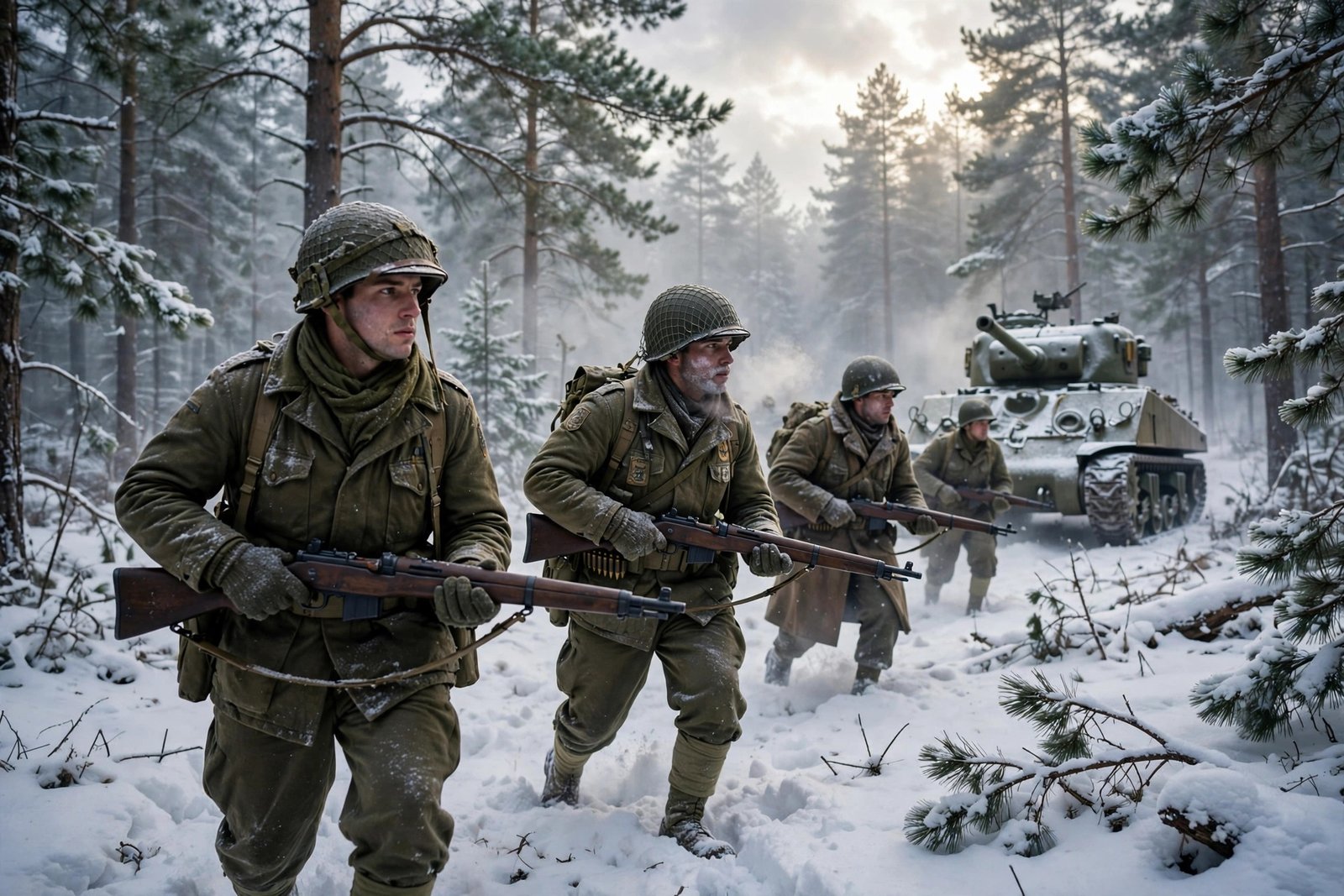
In the cold, foggy forests of the Ardennes in December 1944, the American Army faced one of the greatest tests in its history. The war in Europe seemed all but won. Allied forces had raced across France after D-Day, liberated Paris, and pushed the German Army back to its own borders. Soldiers talked about being home by Christmas. Then, before dawn on December 16, 1944, the quiet shattered. German tanks, artillery, and infantry poured out of the forests of Belgium and Luxembourg in a surprise offensive that would become the largest land battle ever fought by the United States Army. The Battle of the Bulge, named for the deep bulge the German advance punched into the Allied line, lasted six brutal weeks in the dead of winter. It cost tens of thousands of American lives, yet it ended with the German Army broken and the road to Berlin open. This is the story of that battle, and of the ordinary American soldiers who refused to give ground when everything seemed lost.
The Quiet Before the Storm
By the winter of 1944, the mood among Allied commanders was confident, almost relaxed. The German Army had been driven out of France and Belgium, and its losses seemed too great to mount another serious attack. The Ardennes, a thickly forested region of rolling hills and narrow roads in eastern Belgium and Luxembourg, was considered a quiet sector, a place to rest tired divisions and blood new ones. Thinly spread American units held a long front there, many of them divisions that had never seen combat or units pulled off the line to recover after hard fighting.
But Adolf Hitler had a different plan. He believed one last great blow in the west could split the American and British armies, capture the port of Antwerp, and force the Allies to negotiate. The Germans gathered their remaining armored reserves in secret, moving at night and under strict radio silence. They chose the Ardennes precisely because the Allies thought it was quiet, and they chose a moment when bad weather would ground Allied aircraft. In the early morning darkness of December 16, a massive artillery barrage opened the attack, and German tanks rolled forward through fog and snow.
The assault caught the Americans completely by surprise. Some front-line units were overrun in hours. Others fought where they stood, buying precious time with their lives. In the confusion of those first days, German spearheads pushed deep into the Allied lines, and the map began to show the bulge that gave the battle its name.
December 16: The Germans Attack
The German offensive, called Operation Watch on the Rhine by its planners, struck along a front of roughly 80 miles. Three German armies attacked, aiming to cross the Meuse River and drive on to Antwerp. In the center, the Fifth Panzer Army drove toward Bastogne and the Meuse. In the south, the German Seventh Army protected the flank of the advance.
The American soldiers in the path of the attack were outnumbered and, in many places, caught unprepared. The 106th Infantry Division, newly arrived and holding a long stretch of front, took the full force of the blow. Two of its regiments were surrounded and forced to surrender after days of hard fighting, one of the largest surrenders of American troops in the European war. Other units held on in isolated pockets, fighting from foxholes and farmhouses while German columns flowed past them on the roads.
Yet even in those dark first days, American resistance slowed the German timetable. Engineers blew bridges ahead of the advancing tanks. Small groups of soldiers held crossroads and villages long enough to throw the German schedule off by hours, then days. The Germans needed speed above all else, and every hour of delay cost them fuel, daylight, and momentum.
Bastogne: The Crossroads Town
At the center of the battle stood Bastogne, a small Belgian town where seven roads met. Whoever held Bastogne controlled movement through the Ardennes, and both sides knew it. As the German Fifth Panzer Army advanced, American commanders rushed reinforcements to the town. The 101st Airborne Division, the famous Screaming Eagles who had fought at Normandy and in Holland, was resting near Reims when the call came. Trucks carried the paratroopers toward Bastogne through the night, and they arrived just in time.
The 101st reached Bastogne on December 19, along with elements of the 10th Armored Division and other units. Together, they formed a defensive ring around the town. By December 21, German forces had surrounded Bastogne completely. Inside the pocket, American soldiers dug in, low on ammunition, food, and medical supplies. The weather was bitterly cold, and the skies stayed gray, keeping Allied supply planes on the ground. Wounded men waited in basements and cellars, and the town itself was pounded by artillery.
The men of the 101st were paratroopers, trained to fight surrounded, and they made Bastogne a fortress. They held the roads into the town and turned back attack after attack. German tanks probed the perimeter and found no weak spot. As the siege wore on, the defenders grew hungrier and colder, but they did not break. Bastogne became the symbol of the whole battle: a town that would not fall, held by soldiers who would not quit.
“NUTS!” — The Answer That Echoed Around the World
On the morning of December 22, 1944, four German soldiers approached the American lines under a white flag. They carried a written demand from the German commander: the surrounded American forces in Bastogne should surrender honorably, or face annihilation by artillery. The message was delivered to the acting commander of the 101st Airborne, Brigadier General Anthony McAuliffe, who was in command while Major General Maxwell Taylor was away in the United States.
McAuliffe read the demand, and his first reaction has become one of the most famous moments in American military history. According to the accounts of the officers with him, he laughed and said, “Aw, nuts.” His staff then worked out how to turn that reaction into a formal reply. The written answer, delivered back to the Germans, read in full: “To the German Commander: NUTS! The American Commander.”
The Germans were baffled by the word, and the Americans had to explain that it meant, in plain language, go to hell. The reply was not just a piece of bravado. It was a message to the men of the 101st as much as to the enemy: there would be no surrender at Bastogne.
The Germans answered with more shelling and another attack on Christmas Day, but Bastogne held. The 101st and the other defenders of the town had bought the time the rest of the Allied Army needed. Their stand in the snow, hungry and surrounded, remains one of the proudest chapters in the history of the United States Army.
Patton Turns North
While Bastogne held out, General George S. Patton and his Third Army were racing to the rescue. Patton had been preparing an attack to the east when the German offensive struck, and he was ordered to turn his whole army north toward Bastogne. It was one of the great feats of the war. In the middle of winter, over icy roads, Patton wheeled three divisions ninety degrees and drove them toward the besieged town, covering distances that military planners thought impossible in the time available.
The advance was brutal. American tanks and trucks moved through snow and mud while German units fought delaying actions on every road. But the Third Army kept coming, and on December 26, 1944, tanks of the 4th Armored Division broke through to Bastogne, opening a corridor to the surrounded defenders. The siege was over. Supplies and reinforcements poured in, and the 101st, which had held the town alone for a week, was finally relieved.
Patton’s relief of Bastogne was a turning point, but the battle was far from finished. The German bulge still extended deep into the Allied lines, and it would take weeks of hard fighting to push the Germans back. Slowly, yard by yard, the Allies began to squeeze the bulge shut.
The Weather Breaks and the Tide Turns
One of the German advantages in the opening days was the weather. Low clouds and fog kept Allied aircraft grounded, and without air support the American ground forces had to fight the German tanks on their own. But on December 23, the skies cleared. Allied fighter-bombers returned to the battle in force, attacking German columns, supply lines, and tanks. At the same time, transport planes dropped supplies to the defenders of Bastogne, filling the skies with parachutes carrying ammunition, food, and medicine.
The return of Allied air power changed the battle. German units, already short of fuel, found their supply trucks destroyed on the roads. Tanks that had raced forward now sat stranded without gasoline. The German offensive, built on speed, ground to a halt. By early January, American forces were attacking on both sides of the bulge, driving the Germans back toward their starting lines. The fighting was still savage, with villages changing hands and American soldiers advancing through deep snow against determined resistance, but the outcome was no longer in doubt.
By late January 1945, the bulge had been erased from the map. The battle officially ended on January 25, 1945, when Allied forces had pushed the Germans back to their original positions. The German Army had spent its last reserves in the west, losing men, tanks, and fuel it could never replace.
The Cost of the Battle
The Battle of the Bulge was the bloodiest battle American forces fought in the Second World War. Historians working from the U.S. Army Center of Military History’s official histories put American casualties at roughly 81,000, including killed, wounded, and missing, over the six weeks of the battle. German losses are harder to pin down, with estimates generally running from 80,000 to 100,000 casualties. The exact figures vary from source to source, because the chaos of the battle made complete records impossible, but no one disputes the scale: tens of thousands of men on both sides were killed, wounded, or captured in the snows of the Ardennes.
Among the American losses were the men who disappeared in the first days of the offensive, the soldiers of the 106th Division surrounded in the Schnee Eifel, and the paratroopers and tankers who held the crossroads towns. The battle also claimed the lives of Belgian civilians caught in the fighting, as artillery and bombing destroyed villages and towns across the Ardennes. Today, the American cemeteries at Henri-Chapelle and Luxembourg hold the graves of thousands of those who fell, quiet reminders of what the winter of 1944 cost.
The human cost makes the Bulge a solemn subject, but it is also why the battle is remembered with such pride. The soldiers who fought there were not all veterans. Many were young replacements, clerks, cooks, and drivers thrown into the line when the attack came. They held roads, bridges, and villages with whatever they had, and their stand bought the time the Allied armies needed to recover.
Why the Battle of the Bulge Still Matters
The Battle of the Bulge matters because it was the last great test of the American Army in Europe, and the Army passed it. The German offensive was Hitler’s last gamble, a bold plan that depended on surprise, speed, and bad weather. For a few days it worked. Then the American response, from the paratroopers at Bastogne to Patton’s turning Third Army to the clerks and engineers who grabbed rifles and held crossroads, wore the offensive down and destroyed it.
The battle also changed how Americans remember the war. The image of the 101st Airborne at Bastogne, cold and hungry and answering a surrender demand with a single word, became part of the national story. McAuliffe’s “NUTS!” is taught to new soldiers today, and Bastogne remains a place of pilgrimage for veterans’ families and for anyone who wants to understand what American soldiers endured in the Second World War. Every December, the people of Bastogne still honor the soldiers who saved their town.
For students of military history, the Bulge is a lesson in resilience and leadership. It showed that a well-led army can absorb a surprise attack, recover its balance, and strike back. It showed the value of holding key ground, of moving fast, and of the simple refusal to quit. The men who stood in the Ardennes in the winter of 1944 did not set out to become legends. They set out to hold the line. They did, and the world is different because of it.
Frequently Asked Questions
When did the Battle of the Bulge start and end?
The battle began with the German offensive on December 16, 1944, and ended on January 25, 1945, when Allied forces had pushed the Germans back to their original positions.
Why is it called the Battle of the Bulge?
The name comes from the shape of the German advance on the map. The offensive punched a deep bulge, or salient, into the Allied front line in the Ardennes, and the name stuck in newspapers and in history.
Who said “NUTS!” at Bastogne?
Brigadier General Anthony McAuliffe, acting commander of the 101st Airborne Division, gave the one-word reply to the German demand that the surrounded Americans surrender Bastogne on December 22, 1944.
How many Americans were casualties in the Battle of the Bulge?
Historians working from the U.S. Army Center of Military History’s official histories put American casualties at roughly 81,000, killed, wounded, and missing. Estimates vary by source, and German losses are generally estimated at 80,000 to 100,000.
What was the largest battle fought by the U.S. Army in World War II?
The Battle of the Bulge was the largest land battle fought by the United States Army in the war, and the bloodiest for American forces, with more men engaged than in any other single battle.
Can you visit the Battle of the Bulge battlefields today?
Yes. Bastogne and the Ardennes region of Belgium and Luxembourg have museums, memorials, and preserved battle sites, including the Bastogne War Museum and the Mardasson Memorial, and the area is open to visitors year-round.
Related reading
If you enjoyed this story of courage under fire, keep exploring America’s wartime history on Trending 4. Read about the Battle of Midway, the Pacific turning point of 1942, discover the daring Doolittle Raid on Tokyo, and learn the full story behind the flag raising at Iwo Jima.
Sources and further reading: the U.S. Army Center of Military History’s official history of the Ardennes campaign, Hugh M. Cole’s The Ardennes: Battle of the Bulge, and the Battle of the Bulge reference page, which draws on the Army’s official casualty returns.