
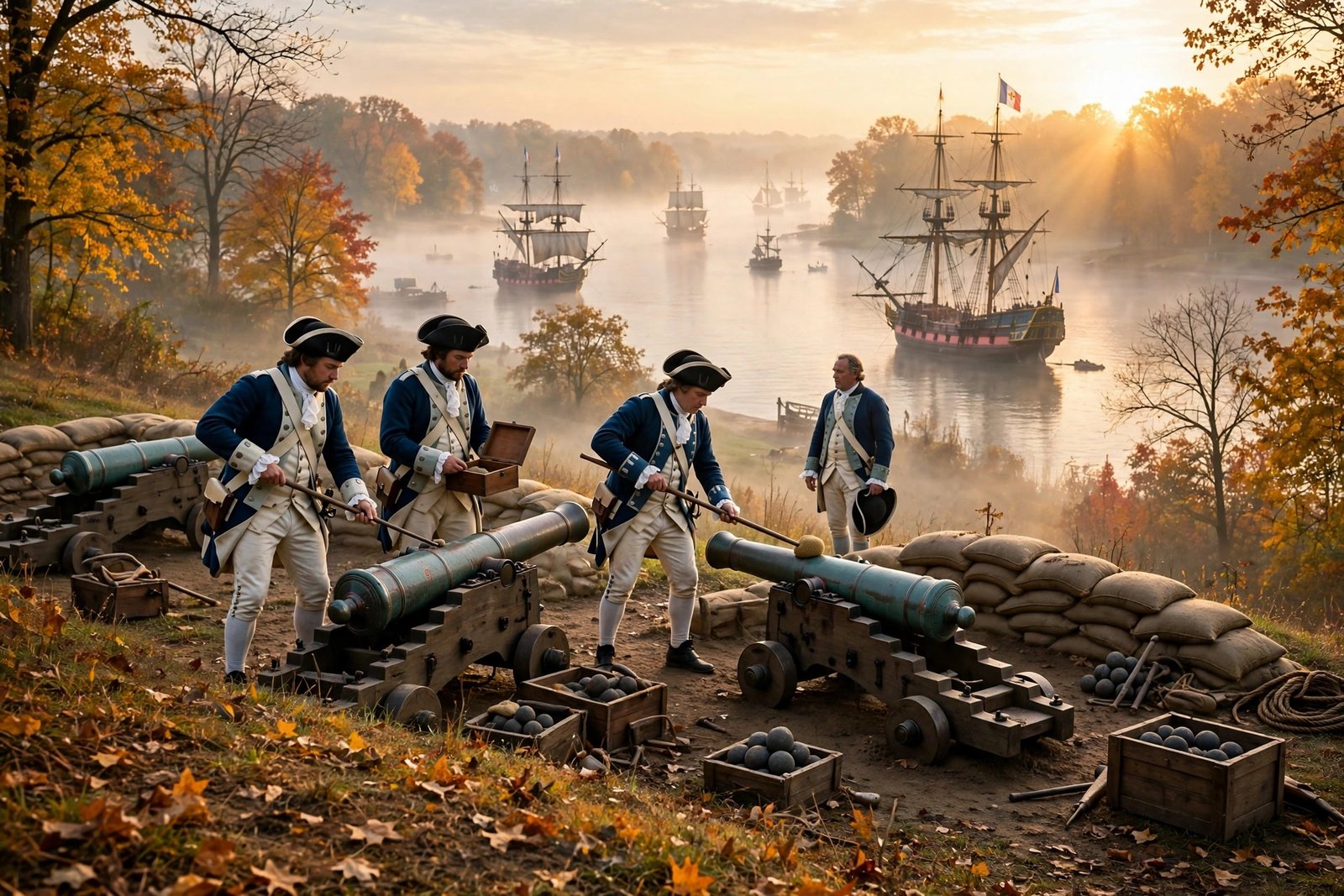
On a sunny autumn afternoon in October 1781, on a field outside a small Virginia tobacco port, the British army laid down its arms. A band played, French and American soldiers stood in lines on either side of the road, and a British officer offered his sword to the victors. That surrender at Yorktown did not just end a battle. It ended the fighting of the American Revolutionary War and made the independence of the United States a reality.
The Battle of Yorktown, also called the Siege of Yorktown, was the last major land battle of the war. It was won by a combined American and French force under General George Washington, and it worked because of careful planning, a daring march, and a French fleet that arrived at exactly the right moment. This is the story of how it happened, why it mattered, and what you can still see at Yorktown today.
The War Before Yorktown
By the summer of 1781, the American Revolutionary War had been going on for six years. The Continental Army had won important victories, including Saratoga in 1777, but it had also suffered bitter defeats, and the British still held New York City, Charleston, and other key places. Money was short, supplies were shorter, and many Americans wondered whether the fight could ever be won outright.
Washington’s army was camped north of New York, watching the British forces under Sir Henry Clinton in the city. The obvious target was New York itself, and Washington had long dreamed of retaking it. But attacking a fortified city held by a strong British army, with the Royal Navy in the harbor, was a gamble he could not afford to lose. He needed a better target, and he needed help.
That help was already in America. French troops under the Comte de Rochambeau had arrived in Rhode Island the year before, and French ships and money had kept the American cause alive. In the summer of 1781, Washington and Rochambeau met to plan a joint campaign. The question was where to strike.
Cornwallis Marches Into a Trap
The answer came from the south. British Lieutenant General Charles Cornwallis had spent months campaigning through the Carolinas and into Virginia, chasing American forces and trying to crush the rebellion in the Southern states. In the summer of 1781, he moved his army to Yorktown, Virginia, a small port on the York River near Chesapeake Bay.
Yorktown seemed like a safe place to wait. Cornwallis expected the Royal Navy to resupply him by sea, and he began building defensive earthworks around the town: an outer line and an inner line of fortifications, protected by redoubts, cannon, and the river at his back. His army numbered about 8,000 British, Hessian, and loyalist soldiers.
But the position had a fatal weakness. Yorktown sits on a peninsula, with the York River on one side and the Chesapeake Bay beyond. If an enemy army sealed off the land and a hostile fleet sealed off the sea, there would be no way out. That is exactly what was about to happen, and a small American force under the Marquis de Lafayette was already in Virginia, shadowing Cornwallis and making sure he stayed put.
The French Fleet Seals the Chesapeake
In mid-August 1781, Washington and Rochambeau received the news they had been waiting for. Admiral Comte de Grasse, commanding a major French fleet in the West Indies, was sailing north with 27 ships and more than 3,000 troops. His ships would be available for a combined operation, but only for a short time before he had to return to the Caribbean.
Rochambeau argued that Cornwallis at Yorktown was a far more conquerable target than the British in New York, especially if the French fleet blocked the entrance to Chesapeake Bay and cut off any escape or rescue by sea. Washington agreed. The plan was set: the allied army would march south to Virginia, and de Grasse’s fleet would close the trap from the water.
De Grasse arrived at Chesapeake Bay at the end of August, bringing troops and establishing the naval blockade. On September 5, 1781, a British fleet under Admiral Thomas Graves sailed out to challenge him, and the two fleets fought the Battle of the Capes, also called the Battle of the Chesapeake. The French held their ground, the British withdrew to New York, and the blockade held. Cornwallis, waiting in Yorktown for ships that would never come, was now sealed off by sea.
Washington’s Great March South
While de Grasse sailed north, Washington and Rochambeau were moving an army. Beginning on August 21, 1781, the main Franco-American force left its positions around New York and began a rapid march south toward Virginia, a journey of hundreds of miles. Washington’s force in New York numbered about 2,500 Continental troops, joined by about 4,000 French troops under Rochambeau, and they left a screen of soldiers behind to fool Clinton into thinking an attack on New York was still coming.
The march was a remarkable feat of planning. Moving thousands of soldiers, horses, wagons, and cannon across New Jersey, Pennsylvania, Maryland, and Virginia in late summer heat required careful supply work, and Washington had to keep the whole movement secret from the British for as long as possible. At the head of Chesapeake Bay, the army linked up with de Grasse’s fleet, which ferried Washington’s troops south to Williamsburg, Virginia, where they joined Lafayette’s forces.
On September 28, 1781, Washington and Rochambeau arrived at Yorktown with a combined force of nearly 20,000 American and French troops, including militia, against Cornwallis’s roughly 9,000. The siege was about to begin.
The Siege Begins
A siege in the 18th century was a slow, grinding business. The attackers dug trenches, called parallels, closer and closer to the enemy’s defenses, then moved their cannon forward and battered the fortifications until an assault or a surrender became inevitable.
That is what happened at Yorktown. The allied army built its first parallel and began a heavy bombardment of the British positions. Day after day, American and French artillery pounded Yorktown, smashing houses, silencing British guns, and wearing down the defenders. Cornwallis’s men were running low on food and ammunition, and disease was spreading through the crowded town.
Meanwhile, a British rescue fleet was being prepared in New York, but it would not be ready in time. By early October, the allied trenches had crept to within about 150 yards of two British outer defenses, Redoubts 9 and 10, and Washington ordered them taken.
The Night of Redoubts 9 and 10
On the night of October 14, 1781, in one of the most dramatic moments of the siege, Washington sent two columns against the last major British outer defenses. A French column of 400 men under the Comte de Deux-Ponts assaulted Redoubt 9, while an American column of 400 light infantry under Lieutenant Colonel Alexander Hamilton, serving under Lafayette’s command, attacked Redoubt 10.
Hamilton’s men moved quickly, clearing away the wooden obstacles in front of the redoubt and swarming over its walls. They captured Redoubt 10, held by only about 70 British soldiers, in about ten minutes. The French attack on Redoubt 9, held by about 120 British and German soldiers, took longer and involved brutal hand-to-hand fighting, but within half an hour both redoubts were in allied hands.
The victory was decisive. With the redoubts taken, the allies could finish their second parallel and bring their artillery to within about 400 yards of the British inner defense line. The bombardment that followed was devastating. Cornwallis’s position was now hopeless: his defenses were crumbling, his supplies were nearly gone, and no rescue was coming.
The Surrender: October 19, 1781
On the morning of October 17, 1781, Cornwallis sent out a flag of truce and asked for terms. After two days of negotiation, the articles of capitulation were agreed. On October 19, the surrender ceremony took place on a field outside Yorktown.
Cornwallis himself did not attend. Claiming illness, and more likely unwilling to face the humiliation, he sent his second-in-command, Brigadier General Charles O’Hara, to lead the defeated army out. O’Hara first offered his sword to Rochambeau, who pointed toward Washington. Washington, in turn, directed O’Hara to hand the sword to his own second-in-command, General Benjamin Lincoln, who had himself surrendered to the British at Charleston the year before.
The numbers tell the scale of the victory. About 8,000 British soldiers were taken prisoner, along with hundreds of cannon, thousands of muskets, wagons, horses, and transport ships. The allied losses, by contrast, were light: fewer than a hundred Americans and French killed in the whole siege. A British army that had marched through the South for months had simply ceased to exist.
News of the surrender spread quickly, and the reaction in America was electric. In Boston, the news was published within a week. In London, the reaction was very different: when the news reached Parliament, it broke the political will to continue the war.
From Yorktown to the Treaty of Paris
Yorktown was the last major land battle of the Revolutionary War, but the war itself was not formally over. Fighting continued in smaller actions, and peace negotiations took nearly two years. The Treaty of Paris was signed on September 3, 1783, formally recognizing the independence of the United States and ending the war.
The victory at Yorktown mattered for another reason too: it showed the world what the American alliance with France could achieve. Without Rochambeau’s army, de Grasse’s fleet, and French money and supplies, the siege would not have been possible. Lafayette, the young French nobleman who had fought for the American cause since 1777, commanded American troops in Virginia and helped pin Cornwallis in place. The victory belonged to the Americans, but it was won together.
For the men who fought there, Yorktown was also the end of a long road. Washington moved the Continental Army to winter quarters, and over the following two years the army was gradually disbanded as peace took hold. Many of the officers who had fought at Yorktown, including Hamilton and Lafayette, would go on to shape the new nation’s politics in the decades that followed.
Visiting Yorktown Today
The Yorktown battlefield is preserved today as part of Colonial National Historical Park, and it is one of the most rewarding historic sites in America to visit. The park includes the battlefield, the restored redoubts, and the town of Yorktown itself, where colonial houses still line the streets.
Start at the Yorktown Battlefield Visitor Center, where exhibits explain the siege and a film sets the scene. Then drive the battlefield tour road, stopping at the redoubts, the surrender field, and the Moore House, where the surrender terms were negotiated. The Yorktown Victory Monument, raised on the centennial of the surrender, stands near the river. Across the water, the colonial town of Yorktown offers museums, riverfront walks, and the American Revolution Museum at Yorktown, which brings the whole era to life with exhibits and living-history demonstrations.
Yorktown pairs naturally with a visit to Colonial Williamsburg and Jamestown, both a short drive away. Together, the three sites tell the full story of America’s beginnings, from the first English settlement to the battle that won independence.
Why Yorktown Still Matters
Yorktown is more than a battlefield. It is the place where the idea of the United States stopped being a hope and became a fact. For six years, independence had been a declaration and a war. After October 19, 1781, it was a settled outcome, waiting only for the diplomats to catch up.
The battle also holds a lesson about alliances. The United States won its independence with the help of a powerful ally, and the victory at Yorktown was a joint one in every sense: American soldiers, French soldiers, and French sailors all played parts that no one of them could have played alone. That is worth remembering whenever the story is told as if one army won it by itself.
Finally, Yorktown is a reminder that wars are often decided by a single campaign, and campaigns are decided by logistics, timing, and nerve. Washington’s march, de Grasse’s voyage, and the night assault on the redoubts all had to work, in the right order, for the trap to close. They did, and a nation was born.
Frequently Asked Questions
Was the Battle of Yorktown the last battle of the Revolutionary War?
It was the last major land battle. Smaller fighting continued afterward, but Yorktown ended major combat operations, and the war was formally concluded by the Treaty of Paris in 1783.
How many soldiers surrendered at Yorktown?
About 8,000 British, Hessian, and loyalist soldiers were taken prisoner, along with hundreds of cannon and thousands of muskets. The allied force that surrounded them numbered nearly 20,000 American and French troops.
Why didn’t Cornwallis escape by sea?
He could not. The French fleet under Admiral de Grasse controlled Chesapeake Bay and had beaten back the British fleet at the Battle of the Capes on September 5, 1781. No British ships could reach Yorktown, and no rescue arrived in time.
Did Cornwallis attend his own surrender?
No. He claimed to be ill and sent his second-in-command, Brigadier General Charles O’Hara, to lead the surrender ceremony on October 19, 1781. O’Hara offered his sword to Rochambeau, who directed him to Washington, who directed him to General Benjamin Lincoln.
Where can I visit the Yorktown battlefield?
The battlefield is part of Colonial National Historical Park in Yorktown, Virginia. The visitor center, battlefield tour road, redoubts, surrender field, and the Moore House are all open to visitors, and the town of Yorktown is nearby.
Related reading
Keep exploring American history with these stories from Trending 4:
- The Boston Tea Party, 1773: History Explained
- Lewis and Clark Expedition: America’s Journey West
- How America Got 50 States: The Order States Joined
Sources: Encyclopaedia Britannica, Siege of Yorktown (britannica.com); Gilder Lehrman Institute of American History (gilderlehrman.org); U.S. Army, Redoubts 9 and 10 (army.mil); American Revolution Institute, Battle of Yorktown (americanrevolution.org).