
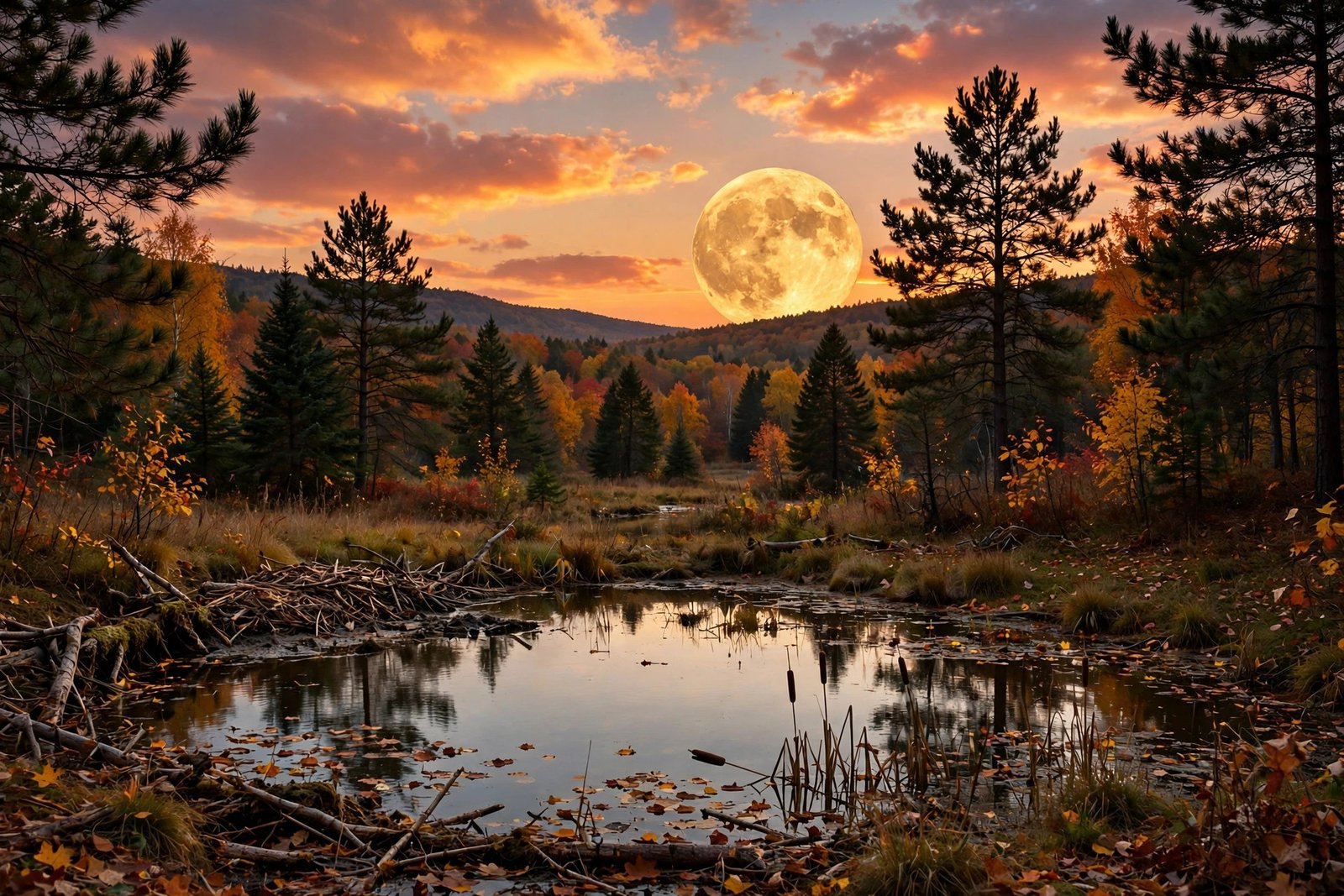
November brings one of the year’s most rewarding skywatching events to American skies. On Tuesday, November 24, 2026, the full Beaver Moon reaches its full phase in the morning, Eastern time, and it will rise on the evenings around that date looking large, bright, and golden near the horizon. According to the U.S. Naval Observatory, the full phase arrives at 9:53 a.m. Eastern Standard Time, which is 8:53 a.m. Central, 7:53 a.m. Mountain, and 6:53 a.m. Pacific. Because the exact moment falls during daylight for most of the United States, the best viewing comes the night before and the night after, when the Moon still looks essentially full to the naked eye.
This November full Moon also qualifies as a supermoon, a popular term for a full Moon that occurs near perigee, the point in the Moon’s orbit when it is closest to Earth. NASA explains that a supermoon can appear up to 14 percent larger and 30 percent brighter than a full Moon at its farthest point from Earth. That difference is subtle in the high sky but striking at moonrise, when the Moon hangs low over rooftops, trees, and open fields and seems enormous against familiar landmarks. It is the kind of night that rewards stepping outside, even for a few minutes, with a warm drink and a clear view of the eastern horizon.
The Beaver Moon is also perfectly timed for the Thanksgiving season. It arrives just two days before Thanksgiving Day, on November 26, 2026, so families gathering for the holiday can build a moonrise walk into the long weekend. Whether you watch from a city balcony, a suburban backyard, or a dark rural field, this guide explains the timing, the science, the name, and the simple tricks that make the night memorable.
When Exactly Is the Beaver Moon Full?
The full Beaver Moon reaches its exact full phase on November 24, 2026, at 9:53 a.m. Eastern Standard Time, according to the U.S. Naval Observatory. In Coordinated Universal Time, that is 14:53 UTC. The Moon does not suddenly switch on and off at that instant, though. It appears full for roughly a day on either side, and the nights of November 23 and November 24 offer the most rewarding views in the United States. On November 23, the Moon rises in the evening nearly full and climbs through the night. On November 24, it rises again, slightly past full but still brilliantly round to the eye.
If you can only pick one evening, choose the one with the clearer forecast and the more open eastern horizon. Moonrise times vary by location, so check a local forecast and a moonrise table for your town before heading out. In general, the Moon rises around sunset on the days near full Moon, which makes it easy to catch low in the sky while there is still a little twilight color left. That low position is exactly when the famous Moon illusion works its magic, making the Moon look much larger than it does overhead later in the night.
Perigee, the Moon’s closest approach to Earth for this cycle, falls about a day after the full phase, on November 25. That closeness is why this Moon counts as a supermoon under the commonly used definition, which treats a full Moon within 90 percent of perigee as a supermoon. The Moon will be roughly 360,800 kilometers from Earth at full phase, noticeably closer than its average distance. You do not need any equipment to enjoy it, but binoculars will reveal craters and the dark plains known as maria in wonderful detail.
Why Is It Called the Beaver Moon?
November’s full Moon is traditionally called the Beaver Moon, a name rooted in North American seasonal life. According to the Old Farmer’s Almanac tradition, the name reflects the time of year when beavers finish preparing for winter, building and repairing their lodges and storing food, and when trappers historically set traps before waters froze. It is a practical, working name from a time when the Moon’s cycle helped people track the seasons and plan essential work.
Many full Moon names come from similar traditions, recorded in almanacs and passed down through generations. January has the Wolf Moon, September has the Harvest Moon, and October has the Hunter’s Moon. November’s Beaver Moon sits naturally in that sequence: the harvest is in, the nights are longer, and animals and people alike are settling in for winter. The name is not an official astronomical designation, but it has become the familiar label used by skywatchers, almanacs, and news outlets across the country.
There is also a quiet poetry to the name. Beavers are among North America’s great builders, shaping wetlands that support birds, fish, and other wildlife. Watching the Beaver Moon rise over a pond or river where beavers actually live adds a layer of connection that a generic date on a calendar never could. If you live near a wetland or a park with beaver activity, a November evening walk can pair the Moon with the animal that gave it its name.
What Makes a Supermoon Look Bigger?
A supermoon is not a different kind of Moon. It is the same Moon, on the same orbit, caught at a moment when full phase lines up closely with perigee. The Moon’s orbit is not a perfect circle, so its distance from Earth changes throughout the month. At perigee it is closest; at apogee it is farthest. When full phase and perigee nearly coincide, the Moon appears slightly larger and brighter than an average full Moon, and noticeably larger than a full Moon at apogee, sometimes called a micromoon.
NASA’s often-quoted comparison says a supermoon can appear up to 14 percent larger and 30 percent brighter than a full Moon at its farthest point. That is a real but modest difference, and most people notice it most at moonrise, when the Moon illusion adds to the effect. The Moon illusion is a trick of human perception: a Moon near the horizon, seen next to trees, buildings, and hills, looks bigger than the same Moon high overhead against an empty sky. Photographers love this moment because a low Moon beside a landmark makes a dramatic picture, while astronomers remind us that the Moon’s actual angular size changes only slightly.
The honest way to enjoy a supermoon is to expect a beautiful, bright, slightly larger-than-usual Moon rather than a giant disc filling the sky. The real reward is the brightness: a supermoon lights up the landscape, casts soft shadows, and makes a night walk feel almost like daylight. Clouds permitting, it is one of the most accessible astronomical events of the year, requiring no telescope, no ticket, and no travel.
How to Watch the Beaver Moon in America
Start with the eastern horizon. On the evening of November 23 or 24, find a spot with a clear view to the east, away from tall buildings if you can. Arrive a few minutes before moonrise so your eyes can adjust and you can watch the Moon climb. A park, a lakeshore, a hilltop, or even an open parking lot with an eastern view can work well. If you live in a city, light pollution dims the stars but barely dents a bright full Moon, so urban viewing is still excellent.
Bring binoculars if you have them. Even small binoculars reveal the Moon’s craters, mountain ranges, and dark maria, and they turn a quick glance into a longer look. A telescope is wonderful but entirely optional. For photography, a phone can capture a lovely moonrise if you steady it against a railing or use a small tripod, and a camera with a zoom lens can frame the Moon beside a landmark. Expose for the Moon itself rather than the dark sky, or it will wash out into a white blob.
Dress for November. Much of the country will be chilly after sunset, so layers, gloves, and a warm drink make the difference between a five-minute peek and a relaxed half hour under the Moon. Check the weather forecast on the afternoon of your viewing night, and have a backup evening ready. The Moon stays more than 90 percent illuminated for several nights around full phase, so a cloudy November 24 does not mean you missed it.
What Else Is in the November Sky?
The Beaver Moon shares November with one of the year’s best-known meteor showers, the Leonids, which peak in mid-November. The Leonids are known for fast, bright meteors, and while a bright Moon washes out the faintest meteors, the shower is still worth watching in the darker hours before dawn, especially in the days before the Moon grows full. The Northern Taurids also peak in mid-November, adding a few slow, bright fireballs to the month’s sky.
Planets add to the show as well. In November 2026, Mars and Jupiter feature in the predawn sky, and Venus and other bright planets appear at various times depending on your location. A free stargazing app or a local planetarium’s monthly guide can help you identify them. The combination of a supermoon, meteor showers, and bright planets makes November one of the most rewarding months for casual skywatching, even for people who never think of themselves as astronomy fans.
For families, November skywatching is also a wonderful teaching moment. Children can learn why the Moon changes shape, why it sometimes looks orange near the horizon, and why different cultures gave the full Moons their names. A simple Moon journal, noting the Moon’s shape and position each evening for a week, turns one night’s viewing into a small science project that costs nothing.
Viewing Tips for the Best Experience
First, escape direct glare where you can. Streetlights and porch lights make your pupils shrink, so stepping into a darker spot, even a few steps away from a bright light, improves the view. Give your eyes ten to fifteen minutes to adapt, and avoid looking at your phone screen at full brightness. Second, look early. The Moon is most dramatic in the first hour after moonrise, when it is low, golden, and framed by the landscape. Later in the night it climbs higher and turns whiter, which is beautiful in its own way but less dramatic.
Third, share the moment. Moonrise is one of the few astronomical events that needs no explanation and no equipment, which makes it perfect for a neighborhood walk, a family gathering, or a quiet date. Finally, be patient with the weather. November skies can be fickle, and a thin cloud layer can actually make moonrise more beautiful, painting the Moon in soft halos and colors. If the sky is fully overcast, try again the next night; the Moon will still be nearly full and still worth the walk.
Related Reading
- How Many National Parks Does America Have? The 63 Explained
- Great Sand Dunes National Park: Colorado’s Hidden Gem
- Why America Has Six Time Zones, Explained
Frequently Asked Questions
Q: When is the Beaver Moon full in November 2026?
The full Beaver Moon arrives on Tuesday, November 24, 2026, at 9:53 a.m. Eastern Standard Time, according to the U.S. Naval Observatory. The best evenings to view it in the United States are November 23 and November 24.
Q: Is the November 2026 Beaver Moon a supermoon?
Yes. The full Moon occurs close to perigee, the Moon’s closest point to Earth, so it qualifies as a supermoon under the commonly used definition. NASA notes a supermoon can appear up to 14 percent larger and 30 percent brighter than a full Moon at its farthest point.
Q: Why is November’s full Moon called the Beaver Moon?
The traditional name reflects the season when beavers prepare for winter and when trapping historically took place before waters froze, according to almanac tradition.
Q: Do I need a telescope to see the Beaver Moon?
No. The full Moon is easily visible with the naked eye, and binoculars will show craters and surface detail. A telescope is optional.
Q: What if it is cloudy on November 24?
Try the next night. The Moon stays more than 90 percent illuminated for several nights around full phase, so a cloudy evening does not mean you missed the show.