
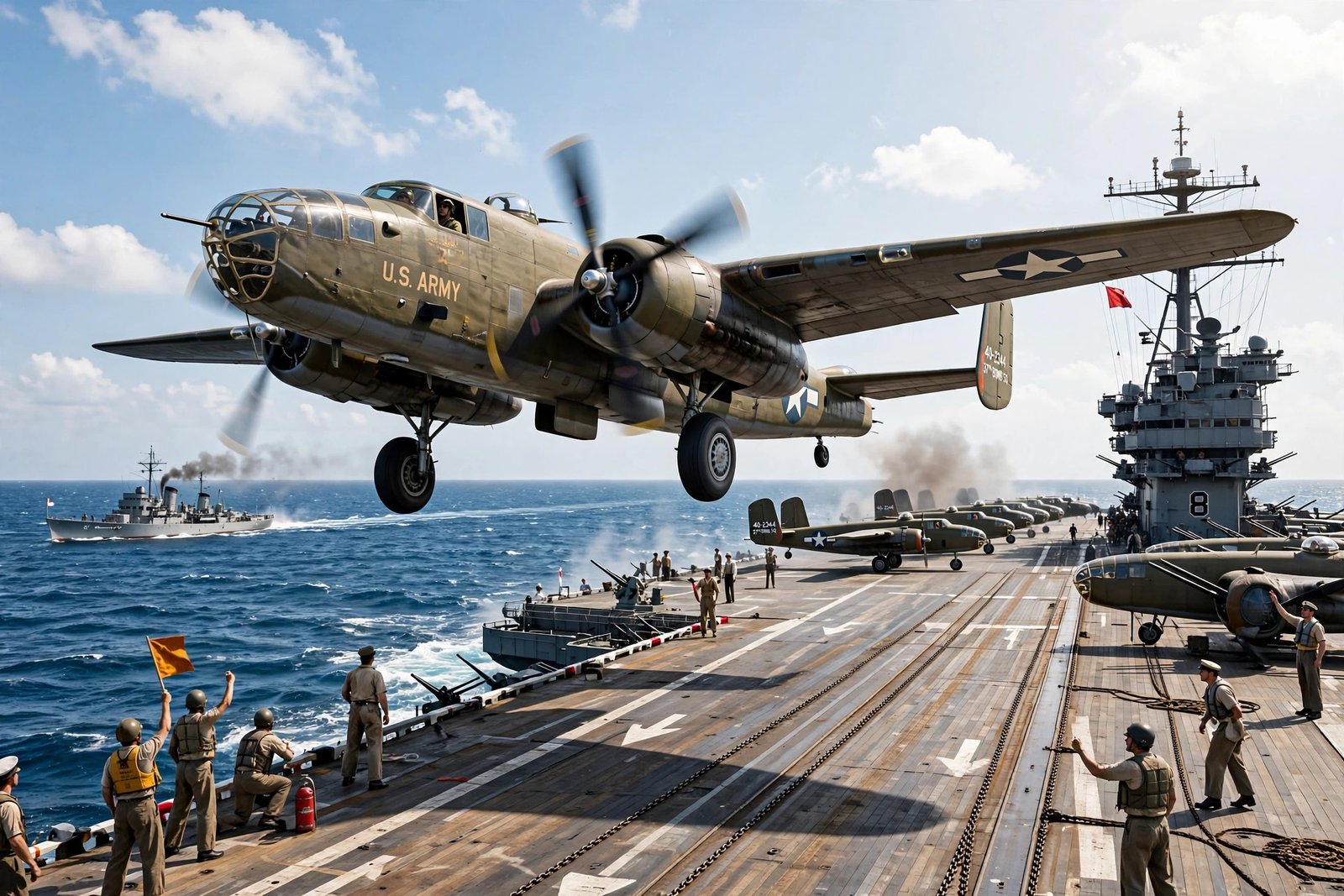
On the morning of April 18, 1942, sixteen American bombers roared off the deck of an aircraft carrier in the middle of the Pacific and flew toward Japan. No bomber had ever taken off from a carrier to strike an enemy capital before, and most of the men aboard did not expect to come home. Their planners called it a one-way trip: bomb Tokyo, keep flying west into China, and hope to land somewhere friendly before the fuel ran out. The raid did very little physical damage — around 50 people killed on the ground. But it changed the war all the same: it proved Japan was not untouchable, gave a battered America something to cheer, and rattled Japan’s leadership into decisions that led, six weeks later, to disaster at Midway.
The raid was named for the man who planned and led it: Lieutenant Colonel James H. Doolittle, a famous aviator and one of the most daring pilots of his generation. The eighty airmen who flew with him became known as the Doolittle Raiders. This is the story of how they did it — and what it cost.
America Needed a Win
By the spring of 1942, the war in the Pacific was going very badly for the United States. Japan had attacked Pearl Harbor on December 7, 1941, sinking or damaging much of the battleship fleet. In the four months that followed, Japanese forces swept across Southeast Asia, taking Hong Kong, Singapore, the Philippines, and the Dutch East Indies. American and British troops were retreating everywhere, and at home, Americans wanted to know when their country would hit back.
President Franklin D. Roosevelt wanted the same thing, and he pressed his military chiefs for a way to strike Japan itself — not just its armies in the field, but the home islands. The problem was distance: Japan was thousands of miles from the nearest American air base, far beyond the range of any bomber. The only way to get a bomber within reach of Tokyo was to carry it there by sea, on an aircraft carrier. But the bombers of the day were land-based aircraft, too large and heavy to operate from a carrier deck. Taking off was hard enough; landing a big bomber back on one was impossible.
The idea was, on its face, absurd: load medium bombers onto a carrier, launch them at Japan, and have them fly on to China instead of trying to come back. Admiral Ernest J. King, the Navy’s commander-in-chief, asked staff officer Captain Francis Low to look into it. Low turned to Captain Donald Duncan, who studied the performance data of every American bomber and settled on the B-25 Mitchell, a twin-engine medium bomber small enough, just barely, to take off from a carrier deck.
The Impossible Idea Takes Shape
The plan was assigned to Lieutenant Colonel James Doolittle, and the name stuck. Doolittle was a celebrated racing pilot who had set speed records in the 1920s and 1930s, and he held a doctorate in aeronautical engineering from MIT. He understood both the flying and the physics, and he was known for calm under pressure and for leading from the front.
The plan called for sixteen B-25B Mitchell bombers, each with a crew of five, to be loaded onto the flight deck of the carrier USS Hornet. The carrier would steam to within a few hundred miles of Japan under the protection of a task force — the Hornet and the carrier USS Enterprise, commanded by Vice Admiral William Halsey, with cruisers and destroyers screening them. The bombers would launch at night, strike military and industrial targets in Japan, and continue west to airfields in China. There would be no fighter escort and no second wave — and no way home for the planes, which would be abandoned in China after landing.
The bombers needed extensive modification. The B-25s were fitted with extra fuel tanks, carrying 1,141 gallons — about 60 percent more than normal — to give them the range for the flight to China. The ventral gun turret was removed to save weight, and an autopilot was added. Each bomber carried four 500-pound bombs, or three high-explosive bombs and a cluster of incendiaries. The crews were volunteers from the 17th Bombardment Group at Pendleton Field in Oregon, told almost nothing about the mission. They knew only that it was dangerous, secret, and important — and that was enough.
Training in Secret
The crews trained at Eglin Field in Florida, learning to take off in an impossibly short distance. A normal B-25 needed a long runway, but on the Hornet‘s deck Doolittle’s pilots would have just 467 feet, with the deck pitching and rolling in the Pacific swell. They practiced again and again, taking off from a painted outline of a carrier deck, until they could lift a fully loaded bomber into the air in the space available. Too slow and the plane would drop into the sea; too fast and it would run out of deck.
On February 3, 1942, Doolittle and Captain Low proved the concept was real, launching two B-25s from the Hornet‘s deck off Norfolk, Virginia. The mission was on. On April 1, sixteen modified B-25s were loaded onto the Hornet at Naval Air Station Alameda, and the next day the carrier steamed out of San Francisco Bay under cover of heavy fog. The crews spent the voyage studying maps and target photographs.
Meanwhile, the task force assembled. The Hornet linked up with Halsey’s force from Pearl Harbor, built around the Enterprise, on April 13. Together the two carriers, four cruisers, eight destroyers, and their oilers steamed west in radio silence, toward a launch point a few hundred miles east of Japan. The plan was to launch at night, so the bombers would arrive over Japan under cover of darkness.
The Picket Boat That Changed Everything
At about 3:10 a.m. on April 18, radar operators on the Enterprise detected a Japanese picket boat far outside the expected patrol area. Then, at 7:38 a.m., the patrol craft Nitto Maru spotted the task force and radioed a warning to Tokyo before the cruiser USS Nashville sank it. The secret was out: the Japanese now knew American carriers were nearby, and the task force could expect attack at any moment.
Doolittle and the Hornet‘s commanding officer, Captain Marc Mitscher, faced a terrible choice: turn back, or launch immediately, in daylight, far further from Japan than planned. The Hornet was still about 650 nautical miles from Japan — roughly 170 nautical miles further out than planned — and the launch would come about ten hours early. The bombers would have to fly further, burn more fuel, and arrive over Japan in daylight, then fly on to China in darkness with almost no fuel to spare.
Doolittle did not hesitate. At 8:20 a.m., he taxied his own bomber to the front of the flight deck, ran the engines up against the brakes, and released them. The plane roared down the rain-slicked deck, lifted off with feet to spare, and climbed into the gray sky. Behind him, fifteen more bombers followed at intervals of about four minutes. By 9:20 a.m., all sixteen were airborne — and no pilot among them had ever launched from a carrier before that morning. The Hornet turned for home. The bombers flew on toward Japan.
Over Tokyo
The bombers arrived over Japan around noon, Tokyo time, six hours after launching. Thirteen of the sixteen were assigned to targets in Tokyo: an oil refinery, ironworks, shipyards, and factories that fed Japan’s war effort. The others were sent to Yokohama, Yokosuka, Nagoya, Kobe, and Osaka. The crews had been ordered to avoid civilian targets, especially the Imperial Palace complex in central Tokyo.
The Japanese were caught completely by surprise. Air raid sirens sounded, but many people on the ground at first mistook the low-flying American bombers for Japanese aircraft on a training exercise. The bombers came in low, at about 1,500 feet, and dropped their loads in quick, accurate runs. Anti-aircraft fire was heavy but poorly aimed, and Japanese fighters scrambled too late. The raiders shot down three Japanese planes, and all sixteen bombers dropped their bombs and escaped — not one was shot down over Japan.
But the damage was small. The raid killed around 50 people on the ground and injured about 400. Factories were hit, a nearly completed aircraft carrier was damaged, and a handful of patrol boats were sunk — but Japanese engineers repaired the damage within days. By any military measure, the raid was a pinprick: sixteen bombers carrying fewer than fifty tons of bombs could not hurt an industrial power like Japan. Its real effect was not on Japan’s factories. It was on Japan’s mind.
The Long Night in China
After bombing their targets, the crews turned west for China, and the mission nearly became a catastrophe. The early launch had burned their fuel margins to nothing. The bombers flew into the night in bad weather, with empty tanks and no radio guidance to the Chinese airfields. One by one, they ran out of fuel over the coast of China. Fifteen of the sixteen planes crashed or were abandoned as their crews bailed out. The sixteenth, unable to reach China, landed at Vladivostok in the Soviet Union, where its crew was interned — the Soviets were not at war with Japan and could not let them go. Those five men eventually escaped through Iran, months later.
Of the eighty airmen, three were killed in the crashes and bailouts. Eight were captured in China: three were executed, one died of disease in captivity, and the other four survived until rescued at the end of the war. The remaining sixty-nine were found and sheltered by Chinese villagers and guerrillas, who risked their lives to hide them, feed them, and guide them to safety. Doolittle himself landed in a rice paddy, unhurt, and at first believed the mission had been a total failure — he thought he would be court-martialed for losing all sixteen planes. Instead, he learned he had been promoted to brigadier general and awarded the Medal of Honor.
The Cost — and the Price China Paid
The human cost did not end with the airmen. The Japanese military was furious and humiliated, and it blamed the Chinese for helping the raiders escape. In the months after the raid, Japanese forces launched a brutal campaign of retaliation across Zhejiang and Jiangxi, where the raiders had landed. Villages that had sheltered Americans were burned, and civilians were massacred. The Museum of Aviation Foundation reports that as many as 250,000 Chinese people were killed — a staggering price, paid by people who had done nothing more than hide a stranger and share a meal, and the darkest part of the Doolittle Raid’s story.
What the Raid Actually Changed
If the raid did little physical damage, why does it matter so much? Wars are fought in minds as well as on battlefields, and the Doolittle Raid changed minds on both sides. For Americans, it was the first good news of the war — proof that the United States could strike the enemy’s capital, just four months after Pearl Harbor. President Roosevelt, asked where the bombers had come from, joked that they had launched from “Shangri-La,” the mythical kingdom from Lost Horizon. The name stuck.
For Japan, the raid was a shock and an embarrassment: leaders had assured the public the home islands were safe, and now American bombers had flown over the capital in daylight. The high command pulled fighter groups back to defend the home islands — Britannica notes that four army fighter groups were kept in Japan during 1942 and 1943, when they were badly needed in the South Pacific — and pushed the empire’s defensive perimeter further out. That overreach helped draw Japan into the Battle of Midway in June 1942, just six weeks later, where the loss of four carriers shifted the balance of the Pacific war in America’s favor.
The most extensive collection of Doolittle Raid memorabilia is at the National Museum of the United States Air Force in Dayton, Ohio, where a restored B-25 painted in Doolittle’s markings stands in a diorama of the Hornet‘s deck. The museum also holds the raiders’ famous silver goblets — eighty engraved cups, one for each man, from which the survivors drank at every reunion, turning one upside down for each comrade who had died. The last surviving raider, Lieutenant Colonel Richard Cole, Doolittle’s co-pilot, died in 2019 at the age of 103.
Frequently Asked Questions
When was the Doolittle Raid?
April 18, 1942, just over four months after the Japanese attack on Pearl Harbor. It was the first American air operation to strike the Japanese home islands during World War II.
How many planes and men took part in the Doolittle Raid?
Sixteen B-25B Mitchell bombers took part, carrying eighty airmen — five per plane. All sixteen planes were lost: fifteen crashed in China after running out of fuel, and one landed at Vladivostok, where its crew was interned. Three airmen were killed, eight captured, and the rest reached safety with the help of Chinese villagers.
Why was the Doolittle Raid launched early?
The task force was spotted by the Japanese picket boat Nitto Maru, which radioed a warning to Tokyo before being sunk. Doolittle ordered an immediate launch, about ten hours early and roughly 170 nautical miles further from Japan than planned, because waiting would have meant discovery and attack. The early launch is why the bombers ran out of fuel over China.
How much damage did the Doolittle Raid cause?
Very little. The raid killed around 50 people on the ground and injured about 400, and the damage was repaired within days. Its importance was psychological and strategic: it boosted Allied morale, embarrassed Japan’s leadership, and forced Japan to keep fighter groups at home and push its defensive perimeter outward — decisions that helped lead to the defeat at Midway.
What happened to the Doolittle Raiders after the war?
Doolittle was promoted to brigadier general and awarded the Medal of Honor. The surviving raiders held reunions for decades, drinking from eighty silver goblets engraved with their names and turning one upside down for each man who died. The last surviving raider, Richard Cole, died in 2019 at age 103. The goblets are on display in Dayton.
Related reading
For more Army stories on Trending 4, read the Battle of Midway, the Pacific turning point, the story of the Iwo Jima flag raising explained, and the Tuskegee Airmen, the Red Tails of World War II.