
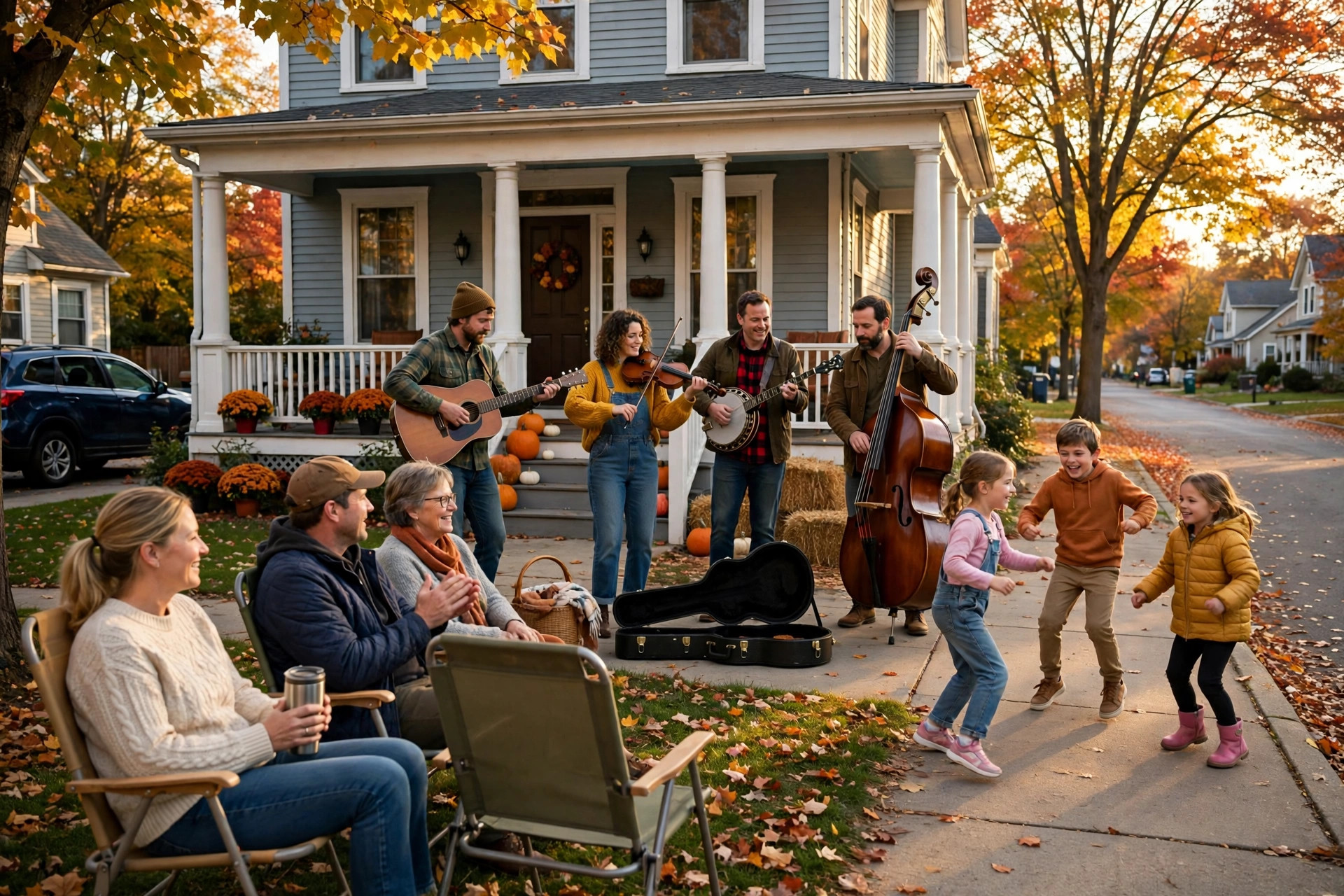
On a Sunday afternoon each fall in Ithaca, New York, something quietly radical happens. The streets of the Fall Creek and Northside neighborhoods fill with thousands of people strolling, biking, and pushing strollers — and from more than a hundred front porches comes music. A string quartet on one block. A teenage rock band on the next. A Filipino ensemble, a funk band, a lone singer with a ukulele. No tickets, no gates, no headliners, no fences. Just porches, neighbors, and songs.
This is Porchfest, and from that one neighborhood in 2007 it has spread to hundreds of communities across the United States, Canada, and even Australia — making it one of the most successful grassroots festival ideas in American history. But Porchfest is really the revival of something older: porch culture itself, the distinctly American tradition of the front porch as a home’s public room. To see why a festival of porches conquered the country, you first have to understand what the porch meant, what America lost when it faded, and why people are so eager to get it back.
The Rise of the American Front Porch
The wide front porch is one of America’s great architectural inventions. Its ingredients were global — verandas from colonial trade, gallery porches from the Caribbean and the Gulf South, Italianate and Victorian pattern books — but the synthesis was American, and in the nineteenth century it swept the country. This was practical design before air conditioning. A deep porch shaded a house’s walls and windows, caught breezes, and gave families a place to sleep, shell peas, cool pies, and escape summer heat in the decades when the alternative was a stifling interior. In the South especially, the porch was not an amenity. It was the only comfortable room in the house for months of the year.
But the porch quickly became social infrastructure. Set between the street and the parlor, it was a semi-public stage: private enough to sit in a rocker in your shirtsleeves, public enough to greet every passerby. Courtships were conducted on porch swings under family supervision. Neighbors “visited” porch to porch in the evening. News, gossip, music, and politics all flowed across the porch rail. On porches, Americans quite literally watched their neighborhoods happen, and the neighborhood, knowing it was watched, behaved — and belonged — accordingly. The porch was where a house kept its membership in the community.
How America Left the Porch
The twentieth century dismantled that world piece by piece, mostly with inventions nobody regrets. The automobile moved the street’s life from walkers to drivers and made front yards noisy and dusty; new houses turned their faces away, putting garages forward and living space in back. Air conditioning, spreading after World War II, removed the porch’s climatic purpose — why sit outside in the heat when the inside could be 72 degrees? Television moved evening entertainment indoors. The backyard deck and patio privatized outdoor life: families still sat outside, but behind the house, among themselves, invisible to the street.
Architects and urbanists noticed what was being lost. The New Urbanist movement of the 1980s and 1990s deliberately revived the front porch in new developments, mandating porches close to sidewalks precisely to recreate the casual surveillance and sociability porches once provided. Older neighborhoods that had kept their porches — often the walkable, pre-war streetcar suburbs — became some of the most desirable real estate in America. The market delivered its verdict: people pay premiums to live where porch life is possible. What remained was to give that life an occasion.
Ithaca, 2007: Two Neighbors and a Ukulele
The founding story of Porchfest is charmingly small, which is the point. In Ithaca’s Fall Creek neighborhood, resident Lesley Greene played ukulele on her front porch. Her neighbor Gretchen Hildreth, passing by, fell into conversation about how many musicians lived in the neighborhood and how rarely anyone heard them. The idea they hatched was simple enough to fit in one sentence: for one afternoon, local musicians would play on local front porches, and everyone would wander from house to house listening.
The first Ithaca Porchfest took place in 2007 with about twenty performers. The founders were unsure musicians would sign up or audiences would come; both did, in numbers that surprised everyone, and it was immediately obvious the idea had tapped something deep. Ithaca’s event has grown to well over 100 porches and around 170 acts in recent years, drawing thousands of visitors each September, staffed by dozens of volunteers, with street closures, food trucks, and an open-band policy — anyone may perform, regardless of age, genre, or experience. The official Ithaca site tells the founding story at porchfest.org, and a broader account of the movement’s growth is in the Porchfest overview.
How Porchfest Spread to Hundreds of Towns
Porchfest had every advantage a grassroots idea can have. It cost almost nothing to copy: no venue to rent, no stage to build, no tickets to sell, and porches — the infrastructure — already existed. It scaled naturally, from one street to a whole neighborhood. It flattered everyone involved: homeowners became venue patrons, amateur musicians became festival acts, and audiences became explorers of their own towns. And the founders in Ithaca encouraged imitation rather than guarding the name, pointing other communities to try it.
They did. Within a decade there were well over a hundred Porchfests; recent counts by the Ithaca organizers and national coverage put the number at more than 250 annual events in the United States, with new ones launching constantly. Somerville, Massachusetts, began its PorchFest in 2011. Others followed from Buffalo and Rochester to Kansas City, Chicago’s suburbs, San Francisco, Washington, D.C., and hundreds of smaller towns — each adapting the template: a spring or fall weekend afternoon, a printed or online map and schedule, porch hosts and performers matched up by volunteers, neighbors selling lemonade, and streets returned to pedestrians for a day. In 2019 the idea crossed an ocean, with an inaugural Porchfest in Morpeth, Australia. AARP’s guide to the phenomenon, “A Music Festival Without the Hassles,” captures why older audiences in particular have embraced it: the music comes to your neighborhood, the pace is gentle, and the whole thing is, in one performer’s words, totally chill.
The variety is the headline act. A single Porchfest afternoon can contain classical quartets, bluegrass pickers, high school jazz combos, indie bands, Latino ensembles, church choirs, spoken-word poets, and a family band whose youngest member is seven. Some Porchfests have added dancers, storytellers, and visual art installations. Because performers choose or are matched to porches they have some connection to — a friend’s house, their own street — the festival feels less like a concert series than like the neighborhood revealing, all at once, talents it had kept politely hidden behind closed doors.
Why It Works: The Porch Is the Point
Strip away the music and Porchfest is a machine for manufacturing the thing modern American life is shortest on: weak ties — the friendly acquaintances, nodding relationships, and familiar strangers that sociologists credit with making neighborhoods safe, resilient, and happy. You cannot attend a Porchfest without meeting people who live three streets away and whom you have somehow never spoken to. You learn the names of dogs. You see the inside of front yards you have passed a thousand times. Children experience their neighborhood as a festival ground, and file that away as what home means.
The porch is the perfect technology for this because it is a threshold — not the street’s full exposure, not the house’s full privacy. Performers are elevated a few feet, literally on a stage the architecture built for free. Audiences stand on the sidewalk and lawn, in public, welcome to stay or wander on. Nobody is a customer; there is nothing to buy a ticket for, and therefore nobody to exclude. In an era when live music increasingly means arenas, dynamic pricing, and phone screens held overhead, Porchfest proposes the radical opposite: the best seat is a curb, the artists are your neighbors, and the show ends in time for dinner.
Timing helped, too. The pandemic years taught Americans the cost of isolation and the value of outdoor, local, low-barrier gathering; Porchfests were among the first festivals to return, in some places adapted with distanced lawns, and new ones sprouted in towns hungry to rebuild community muscle. Remote work, similarly, returned millions of people to their neighborhoods during daylight hours, where some discovered — perhaps to their surprise — that the neighborhood was interesting.
Start One, or Just Sit on the Porch
Perhaps the most Porchfest thing about Porchfest is that you do not need permission to join the movement. The Ithaca organizers publish guidance for new festivals, and the standard recipe is within reach of any neighborhood association or handful of volunteers: pick a walkable area rich in porches, choose a pleasant weekend afternoon, recruit hosts and musicians with a simple signup, publish a map and schedule, arrange any needed street closures with the city, and let the porches do the rest. Towns with no festival tradition have launched successful Porchfests in a single season of organizing.
But the deeper invitation of the porch revival does not require a festival at all. It is the older, daily practice: sit out front, in the evening, where the neighborhood can see you and stop by. Rock a little. Wave. The musicians of Fall Creek did not invent porch culture; they reminded America it was still there, waiting under the porch roofs of a million houses, needing only an occasion. Porchfest gave it a date on the calendar. The rest of the year, the porch is open whenever you are.