
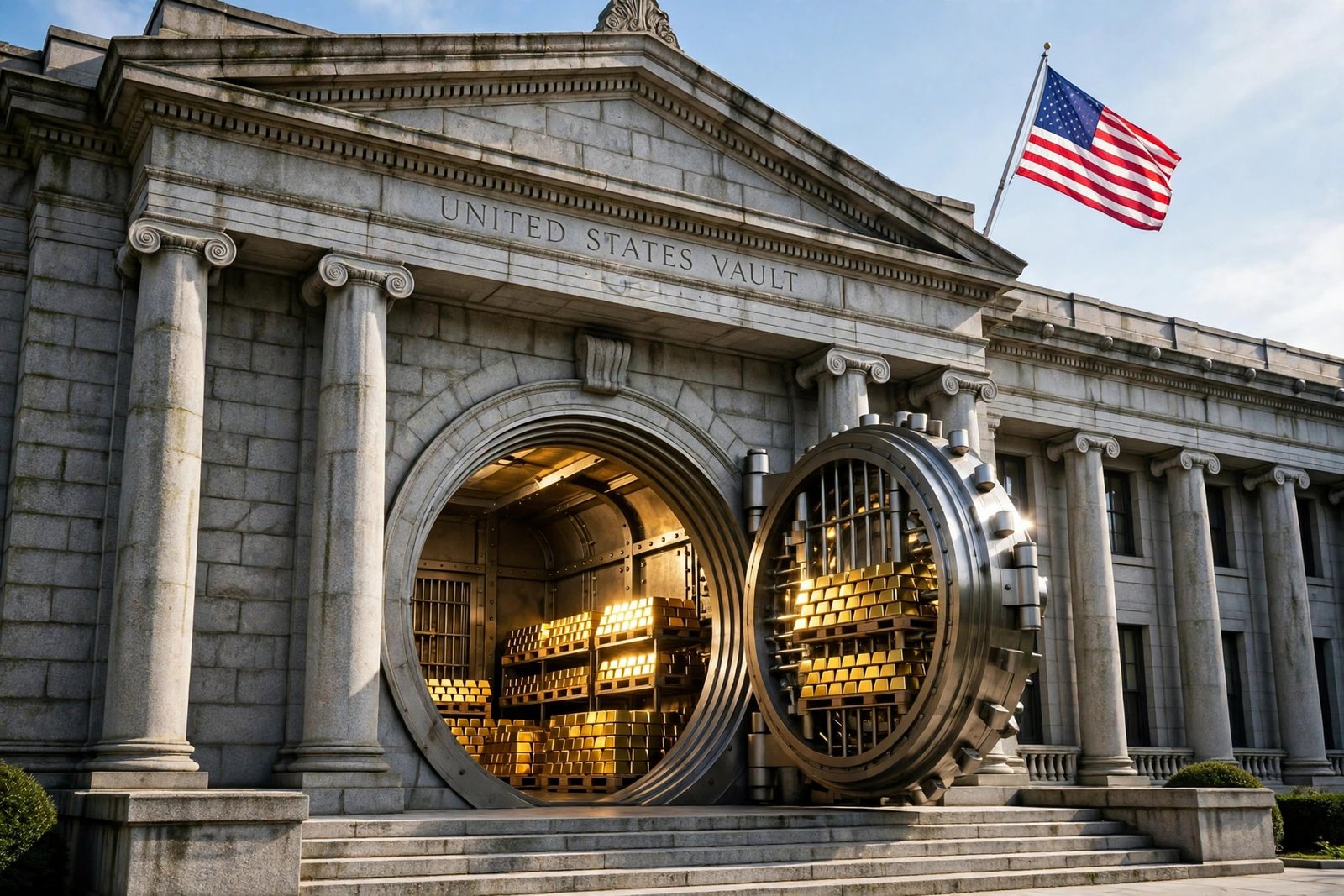
There is no building in America more synonymous with security than the vault at Fort Knox. The phrase “locked up like Fort Knox” is shorthand for impregnable, and the United States Bullion Depository in Kentucky has earned that reputation. It holds a large portion of the nation’s gold reserves, it is guarded by the United States Mint Police and ringed by fences within an Army post, and it has been opened to outsiders only a handful of times in nearly ninety years. Yet the real story of Fort Knox is more interesting than the myth, involving the Great Depression, a secret gold move, wartime treasures, and a vault that still holds billions in bullion.
The depository was built in 1936 on land transferred from the Army post of Fort Knox, Kentucky, and its first gold arrived in early 1937. Today it holds about 147.3 million troy ounces of gold bullion, roughly 4,580 metric tons, a little over half of the gold held by the federal government. The building itself is modest in size, just two stories tall, but its construction, granite, steel, and concrete, and its security have made it a symbol of American financial power around the world.
This article explains why Fort Knox was built, what it holds, what else it has protected, and why it still matters, separating documented history from the legends that surround it.
Why America Needed a Fort Knox
The story begins with the Great Depression and the end of the gold standard as Americans knew it. In 1933, President Franklin D. Roosevelt issued Executive Order 6102, which required most Americans to surrender gold coins, bullion, and certificates to the Federal Reserve in exchange for $20.67 per troy ounce. The federal government’s gold holdings grew dramatically as a result, from about $4 billion to about $12 billion between 1933 and 1937, and the government needed a secure place to store it.
At the time, much of the nation’s gold was kept in New York City and Philadelphia, coastal cities that military planners considered vulnerable to foreign attack. The Treasury wanted an inland location, far from either coast, within an established military reservation, and protected by the most modern methods available. Fort Knox, Kentucky, an Army post established as a training camp in 1918 and made permanent in 1932, fit the bill. In June 1935, the Treasury announced its plan to build a depository there, and construction began in 1936 on land transferred from the military.
The building was completed in December 1936 at a cost of $560,000, a figure that would be more than $10 million in today’s dollars by some estimates. Its exterior measures about 105 feet by 121 feet, its height is 42 feet above ground, and its construction used 16,000 cubic feet of granite, 4,200 cubic yards of concrete, 750 tons of reinforcing steel, and 670 tons of structural steel. It was placed under the jurisdiction of the Director of the United States Mint, and the United States Mint Police were charged with guarding it.
The Secret Gold Trains of 1937 and 1941
The first gold shipments to Fort Knox were made in secret, semi-weekly, between January 11 and June 17, 1937, overseen by the Post Office Department. The first deposit, on January 13, 1937, consisted of gold bars from the Philadelphia Mint. Unlike an earlier, theatrical transfer of gold from San Francisco to Denver, the Fort Knox transfers were kept quiet, with trains moving under guard and without fanfare. Between January and June 1937, dozens of train loads moved gold to the new vault.
A second wave followed in 1941, and together the two shipments totaled roughly 417 million troy ounces, almost two-thirds of the total gold reserves of the United States at the time. Gold holdings at Fort Knox peaked during World War II at more than 20,000 metric tons, or about 649 million troy ounces, before declining in later decades as gold was sold or transferred. Today, the depository holds about 147.3 million troy ounces, stored as roughly 368,000 standard 400-ounce bars.
The sheer scale of the move is hard to grasp. Gold is dense and heavy, and moving hundreds of millions of ounces by rail required careful planning, armed guards, and absolute secrecy. The trains ran on schedules that were not publicized, and the gold was loaded and unloaded under tight security. It was, in its way, one of the largest logistical operations of the decade, and it succeeded without incident.
More Than Gold: Wartime Treasures in the Vault
During World War II, the Fort Knox vault held more than gold. For protection, the government stored there the signed originals of the Declaration of Independence and the Constitution, the Articles of Confederation, Lincoln’s Second Inaugural Address and drafts of the Gettysburg Address, a Gutenberg Bible, and an exemplified copy of the Magna Carta. These documents, among the most precious in American and world history, were kept in the vault until the war ended and they could be safely returned.
The choice made sense. Fort Knox was inland, fortified, and guarded, and its vault was considered one of the most secure rooms in the country. The documents were stored in a specially prepared case, protected from fire, flood, and theft, while the war raged overseas. Their presence in the vault is a reminder that Fort Knox was never just a bank; it was a fortress for the nation’s treasures, in every sense of the word.
After the war, the documents returned to Washington, where they are now displayed at the National Archives. The vault returned to its primary mission, holding gold, but the wartime episode remains one of the most fascinating chapters in its history, and a favorite story for guides and historians.
Inside the Vault: What We Know and What We Don’t
Fort Knox is famously secretive, and that secrecy has fueled decades of speculation. The depository is not open to the public, tours are not offered, and photography of the interior is rare. What is publicly known is that the vault is a two-level structure with a massive door, that the building is ringed with fences, and that the Mint Police, supported by the Army post that surrounds it, provide security. The vault’s compartments are secured in ways that require multiple people to open, so no single person can access the gold alone.
The vault has been opened to outsiders only twice in its history. On September 23, 1974, a congressional delegation and a group of journalists were allowed inside, in response to rumors that the gold was gone. On August 24, 2017, Treasury Secretary Steven Mnuchin, Kentucky Governor Matt Bevin, and congressional representatives visited the vault. Both visits confirmed that the gold was present, and both were widely reported. The Treasury’s Office of Inspector General also conducts ongoing partial audits of the holdings.
Despite those visits, theories persist that the gold has been sold, swapped, or replaced. There is no credible evidence for those claims, and the audits, the book value accounting, and the physical inspections all point to the same conclusion: the gold is there, held at a statutory book value of $42.22 per troy ounce, a figure set by law that is far below the market price of gold. That accounting quirk, the difference between book value and market value, is itself a source of confusion, since the gold’s market value is far higher than its book value.
Why Fort Knox Still Matters
Fort Knox matters for three reasons. First, it holds real wealth: about half of the federal government’s gold, a reserve that underpins confidence in the nation’s finances even though the dollar is no longer backed by gold. Second, it is a symbol: the idea of Fort Knox, impregnable and incorruptible, reassures Americans and the world that the nation’s reserves are safe. Third, it is a piece of history, listed on the National Register of Historic Places in 1988 for its significance in the economic history of the United States.
The depository also anchors the Army post that shares its name. Fort Knox, Kentucky, is a major Army installation with its own history, including its role as a training center and, for many years, the home of the Army’s armor school. The post and the depository are separate, but they share a name and a landscape, and the Army’s presence adds a layer of protection to the Treasury’s vault.
For visitors, Fort Knox itself cannot be toured, but the surrounding area offers alternatives. The General George Patton Museum at Fort Knox, when open, tells the story of armor and cavalry, and the town of Elizabethtown and the city of Louisville, both within driving distance, offer museums, restaurants, and bourbon-country attractions. The vault may be closed, but its story is open to anyone willing to read it.
Related Reading
- US Aircraft Carriers: Sea Power Explained
- Hoover Dam: Engineering Power for America
- The Interstate Highway System: Surprising Facts
Frequently Asked Questions
Q: How much gold is in Fort Knox?
As of 2025, the depository holds about 147.3 million troy ounces of gold bullion, roughly 4,580 metric tons, a little over half of the gold held by the federal government.
Q: When was the Fort Knox depository built?
The United States Bullion Depository was built in 1936 and completed in December of that year, at a cost of $560,000.
Q: Can I tour Fort Knox?
No. The depository is not open to the public and tours are not offered. It has been opened to outsiders only twice, in 1974 and 2017.
Q: Did Fort Knox hold the Declaration of Independence?
Yes, during World War II. The signed originals of the Declaration of Independence and the Constitution, among other documents, were stored in the vault for protection.
Q: Is Fort Knox an Army base?
Fort Knox is an Army post, and the Bullion Depository is a separate Treasury facility located on land within the post’s area. The Mint Police guard the depository, with the Army providing additional protection.