
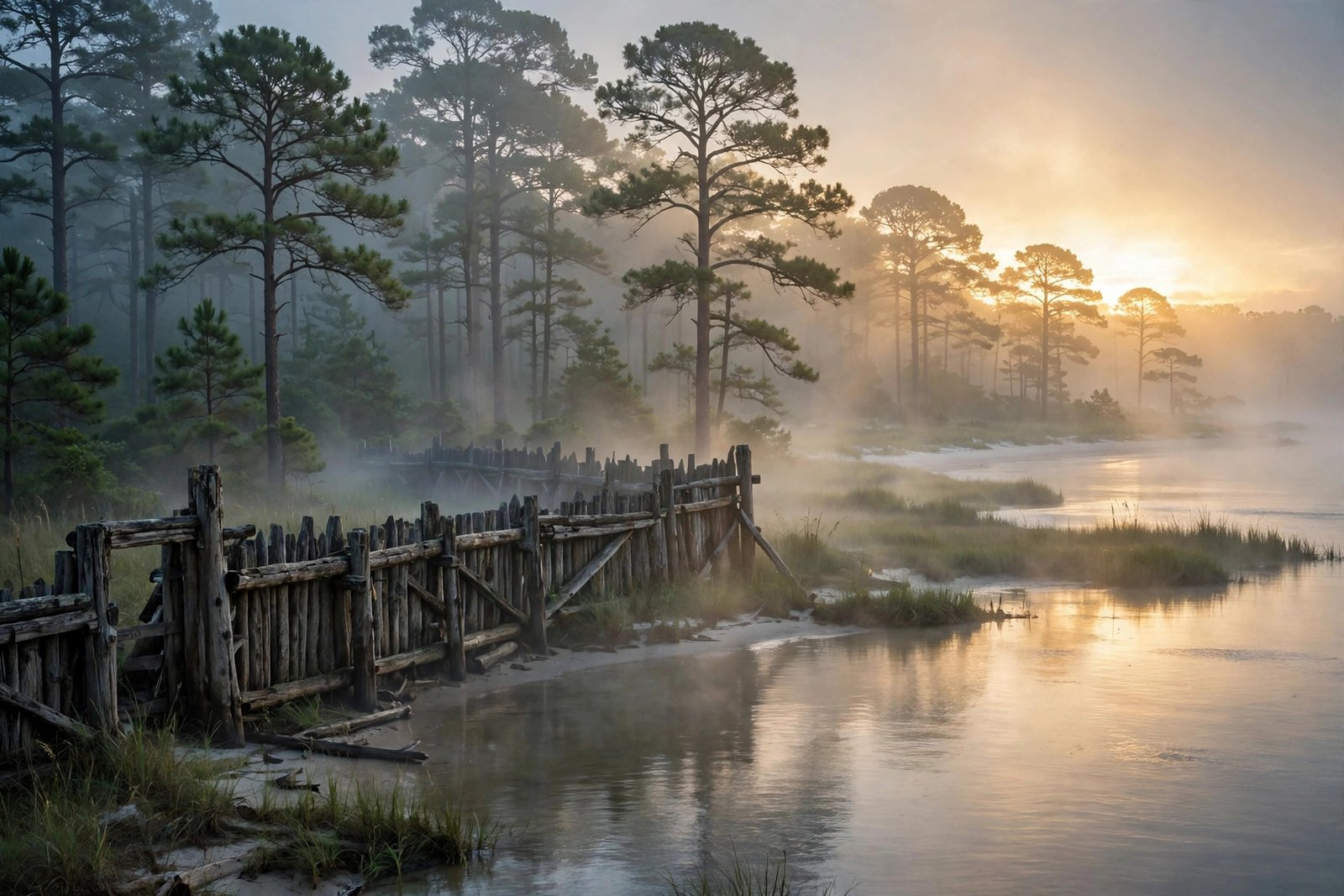
In August 1590, an English artist named John White stepped ashore on Roanoke Island, off the coast of what is now North Carolina, expecting to find his family. He had left them there three years earlier: his daughter Eleanor, her husband Ananias Dare, and his granddaughter Virginia, the first child of English parents born in the Americas. Instead, White found an empty settlement, its houses dismantled, its fence standing, and a single word carved into a wooden post in large capital letters: CROATOAN.
Nobody was there to explain it. No bodies, no graves, no signs of a battle. More than four centuries later, the fate of those roughly 115 men, women, and children — the Lost Colony of Roanoke — remains America’s oldest unsolved mystery. It has inspired plays, novels, television shows, and countless theories, from the plausible to the wild. Yet the real story, pieced together from White’s own writings, archaeology, and the history of the Native peoples of the Carolina coast, may be quieter and more human than the legend suggests.
England’s First Try at America
The Roanoke story begins with Sir Walter Raleigh, a courtier and favorite of Queen Elizabeth I, who held a royal patent to plant an English colony in North America. Raleigh never sailed to America himself, but he financed the voyages. The first attempt, in 1585, landed about a hundred men on Roanoke Island under Governor Ralph Lane. That colony struggled: supplies ran short, relations with local Native communities deteriorated, and when Sir Francis Drake stopped by in June 1586 offering passage home, Lane’s men took it. The first colony, in the National Park Service’s words, ended in disorder.
Before leaving, Lane’s men had a final mishap. Three of his men were away on an expedition when Drake sailed, and they were left behind. A relief fleet under Sir Richard Grenville arrived days later, found the island empty, and left about fifteen men to hold the site before sailing home. Those men, too, were never seen again. They were, in a sense, the original lost colonists — a warning of how unforgiving the Carolina coast could be.
The 1587 Colony: A Different Kind of Settlement
Raleigh tried again in 1587, but this time the plan was different. Instead of a military outpost of soldiers, the new colony would be a civilian settlement of families — men, women, and children who intended to stay, farm, and build a town called the Cittie of Raleigh. On January 7, 1587, Raleigh granted a corporate charter for the settlement, naming John White as governor. White was an artist and mapmaker who had traveled on the 1585 voyage and painted remarkable watercolors of Algonquian villages, plants, and animals.
The expedition that sailed in the spring of 1587 carried roughly 115 to 117 people, including White’s pregnant daughter Eleanor Dare and her husband Ananias. Also aboard was Manteo, an Algonquian man from Croatoan who had traveled to England and become a close ally of the English. The plan was to settle on Chesapeake Bay, farther north, where the colonists hoped to find a better harbor and more fertile land. But the voyage went wrong almost immediately.
The expedition’s pilot, Simon Fernandes, refused to take the colonists to Chesapeake Bay and instead put them ashore on Roanoke Island in July 1587, where the earlier colony had already failed. The reasons for Fernandes’s decision remain debated by historians, but the result was clear: the settlers were stranded on an island they had not chosen, with supplies meant for a different destination. Within weeks, tensions rose. George Howe, one of the colonists, was killed while fishing alone, and in a tragic mistake, English soldiers attacked a village of Croatoan allies, believing them to be enemies. The colony’s position grew more fragile by the day.
Virginia Dare and a Colony in Trouble
On August 18, 1587, Eleanor Dare gave birth to a daughter, Virginia Dare — the first child of English parents born in the Americas. The birth was a moment of hope for a struggling settlement, and Virginia’s baptism a few days later was a small celebration. But the colony’s food was running low, and the settlers knew they could not survive the winter without resupply from England.
The colonists themselves made the decision that would seal their fate. They pressed Governor White to sail back to England for supplies, promising to wait for his return. Before he left, White and the colonists agreed on a signal: if they moved from Roanoke Island, they would carve the name of their new location into a tree or post. If they were forced to leave in distress, they would add a cross above the name. White sailed in late August 1587, leaving behind his daughter, his son-in-law, and his newborn granddaughter, believing he would return within months.
War, Delay, and the Return of 1590
White’s return took three years, not months. When he reached England, he found the country mobilizing for war with Spain. The Anglo-Spanish War, culminating in the Spanish Armada’s attempted invasion in 1588, consumed every available ship, and the queen forbade vessels from leaving for America. Relief expedition after relief expedition failed: one small fleet was attacked by French ships at sea and robbed of its supplies before it could reach Roanoke.
It was not until August 1590 that White finally got back to Roanoke Island, aboard a privateering expedition that agreed to stop there on its way to the Caribbean. On August 18, 1590 — Virginia Dare’s third birthday — White waded ashore and found the settlement deserted. The houses had been taken down, not burned or destroyed, and the site was enclosed by a high palisade. Carved into a post at the entrance, in what White described as fair capital letters, was the word CROATOAN. The letters CRO were carved into a nearby tree. There was no cross above either carving — the agreed sign of distress was absent.
White understood the message. Croatoan was the name of both a place — the island now known as Hatteras Island, south of Roanoke — and the Native community that lived there, the people of Manteo, the colonists’ ally. The carving suggested the colonists had gone to Croatoan willingly, as planned. But White never got to check. A storm blew up as his party prepared to sail south, anchors dragged, and the expedition’s captain refused to risk his ships further. White was carried back to England against his will, never to return to America. He never learned what happened to his family.
What Does CROATOAN Mean?
For centuries, the word CROATOAN was treated as a riddle. In fact, White knew exactly what it meant, and modern historians agree with him: it was a destination, not a cry for help. The colonists had told White they would carve their destination if they moved, and Croatoan was a known place with known allies. The absence of the distress cross is the most important detail in the whole mystery — it suggests a planned, orderly departure, not a panicked flight or a massacre.
That reading is supported by what the National Park Service now describes as the colonists’ own plan. Before White left, the settlers were already preparing to relocate. The Park Service’s updated history describes the colonists dividing into two groups: one would remain on Roanoke Island through the winter, while another moved inland in search of a better location and more dependable supplies. White himself later wrote that the settlers had been prepared to move roughly fifty miles into the mainland. In other words, there may never have been a single colony left to lose — the settlers may have split up by design.
The Leading Theory: Assimilation
The theory most historians favor today is that the colonists survived by joining Native communities. After leaving Roanoke, some likely went south to Croatoan, where Manteo’s people lived, while others moved inland to the mainland. There, over time, they would have married into Algonquian families, adopted local ways of life, and gradually disappeared as a distinct English community — not because they died, but because they adapted.
The evidence for this is circumstantial but growing. In 1701, the explorer John Lawson traveled through the Carolina interior and reported meeting Native people who said some of their ancestors were white, and who spoke of English ancestors. Later writers seized on stories of blue-eyed Native people and English words in Algonquian languages, though those accounts are far less reliable than they once seemed. Stronger evidence has come from archaeology: since 2015, excavations at sites in Bertie County, North Carolina — known as Site X and Site Y — have uncovered English pottery and other artifacts far from Roanoke Island, suggesting English settlers lived among Native communities inland. In May 2025, researchers announced the discovery of iron-working hammer scale on Hatteras Island, further evidence of an English presence among the Croatoan community.
What archaeology has not found is equally telling. No mass graves, no battlefield littered with English weapons, no burned settlement. If the colonists had been wiped out in a single violent event, some trace would likely remain. The absence of such evidence, combined with the orderly dismantling of the houses at Roanoke, points toward a planned departure and a gradual absorption into Native life.
Other Theories, from Starvation to the Supernatural
Not every theory is so grounded. Over four centuries, the Lost Colony has attracted explanations ranging from starvation and disease to attacks by Spanish soldiers or hostile tribes, to a failed attempt to sail back to England in small boats that were lost at sea. In the nineteenth century, sensational writers transformed the story into a full-blown mystery, and in the twentieth century it inspired everything from horror stories to alien abduction tales. One popular modern theory — that the colonists were killed by a supernatural force — owes more to television than to history.
Historians treat those ideas cautiously. Starvation and disease certainly could have claimed some colonists, especially in the first hard winter, but they do not explain the carved message or the dismantled houses. A Spanish attack is unlikely: Spain had little presence that far north in the 1580s, and no Spanish records mention such an action. The most honest answer is that the colonists’ fate was probably mixed — some may have died, some may have moved inland, some may have reached Croatoan — and the neat, single explanation the legend promises may never have existed.
The Lost Colony Today
Today, the story is preserved at Fort Raleigh National Historic Site on Roanoke Island, where visitors can walk the grounds of the settlement, see exhibits about the English voyages and the Algonquian peoples they encountered, and watch archaeologists at work. Every summer since 1937, the outdoor symphonic drama “The Lost Colony,” written by Paul Green, has been performed in the Waterside Theatre at the site, telling the colonists’ story under the stars on the very island where they lived.
The mystery also continues to drive research. The First Colony Foundation, working with the National Park Service, continues to excavate promising sites, and the Lost Colony DNA Project, begun in 2007, has explored whether descendants of the colonists can be traced through genetic evidence among present-day families in the region. Each new season of digging adds a fragment: a piece of pottery here, a tool there, a hint of a settlement inland. None of it, so far, has produced a single dramatic answer — and that may be the point.
The Lost Colony endures not because we know nothing, but because what we know is incomplete in exactly the way that fires the imagination. A word carved on a post. A baby born on an island. A grandfather who sailed home for help and arrived three years too late. It is a story about ambition and miscalculation, about two peoples meeting on a fragile shore, and about how ordinary people, cut off from home, make the hardest choice of all: to leave everything they built and start again somewhere new, with strangers who become family. Whether the colonists’ descendants still walk the Carolina coast today, as some evidence suggests, we may never know for certain. But the search itself — careful, patient, and grounded in evidence — is the best tribute to the people who vanished from Roanoke Island so long ago.
Related reading
More American mysteries on Trending 4: Bigfoot, America’s enduring cryptid mystery, the Mothman of Point Pleasant, and the Bell Witch of Tennessee.
Frequently Asked Questions
What was the Lost Colony of Roanoke?
The Lost Colony was an English settlement of roughly 115 men, women, and children who landed on Roanoke Island, in present-day North Carolina, in July 1587 under Governor John White. When White returned from a supply trip to England in August 1590, the settlement was deserted, with only the word CROATOAN carved on a post as a clue.
What does CROATOAN mean?
Croatoan was the name of an island — now Hatteras Island — and the Native community that lived there, allies of the English through Manteo. Before leaving, White and the colonists had agreed the settlers would carve their destination if they moved. The carving, with no distress cross above it, suggests the colonists relocated to Croatoan willingly.
Who was Virginia Dare?
Virginia Dare, born on Roanoke Island on August 18, 1587, was the first child of English parents born in the Americas. She was the daughter of Eleanor Dare and Ananias Dare and the granddaughter of Governor John White. Like the rest of the colonists, her fate has never been confirmed.
What is the most likely explanation for the colonists’ disappearance?
Most historians now believe the colonists split into groups and assimilated with neighboring Algonquian peoples — some going to Croatoan, others moving inland to the mainland. Archaeological finds of English artifacts at inland sites and on Hatteras Island support this theory, and no evidence of a massacre has been found.
Can I visit the Lost Colony site?
Yes. Fort Raleigh National Historic Site on Roanoke Island preserves the settlement location and offers exhibits, walking trails, and the long-running outdoor drama “The Lost Colony,” performed each summer since 1937. Sources: National Park Service, Fort Raleigh, Fort Raleigh National Historic Site, IFL Science on the archaeology.