
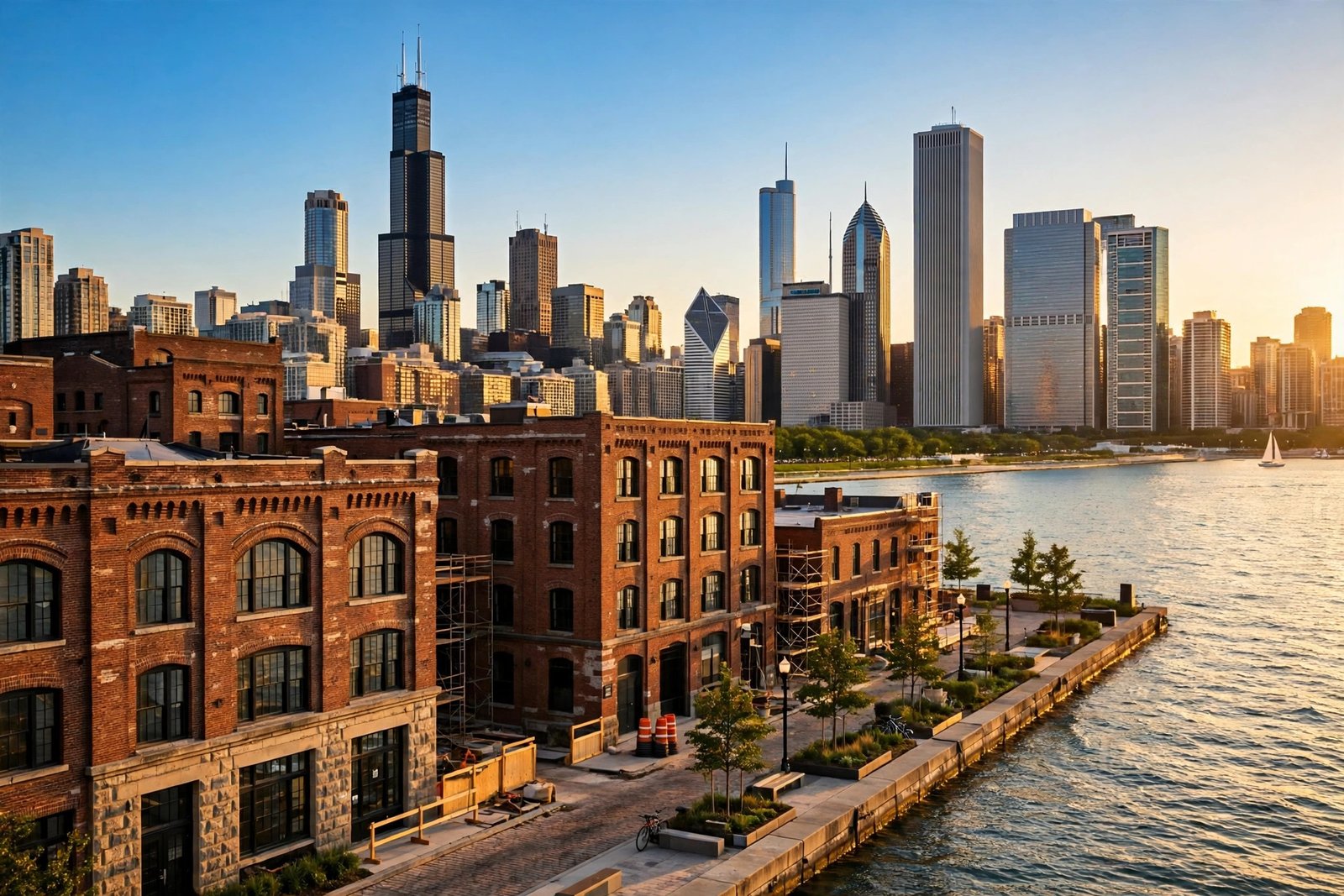
On the night of October 8, 1871, a fire started in a small barn on the southwest side of Chicago. Within days, it had become one of the most famous disasters in American history. The Great Chicago Fire burned for more than a day, destroyed around 17,450 buildings, left nearly 100,000 people homeless, and took about 300 lives. And then, against every expectation, the city did something extraordinary: it rebuilt itself bigger, stronger, and more ambitious than before, and in doing so it invented much of the modern American city.
The story of the fire is about more than flames. It is about a city built almost entirely of wood, a summer of drought, a tired fire department, and a wind that would not stop. It is also about the myths that grew up around the disaster, especially the famous story of Mrs. O’Leary’s cow, and about the real people who lost everything and started again. More than 150 years later, the fire still shapes how Chicago looks, how it builds, and how it thinks about itself.
Chicago Before the Fire: A City Made of Wood
Chicago in 1871 was a boomtown. Built at the junction of the Great Lakes and the nation’s expanding railroad network, it had grown from a frontier settlement into one of America’s great commercial cities in a single generation. Its population was roughly 300,000, its streets were crowded with warehouses, lumber yards, factories, and homes, and its future seemed limitless. But the city was built, almost literally, out of wood.
Houses were built of wood. Many streets were paved with wooden blocks. Sidewalks were wooden. Even water still ran through wooden pipes in parts of the city, because the growing metropolis had not yet swapped them for iron. Chicago was a city of timber from the ground up, and timber, in a dry autumn, is fuel waiting for a spark. The Chicago History Museum’s exhibit on the fire has challenged the old idea that the city was unprepared: Chicago actually had one of the most sophisticated firefighting systems in the United States at the time, with steam engines, alarm boxes, and organized companies. The problem was not a lack of preparation. It was that the conditions overwhelmed everything the city had.
Those conditions had been building all summer. The summer of 1871 was unseasonably warm and plagued by drought. Very little rain fell between July and October, and fires had been popping up all summer, exhausting the fire department and wearing down its equipment. Some hoses leaked, some alarm boxes malfunctioned, and firefighters were tired. When the wind picked up on the night of October 8, blowing hot and strong from the southwest, the city was as dry as it had ever been.
The Night of October 8: How the Fire Started
What we know for certain is this: on the night of Sunday, October 8, 1871, a fire began in or near a small barn owned by Patrick and Catherine O’Leary at 137 DeKoven Street, on Chicago’s southwest side. A neighbor spotted the flames in the evening, and the alarm was raised. But the fire department was initially sent to the wrong location, a mistake that cost precious time, and by the time firefighters reached the right place, the fire was already spreading.
The wind did the rest. Strong southwesterly winds drove the flames northeast, across the Chicago River and into the heart of the business district. Burning embers carried on the wind started new fires blocks ahead of the main blaze. Wooden buildings, wooden sidewalks, and wooden streets caught quickly, and the fire jumped from block to block faster than firefighters could respond. Gas lines under the streets added to the danger as they heated and failed. The river itself offered no protection: the water was slick with oil and debris, and the flames crossed it and kept going.
For the people in the fire’s path, the night became a desperate flight. Families grabbed what they could carry and ran, often more than once, as the fire overtook each new refuge. Crowds surged toward Lake Michigan, where the open shore offered the only safe ground, and toward the prairie to the west. The sky turned red, the air filled with smoke and ash, and the roar of the fire could be heard for miles. By Monday, much of the city’s core was gone, and the fire was still burning.
How the Fire Finally Stopped
The fire burned for more than a day, finally dying down in the early hours of Tuesday, October 10. Two things helped end it. Rain finally fell around midnight on October 10, dampening the embers and giving exhausted firefighters a chance to gain ground. And the fire eventually reached the northern part of the city, where an area that had already burned in an earlier fire offered less fuel. With nothing left to consume, the blaze burned itself out.
The scale of the destruction was staggering. The fire consumed a swath of the city roughly three and a half miles long, destroying about 17,450 buildings and causing damage estimated at the time at around $200 million, an enormous sum in 1871. About 300 people lost their lives, and nearly 100,000 people, roughly a third of the city’s population, were left homeless. The business district was gutted, homes were reduced to ash, and the city’s infrastructure, from waterworks to telegraph lines, was shattered.
Yet even in the immediate aftermath, something remarkable happened. Relief poured in from across the country. Food, clothing, and money arrived by train. Temporary shelters went up. And within days, Chicagoans were already talking not about whether the city would survive, but about how it would rebuild. The spirit of that response became part of the city’s identity, summed up in the motto that later appeared on the city seal: Urbs in Horto, city in a garden, and in the defiant slogan that Chicago would rise again.
The Myth of Mrs. O’Leary’s Cow
No story about the Great Chicago Fire is complete without Mrs. O’Leary’s cow. According to legend, Catherine O’Leary’s cow kicked over a lantern in the barn on DeKoven Street, starting the blaze that destroyed the city. The story has been told in songs, books, and school lessons for generations. It is also almost certainly untrue. The true cause of the fire has never been determined, and no solid evidence has ever tied the cow, or Catherine O’Leary herself, to the fire’s origin.
An official inquiry in 1871 cleared Catherine O’Leary of any wrongdoing, but the legend stuck anyway, and it ruined her life. She spent her remaining years as a virtual recluse, blamed by the public for a disaster she did not cause. Historians now see the cow story as a product of its time, shaped by anti-Irish prejudice and by the human need for a simple explanation for a catastrophe that had no simple cause. The real explanation is less colorful but more honest: a dry city, built of wood, on a windy night, with a fire department already stretched thin.
The cow legend also distracts from a larger truth. The same night Chicago burned, other fires raged across the region. Peshtigo, Wisconsin, was destroyed by a forest fire that same night in a disaster that killed far more people than the Chicago fire, yet it is barely remembered outside Wisconsin. The town of Holland, Michigan, also burned. The autumn of 1871 was a season of fire across the upper Midwest, and Chicago was the most famous victim, not the only one.
Rebuilding: How the Fire Made Modern Chicago
The rebuilding of Chicago is one of the great stories in American urban history. Within a few years, the city had risen from the ashes with new buildings, new streets, and new ideas about how a city should be built. Wood gave way to brick, stone, and eventually steel. Fire-resistant construction became the rule rather than the exception. The city professionalized its fire department, improved its water system, and standardized fire safety in ways that influenced cities across the country.
The fire also cleared the way for architectural revolution. With the old, cramped, wooden city gone, architects and engineers had room to experiment. Chicago became the birthplace of the modern skyscraper, as steel-frame construction allowed buildings to rise far higher than ever before. The city’s grid was rebuilt with wider streets and better infrastructure, and the downtown that emerged, the Loop, became one of the great commercial centers of the world. The fire, paradoxically, made Chicago more modern than it would otherwise have been.
There were darker sides to the rebuilding too. The disaster wiped out the property of the poor as thoroughly as that of the rich, and the new city that rose was not equally welcoming to everyone who had lost their home. Land values soared, rents rose, and many working-class families were pushed out of the rebuilt center. The fire remade Chicago, but it remade it for some people more than others, a pattern that would repeat in American cities for generations.
What Survived: The Water Tower and Other Landmarks
Remarkably, a handful of buildings survived the fire, and they are among Chicago’s most treasured landmarks today. The most famous is the Chicago Water Tower, built in 1869 on Michigan Avenue. Designed by architect William Boyington in a castellated Gothic Revival style and built almost entirely of Joliet limestone, the Water Tower held pumps that drew water from Lake Michigan and tall standpipes that regulated water pressure for firefighting. Because it was built of stone rather than wood, it survived when nearly everything around it burned. Today it stands as the city’s most beloved symbol of survival, and it now houses a gallery for the city’s tourism office.
The site of the O’Leary barn is itself a landmark of a different kind. It is now home to the Chicago Fire Academy, the city’s firefighter training facility, and a sculpture called the Pillar of Fire marks the spot where the fire began. The Chicago History Museum, at 1601 North Clark Street, holds the finest collection of fire artifacts anywhere: melted telegraph wires, church bells warped by heat, survivor diaries, and everyday objects transformed by flame. Its exhibits walk visitors through the wooden city before the fire, the night of the blaze, and the rebuilding that followed.
For readers who want to go deeper, see the Chicago History Museum exhibit coverage at Firehouse, the virtual tour of fire sites at Clio, and the anniversary history at HHHistory. The museum’s own exhibits remain the best place to see the artifacts of that night up close.
Related reading
- Statue of Liberty Dedication, October 28, 1886
- Abraham Lincoln Created Thanksgiving in 1863
- Interstate Highway System: Surprising Facts
Frequently Asked Questions
When was the Great Chicago Fire?
The fire started on the night of Sunday, October 8, 1871, and burned until the early hours of Tuesday, October 10, 1871.
How did the Great Chicago Fire start?
The fire began in or near a barn owned by Patrick and Catherine O’Leary at 137 DeKoven Street. Its exact cause has never been determined. The famous story about Mrs. O’Leary’s cow kicking over a lantern is a legend, not an established fact.
How much of Chicago was destroyed?
The fire destroyed about 17,450 buildings across roughly three and a half square miles, left nearly 100,000 people homeless, and took about 300 lives.
What buildings survived the fire?
Very few. The most famous survivor is the Chicago Water Tower on Michigan Avenue, built of Joliet limestone in 1869, which survived because it was made of stone rather than wood.
How did the fire change Chicago?
The rebuilding replaced wood with brick, stone, and steel, professionalized firefighting, improved the water system, and helped make Chicago the birthplace of the modern skyscraper.