
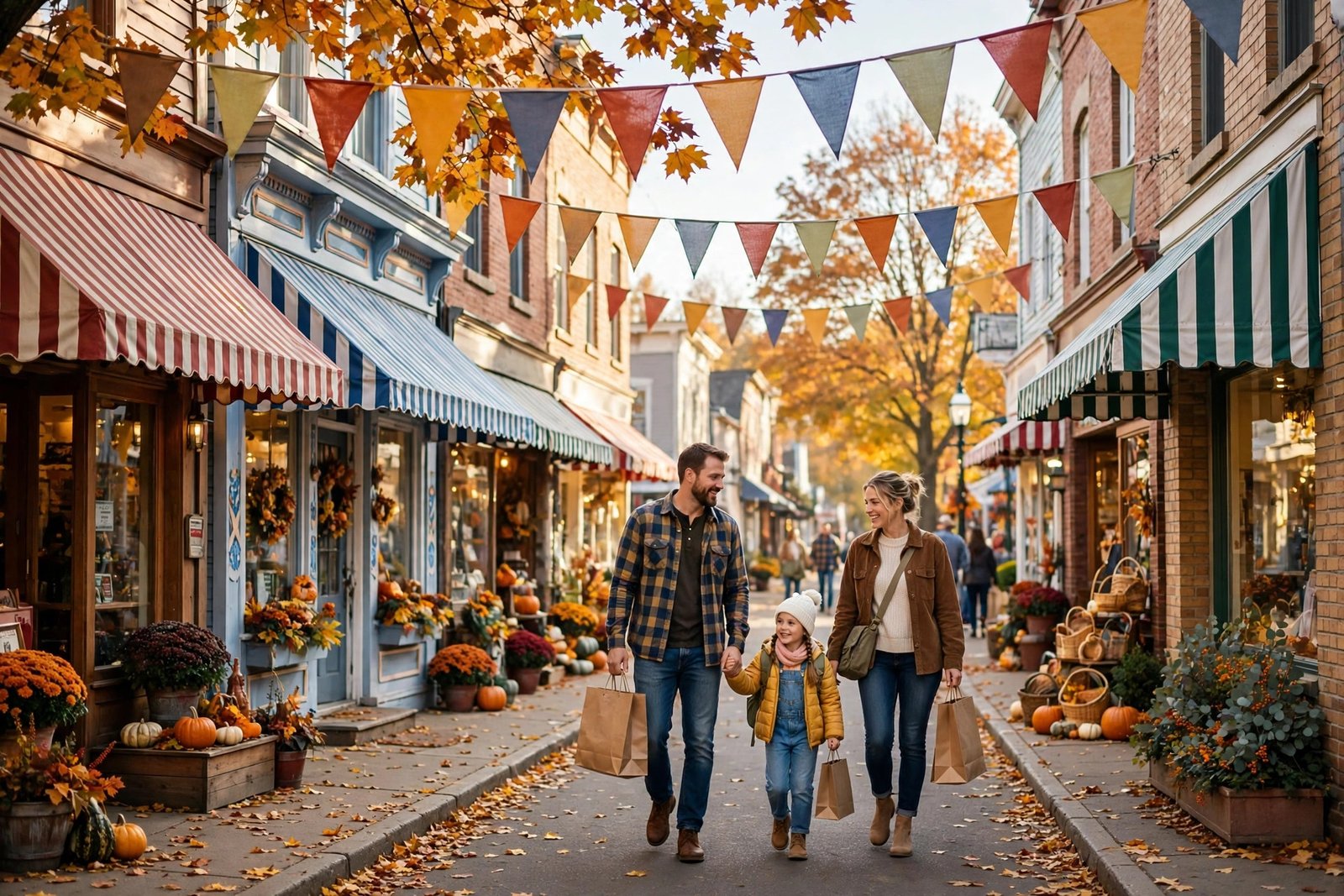
There is a Saturday every year when Main Street gets its turn. It comes the day after Black Friday, when the big-box crowds thin out and the holiday rush moves to the bakery, the bookshop, the toy store and the corner cafe. That day is Small Business Saturday, and in 2026 it falls on Saturday, November 28, the Saturday after Thanksgiving.
It is not a federal holiday, and it is not a sales event invented by a single store. It is a national nudge, started by American Express in 2010 and co-sponsored by the US Small Business Administration since 2011, that asks Americans to spend part of their holiday budget with the independent businesses in their own communities. Sixteen years in, it has become a fixture of the holiday weekend, sitting between Black Friday and Cyber Monday as the day for shopping small.
This guide explains when it is, how it started, why it matters, and how to make the most of it, whether you are a shopper looking for gifts with a story behind them or a small business owner getting ready for the biggest Saturday of your year.
When is Small Business Saturday 2026?
Small Business Saturday 2026 is Saturday, November 28, 2026. It always falls on the Saturday after Thanksgiving, which means it always lands the day after Black Friday. This year the holiday weekend lines up like this: Thanksgiving is Thursday, November 26, Black Friday is Friday, November 27, Small Business Saturday is Saturday, November 28, and Cyber Monday is Monday, November 30.
That placement is deliberate. Black Friday belongs to the big retailers and their doorbuster deals. Cyber Monday belongs to online shopping. Small Business Saturday was designed to give independent shops, restaurants and service businesses their own day in the busiest shopping weekend of the year, when Americans are already out spending and thinking about gifts.
The US Small Business Administration confirms the date on its Small Business Saturday page, where it encourages Americans to champion small businesses nationwide and shop small on November 28. American Express, which founded the day, confirms the same date on its Shop Small pages. If you see a different date floating around online, it is almost certainly for another country: the United Kingdom runs its own Small Business Saturday on the first Saturday in December, which is December 5 in 2026.
How Small Business Saturday started
Small Business Saturday was created by American Express in 2010, in the middle of the long recovery from the Great Recession. Small businesses had been hit hard, and American Express wanted a day that would send holiday shoppers toward independent stores at the start of the shopping season. The idea was simple: give the day a name, a date and a hashtag, and make it easy for shoppers and shop owners to take part.
The Small Business Administration began officially co-sponsoring the day in 2011, and the idea caught on quickly in Washington as well. On November 10, 2011, the US Senate agreed by unanimous consent to a resolution designating November 26, 2011, as Small Business Saturday. A Senate resolution is not a law, and the day has never become a federal holiday, but the bipartisan support helped turn a marketing campaign into a national tradition.
Over time, the day grew into American Express’s year-round Shop Small movement, encouraging people to support independent businesses all year, not just one Saturday in November. The hashtag is #ShopSmall: shoppers post what they found, shops post what they offer, and a local purchase joins a national conversation.
The day has also grown beyond shopping. Restaurants, cafes, salons, gyms, bookstores, florists, repair shops and service businesses of all kinds now take part. For many of them, the Saturday after Thanksgiving is one of the busiest days of the year, and the sales and new customers it brings can carry a business through the slower weeks of January.
Why shopping local matters
The case for shopping small is not really about one day of sales. It is about what happens to a dollar after you spend it. When you buy from a locally owned shop, more of that money tends to stay in the community, paying local wages, local rent and local suppliers, instead of flowing out to a distant corporate headquarters. That is a qualitative point, not a precise number, and it is the reason the day’s supporters keep coming back to it year after year.
There is also a visible difference. Independent businesses are what make one town feel different from the next. The used bookstore with the handwritten recommendations, the bakery that still makes the same rolls your grandparents bought, the hardware store where someone can tell you which screw you actually need: these are the places that give a Main Street its character. When they close, they are usually replaced by something generic, or by nothing at all.
The numbers behind the day are striking, with one important caveat. According to the SBA, Small Business Saturday has generated more than $220 billion for independent retailers, restaurants and service-based businesses since it began in 2010. That figure is an aggregate of consumer surveys commissioned by American Express over the years, based on what shoppers said they spent, and it does not reflect actual receipts or card spending data. It is a useful sign of scale, not a precise accounting.
More recent figures come with the same caveat. In 2024, estimated spending at local merchants on Small Business Saturday was around $22 billion, according to the American Express 2024 Small Business Saturday Consumer Insights Survey cited by the SBA. That survey asked a nationally representative sample of American adults what they spent, so the figure is an estimate built from self-reported answers, not a tally of real transactions. No verified total for 2025 has been published by American Express or the SBA as of this writing, so this guide does not state one.
What the surveys do show clearly is that the day matters to the businesses themselves. In American Express research cited by the SBA, small business owners surveyed said they expected nearly 20 percent of their annual revenue to come from sales on Small Business Saturday alone. Whether or not that figure holds for every shop, it explains why owners plan for this Saturday the way other retailers plan for Black Friday: it is a day that can shape the whole year.
A simple plan for Small Business Saturday
You do not need a complicated strategy to shop small well. A little planning goes a long way, because the best local shops are often small, and small shops run out of the good stuff first.
Start with a list. Before Saturday, write down the people you still need gifts for and one or two ideas for each. Then match the ideas to local shops instead of defaulting to a search bar. A gift list keeps you from wandering and buying the same candle for the third year in a row, and it turns the day into a treasure hunt rather than a chore.
Go early if you can. Many independent shops open early on Small Business Saturday and run their best offers in the morning, when shelves are fullest and staff have time to help. Some of the best finds come from a conversation: the bookseller who asks what your dad likes to read, or the jeweler who can resize a ring while you wait.
Walk instead of driving between stops when you can. Part of the point of the day is the street itself. A farmers market next to a toy shop next to a cafe is the whole experience, and you will notice places you would have driven straight past.
Finally, leave a review. If a shop impressed you, say so online while it is fresh. A short, honest review costs nothing and helps a small business more than almost any other free thing you can do.
Where to shop local on the day
Almost every kind of small business takes part in Small Business Saturday, and the best stops depend on your town. A few categories are worth seeking out wherever you are.
Bookstores and toy shops are natural first stops for gifts. Independent bookstores are famous for staff picks, and a bookseller’s recommendation beats an algorithm more often than not. Toy shops carry games and toys you will not find in the big chains, and the staff can usually tell you which ones are worth the price.
Bakeries, delis and specialty food shops are worth visiting even if you are not buying gifts. Holiday baking starts the week after Thanksgiving in many households, and a local bakery is the place for pies, breads and treats that taste like someone made them that morning, because someone did.
Farmers markets and farm stands deserve a look too, even in late November. Fall markets still carry squash, apples, preserves, honey, baked goods and handmade crafts, and buying from the vendors there is about as direct as local shopping gets.
Do not forget services. Salons, barbershops, repair shops, tailors and local gyms all count as small businesses, and a gift card for a haircut, a phone repair or a month of classes is a practical gift that supports a neighbor’s livelihood.
Shopping small online too
Not every small business has a storefront, and not every shopper can spend the day walking Main Street. Many independent shops now sell online, through their own websites or through marketplaces, and Small Business Saturday includes them. If you have a favorite small brand from another town, or a maker you follow on social media, check whether they are running a Small Business Saturday offer.
The SBA and American Express publish free Shop Small marketing materials every year, including posters and social media graphics, and the SBA’s Small Business Saturday page links to them. Shoppers can use those same resources to find participating businesses: the Shop Small map and business directory, run by American Express, lets you search for independent shops near you.
One honest note: an online order from a small business is still a small business purchase, but it does not do the same work for your own street as a walk-in visit. If you can do both, buy the gift online from a maker you love, and spend Saturday morning on your own Main Street.
If you own a small business, get ready now
For owners, Small Business Saturday rewards preparation, and the preparation does not have to be expensive. The free materials are the place to start. American Express publishes posters, social media posts and email templates through its Shop Small resource hub, and the SBA links to them from its Small Business Saturday page. Put the poster in the window, post the graphics in the week before, and tell your regulars the date in person. Many shoppers still learn about the day from a sign, not a feed.
Plan one offer, not ten. A single clear deal, a gift-with-purchase, a bundle, or a small discount on a category, is easier to explain to staff and customers than a complicated set of promotions. The research suggests owners value the day partly for the new customers it brings, so give those customers a reason to return.
Staff for the morning rush and train everyone on the same message. The busiest hours are usually late morning, and the questions will be practical: what is on offer, what is new, what would you recommend. A short team huddle before opening, with the day’s offer and the bestsellers agreed in advance, prevents the mid-morning confusion that loses sales.
Make the day easy to share. A simple photo spot, a chalkboard with the day’s offer, or a small free sample gives shoppers something to post, and every post is free advertising to their friends. Keep the hashtag #ShopSmall visible, and share customer posts through the day.
Finally, collect a little information while the goodwill is high. An email list signup at the counter, with a small incentive, turns a one-day shopper into a year-round customer. Just keep it simple and optional.
Beyond one Saturday
The honest limit of Small Business Saturday is that it is one day, and small businesses need 364 others. That is why American Express frames the day as part of its year-round Shop Small movement, and why the SBA promotes it alongside its everyday support for small firms. The habit the day is trying to build is not a once-a-year gesture but a default: check the local shop first, and only go further afield when it does not have what you need.
That habit is easier to keep than it sounds. A weekly coffee from the local cafe, a monthly book from the independent bookstore, a haircut from the barber down the street: these are small, ordinary choices that add up to a living Main Street. Small Business Saturday is the day that reminds you to start. This year, that Saturday is November 28. Put it on the calendar, make a list, and go and see what your town has to offer.
Frequently asked questions
When is Small Business Saturday 2026? Saturday, November 28, 2026, the Saturday after Thanksgiving and the day after Black Friday. Thanksgiving is Thursday, November 26, and Cyber Monday is Monday, November 30.
Who started Small Business Saturday? American Express founded it in 2010. The US Small Business Administration has officially co-sponsored it since 2011, and the US Senate passed a resolution recognizing it in 2011.
How much do Americans spend on Small Business Saturday? Estimated spending in 2024 was around $22 billion, according to the American Express Consumer Insights Survey cited by the SBA. That figure is based on self-reported survey answers, not actual receipts. No verified total for 2025 has been published, and the SBA reports more than $220 billion in estimated spending since 2010 on the same survey basis.
Do I have to buy anything to take part? No. Eating at a local restaurant, leaving a review, sharing a shop’s post or buying a gift card all count as supporting small businesses on the day.
Is Small Business Saturday only for shops? No. Restaurants, cafes, salons, service businesses, markets and online-only small businesses all take part, and many run their own offers for the day.
Related reading
Planning the rest of your holiday shopping? See our Black Friday 2026 shopping trends guide, find out why the holiday shopping season in 2026 starts earlier than it used to, and take a seasonal detour through our fall farmers markets harvest guide.