
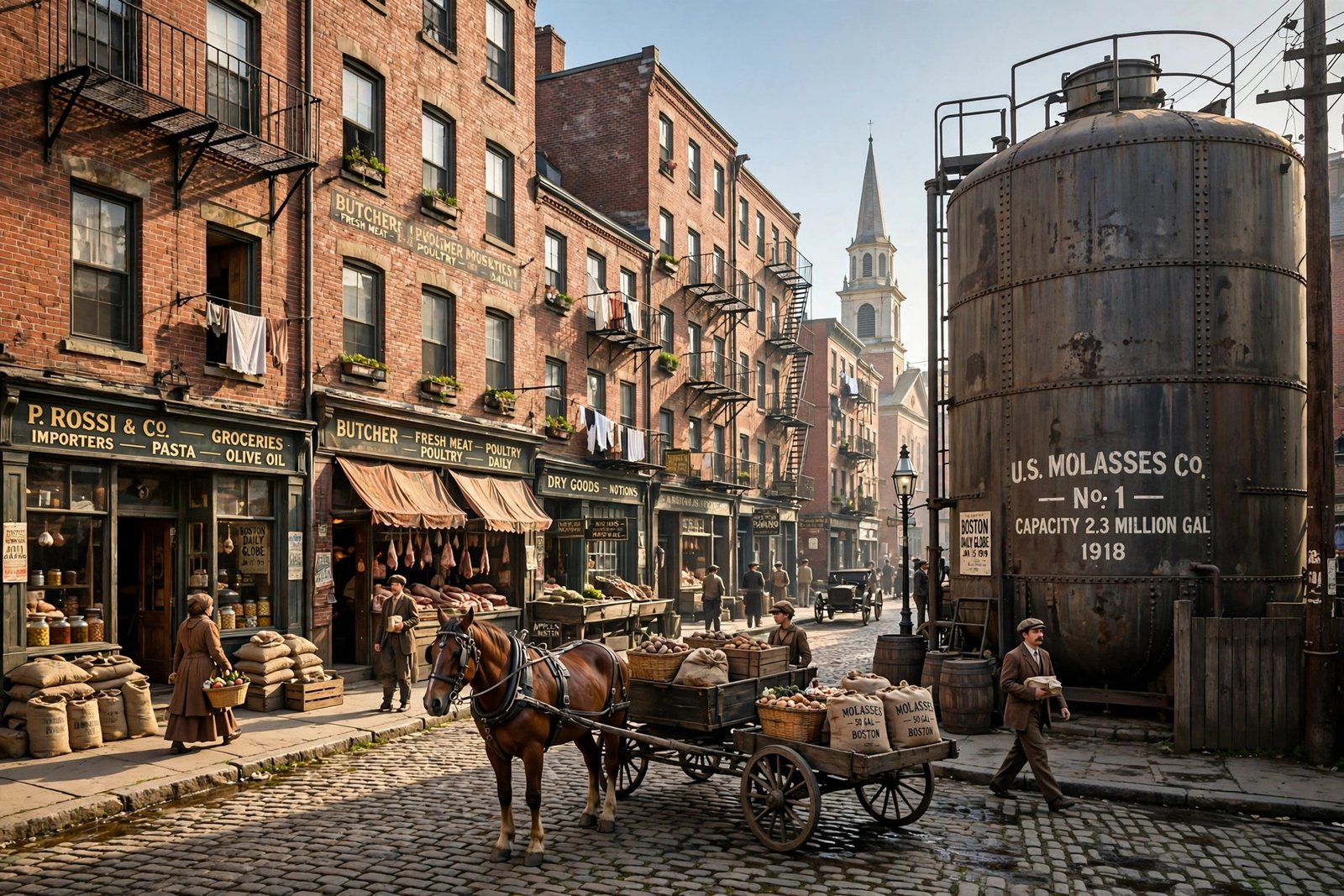
It sounds like the setup for a joke: a city drowned in syrup. But on January 15, 1919, the people of Boston’s North End lived through a disaster so strange that newspapers struggled to describe it, and so deadly that it changed the way America builds industrial tanks. A steel storage tank burst open at lunchtime and sent more than two million gallons of molasses roaring through the streets. Twenty-one people were killed, about 150 were injured, and a working-class neighborhood was buried under a sticky, suffocating tide.
What makes the story endure is not just its strangeness, but the chain of carelessness behind it: a tank built too fast and too thin, never inspected, and painted to hide its leaks. It is also the story of the people who paid for that carelessness — and of a six-year legal battle that finally forced the company responsible to pay.
A Warm Winter Day in the North End
January 15, 1919, had begun as an unusually pleasant winter day in Boston. The temperature had climbed to around 40 degrees Fahrenheit, a sharp rise from the bitter cold earlier in the week, and the sunshine drew people into the streets of the North End — one of the city’s busiest working districts, home to Italian and Irish immigrant families, warehouses, rail yards, and the wharves along the harbor. Children played near the waterfront, men loaded cargo, and a firehouse crew went about its midday routine on Commercial Street.
At 529 Commercial Street, near Keany Square, stood a giant steel tank belonging to the Purity Distilling Company: 50 feet tall and 90 feet across, holding as much as 2.3 million gallons of molasses shipped from the Caribbean and waiting to be fermented into industrial alcohol. It had been filled to near capacity just days earlier, and the warm afternoon was making the molasses inside expand.
Around 12:30 p.m. — some accounts put the moment a few minutes later, closer to 12:40 — people near the tank heard a sound like machine-gun fire. It was the steel rivets tearing loose, popping out of the tank’s plates one by one. Then came a low, grinding rumble, and the tank split open. In seconds, the wall of the tank peeled away and the molasses came out all at once.
The Tank on Commercial Street
The tank had been built in 1915, when World War I had sent demand for industrial alcohol soaring. The Purity Distilling Company, a subsidiary of the United States Industrial Alcohol Company, needed somewhere to store the vast quantities of molasses it was importing. Construction was rushed, and the work was shoddy from the start. Later investigations found that the steel walls of the tank were thinner than they should have been, and that the builders had not accounted properly for the enormous weight of the liquid inside.
There were warning signs for years, and they were ignored. The tank leaked from the day it was first filled, with molasses seeping through the seams. Instead of draining it and fixing the problem, the company had workers paint the tank brown — the same color as molasses — so the leaks would be harder to see. Residents complained about the groaning sounds it made when full, and about rivets that sometimes popped loose and clattered to the ground.
No government inspector ever examined the tank. Boston had no building code covering such industrial storage tanks, and nobody in authority had ever required the company to prove it was safe. The tank stood, leaking and groaning, in the middle of a crowded neighborhood for more than three years, until the warm day in January 1919 when its weakened walls finally gave way.
Why Boston Was Full of Molasses
To understand why so much molasses sat in the middle of a Boston neighborhood, you have to know what it was for in 1919. Molasses is the thick, dark syrup left over when sugar cane is refined, and it can be fermented to produce ethanol. In wartime, ethanol was far more valuable as an ingredient in munitions. The United States Industrial Alcohol Company bought molasses in enormous quantities, fermented it, and sold the alcohol for explosives, smokeless powder, and other war materials.
The war had ended just two months before the flood, with the armistice of November 11, 1918. But the demand for alcohol had not gone away. Prohibition was about to take effect — the Eighteenth Amendment, banning the production of alcohol, was ratified the very next day, on January 16, 1919 — and the company was stockpiling molasses to distill into rum and other spirits before the ban shut that business down. The tank on Commercial Street was, in effect, a warehouse full of liquid money, sitting in one of the most crowded parts of Boston.
The 2.3 million gallons inside the tank weighed roughly 13,000 short tons — about 26 million pounds. When the tank failed, all of that weight was released in seconds, with nowhere to go but out into the streets.
The Wave
Witnesses described a wall of dark syrup between 15 and 25 feet high — some early reports put it at 15 feet, while the historian Stephen Puleo, author of Dark Tide: The Great Boston Molasses Flood of 1919, describes it as 25 feet high and 160 feet wide. Either way it was taller than a house, and it moved at an estimated 35 miles per hour, faster than anyone on foot could run.
The wave swept down Commercial Street and spread across a two-block radius, flattening everything in its path. It lifted a firehouse off its foundation and carried it along. It smashed buildings, twisted the steel supports of the elevated railway, and knocked over telegraph poles. A truck was tossed into the harbor. Horses pulling wagons were swept off their feet and drowned in the syrup. People caught in the open had no chance to escape: the molasses knocked them down, covered them, and held them fast.
Boston police patrolman Frank McManus was among the first to see the wave coming, and he reportedly ran through the streets shouting a warning. But there was almost no time. Within minutes, the wave had spent its force and settled into a spreading, knee-deep flood that coated the streets and buildings — and then came the cries of people trapped in the syrup.
Rescue in the Sticky Dark
The rescue effort began almost immediately, and it was nightmarish. Firefighters, police officers, soldiers from a nearby Navy yard, and ordinary residents waded into molasses that in places was waist-deep. The syrup clung to their boots and clothing, and every step was an effort. Victims were hard to find because the molasses covered them completely — rescuers often located people only by the sound of their cries, or by a hand sticking out of the dark surface.
The molasses itself made the rescue harder as the hours passed. Fresh from the tank, the syrup was warm and flowed quickly. But as it spread across the cold streets and the January night closed in, it cooled and thickened. A team of Harvard researchers who studied the disaster in 2016 found that cooling molasses from 10 degrees Celsius to freezing triples its viscosity. Victims who could not free themselves quickly found themselves pinned in a mass hardening around them like cement. Some suffocated; others were crushed under debris or drowned. A Harvard researcher later said that about half the victims died, in essence, because they were stuck.
The death toll climbed over the following days as bodies were recovered. In the end, 21 people were killed and about 150 were injured — mostly working-class immigrants: longshoremen, city paving crews, teamsters, a firefighter, and three children. About 25 horses were killed as well. Rescue workers used salt water from the harbor to wash the molasses off survivors and the streets, and the cleanup took weeks. For years afterward, people said that on hot summer days, the North End still smelled faintly of molasses.
The Blame Game and a Six-Year Trial
Almost before the rescue was finished, the argument over who was to blame had begun. The United States Industrial Alcohol Company insisted that it was not at fault. Its lawyers claimed that anarchists had planted a bomb and blown up the tank — a convenient theory in 1919, when fear of anarchist violence was running high across America and Boston had seen its share of radical unrest. The company pointed to the sound of the explosion and to the fact that the tank had stood for years without failing as evidence that something outside the tank must have caused the disaster.
The victims’ families sued, and what followed was one of the longest civil cases in Massachusetts history. The court appointed an auditor, Colonel Hugh W. Ogden, to hear the evidence. The hearings stretched on for years — 341 hearing days and roughly 3,000 witnesses. Engineers argued over the steel thickness, the rivets, and the tank’s design; chemists argued over whether fermentation could have built up enough gas pressure to burst it. Investigators produced no evidence of a bomb.
In April 1925, more than six years after the flood, Ogden ruled that negligent construction had caused the disaster: the tank’s walls were too thin for the load, the company had ignored leaks and warning signs, and the structure had never been inspected. The anarchist-bomb theory was rejected. United States Industrial Alcohol eventually paid $628,000 in settlements — worth many millions in today’s money. The case became a landmark in American law, still cited as a classic example of corporate liability for industrial accidents.
What the Science Says Now
For decades after the trial, one question lingered: why did a wave of syrup kill so many people? Molasses is thick and slow, and it seems strange that it could move at 35 miles per hour and trap people so completely. The answer came nearly a century later, when Harvard physicists Nicole Sharp, Jordan Kennedy, and Shmuel Rubinstein studied the flood as a problem in fluid dynamics, combing through hundreds of pages of historical accounts, century-old maps, and archived weather data.
Their findings, presented to the American Physical Society in November 2016, explained what the 1919 investigators could not. The molasses in the tank was warmer than the winter air by about 5 degrees Celsius, because it had been shipped from the warm Caribbean and had not fully cooled. Warm molasses flows fast — fast enough to surge through the streets at the speed witnesses reported. But once it spread across the cold pavement, it cooled rapidly and thickened dramatically, becoming a heavy, hardening mass that pinned people down. The researchers concluded the flood might have claimed few lives at all had it happened in a warmer season. It was the winter cold, as much as the faulty tank, that made the disaster so deadly.
A separate engineering study, published in 2014 by the engineer Ronald Mayville, reached a similar conclusion about the tank itself: its steel walls were too thin, a flaw that builders of the time should have recognized. Between the science and the court record, the picture is now clear. The Great Molasses Flood was not a freak accident and not an act of sabotage. It was the foreseeable result of a badly built tank, filled with an enormous weight of liquid, in the middle of a crowded neighborhood, on a cold winter day.
The Legacy: Langone Park and Safer Tanks
Today, the site of the flood is part of Langone Park, a small waterfront park in Boston’s North End. A plaque marks the spot where the tank stood, and a marker shows the outline of its footprint. In 2019, on the hundredth anniversary of the disaster, construction workers uncovered the tank’s concrete foundation, buried about 20 inches underground.
The legal legacy of the flood is larger than the park. The Ogden ruling helped establish the principle that companies are responsible for the safety of the structures they build, and the case is still studied by lawyers and engineers. Building codes were tightened, and the idea that an industrial tank could be erected without inspection or oversight became unthinkable. The flood also left a cultural legacy: Stephen Puleo’s book Dark Tide brought the story to a wide audience, and the disaster has become a fixture of Boston’s local history, told and retold as a cautionary tale about what happens when profit is put ahead of safety.
It is easy to laugh at the idea of a molasses flood, and Bostonians have always had a dark sense of humor about it. But the 21 people who died on Commercial Street were not a joke. They were workers and children, killed because a company cut corners on a tank and then tried to blame anarchists. The sticky smell that lingered in the North End for years was a fitting memorial: a disaster that was impossible to clean up quickly, and impossible to forget.
Frequently Asked Questions
How many people died in the Great Molasses Flood?
Twenty-one people were killed and about 150 were injured — mostly working-class Italian and Irish immigrants, including longshoremen, teamsters, paving workers, a firefighter, and three children. About 25 horses were also killed.
How much molasses was released in the flood?
The tank contained as much as 2.3 million gallons of molasses, weighing roughly 13,000 short tons, or about 26 million pounds. Nearly all of it escaped in a matter of seconds when the tank burst open at about 12:30 p.m. on January 15, 1919.
How tall was the wave of molasses?
Estimates vary. Some early accounts describe a wave about 15 feet high, while the historian Stephen Puleo describes it as 25 feet high and 160 feet wide. Sources disagree on the exact height, but all agree it was tall enough to swallow buildings, lift a firehouse off its foundation, and sweep away anyone in its path.
What caused the tank to burst?
The tank failed because it was badly built. The court-appointed auditor, Colonel Hugh W. Ogden, ruled in April 1925 that negligent construction was the cause: the steel walls were too thin for the weight of the molasses, and the company had ignored years of leaks and warning signs. The company’s claim that anarchists had bombed the tank was rejected for lack of evidence.
Can you still visit the site of the Great Molasses Flood?
Yes. The site is now part of Langone Park in Boston’s North End, near 529 Commercial Street, where a plaque marks the location. In 2019, workers uncovered the tank’s foundation about 20 inches below the surface.
Related reading
For more American history on Trending 4, read the Great Chicago Fire of 1871 and its legacy, the Boston Tea Party of 1773 explained, and how the Transcontinental Railroad connected America in 1869.