
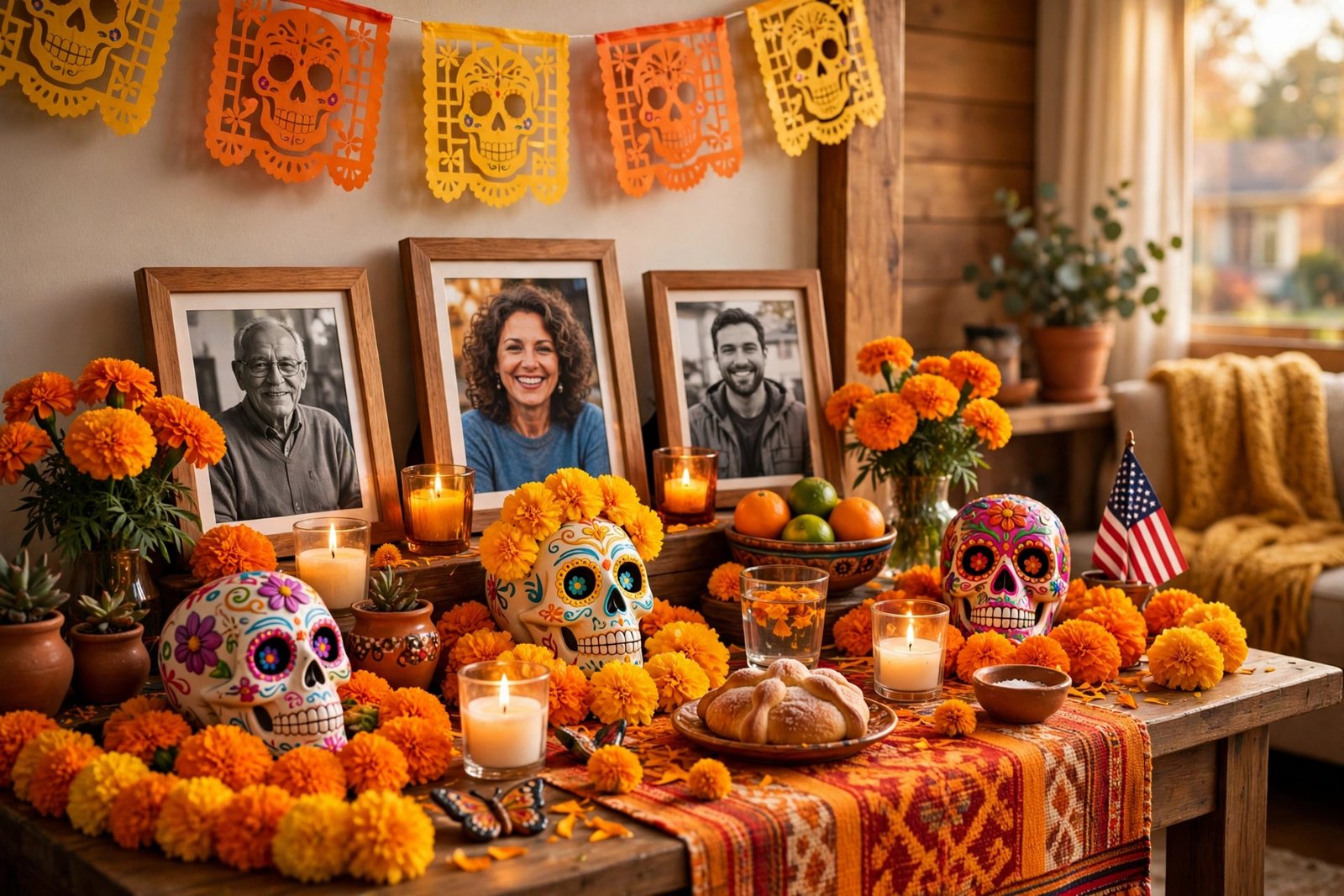
On November 1 and 2, homes and cemeteries across the United States glow with candlelight, marigold petals, and photographs of loved ones who have died. Families build altars, share favorite foods, play music, and tell stories. It is not Halloween, and it is not a funeral. It is Dia de los Muertos, the Day of the Dead, and it is becoming one of America’s fastest-growing cultural celebrations.
Once observed mainly in private by Mexican American families, Day of the Dead is now marked in public by museums, schools, city parades, churches, and community centers from Los Angeles to Chicago to San Antonio. Store shelves in October now carry marigold garlands and sugar skulls alongside Halloween candy. For many Americans, including those with no Mexican heritage, the holiday offers something Halloween does not: a joyful, open way to remember the dead and celebrate a life well lived.
This article explains what Day of the Dead is, where it came from, how it took root in the United States, and how to celebrate it respectfully, whether you are honoring your own family or learning about a neighbor’s tradition for the first time.
What Is Day of the Dead?
Dia de los Muertos, often shortened in the United States to Dia de Muertos, is a multi-day holiday celebrated on November 1 and 2. The belief at its heart is simple and profound: once a year, the souls of the dead return briefly to visit the living. Families welcome them home with offerings, food, music, and remembrance.
November 1 is traditionally dedicated to children who have died, sometimes called the Day of the Innocents or Day of the Little Angels. November 2 honors departed adults. Some communities begin observances on October 31 or extend them into early November, depending on local custom. The holiday is festive by design. As families in Mexico and the United States often explain, it replaces mourning and sadness with love, humor, and gratitude for a life well lived.
It is important to understand what Day of the Dead is not. It is not Mexican Halloween. Halloween and Day of the Dead share timing and skeleton imagery, which causes confusion, but their meanings are different. Halloween grew from Irish and wider European traditions around Samhain and All Saints’ Day. Day of the Dead grew from Indigenous Mexican traditions honoring the dead, later blended with Catholic observances of All Saints’ Day and All Souls’ Day. The skeletons are not meant to frighten. They are a playful, artistic reminder that death is part of life.
Ancient Roots and a UNESCO Honor
The roots of Day of the Dead stretch back thousands of years to rituals honoring the dead in pre-Columbian Mesoamerica, among peoples including the Mexica, Maya, Mixtec, Zapotec, and others. UNESCO describes the tradition as an Indigenous festivity dedicated to the dead, practiced by Indigenous communities in Mexico, in which families facilitate the return of souls by laying flower petals, candles, and offerings along paths from cemeteries to homes.
When Spanish missionaries arrived in Latin America, they moved Indigenous observances to coincide with Catholic All Saints’ Day on November 1 and All Souls’ Day on November 2, creating the blended tradition we know today. The result is a holiday that is both Indigenous and Catholic in origin, though families celebrate it in many different ways, some religious, some cultural, some both.
In 2008, UNESCO inscribed Mexico’s Indigenous festivity dedicated to the dead on its Representative List of the Intangible Cultural Heritage of Humanity, after originally proclaiming it in 2003. UNESCO notes that the festivities take place each year at the end of October to the beginning of November, a period that also marks the completion of the annual maize harvest cycle. That international recognition helped raise the holiday’s profile worldwide and affirmed its importance to community life and identity.
For much of the twentieth century, Day of the Dead was celebrated mainly in rural and Indigenous areas of Mexico. Beginning in the 1980s, it spread into Mexican cities, and from there its visibility grew internationally through art, film, music, and migration.
How Day of the Dead Took Root in the United States
Mexican American communities have celebrated Day of the Dead in the United States for hundreds of years, often with personal and sometimes religious ceremonies at home and in cemeteries. The public celebration familiar today, however, took shape in the 1970s during the Chicano Movement.
As Rutgers scholar Regina Marchi explains, Chicano artists born and raised in the United States began reclaiming Indigenous Mexican roots at a time when Mexican culture in America was often reduced to Spanish elements like flamenco and bullfighting. Young artists traveled to rural Mexico, studied Indigenous traditions, and brought them back through visual art, public altar installations, street processions, craft workshops, and Aztec danza. For these artists, celebrating an Indigenous Mexican ritual in an Anglo-dominant country was both an act of cultural pride and an act of political resistance.
Organizations that began public observances in the 1970s, including Self Help Graphics and Art in Los Angeles, Centro Cultural Aztlan in San Antonio, and the Guadalupe Cultural Arts Center, continue to anchor the tradition today. Artists such as Carmen Lomas Garza created public altars in museums and galleries, helping expand the holiday beyond private family observance to community celebration.
Over the past fifty years, that public celebration has grown steadily, especially among non-Latino Americans as well. Museums across the country now host Day of the Dead exhibitions and altar installations. Schools build classroom ofrendas to teach students about Mexican culture and about grief and remembrance. Cities host parades and festivals. The holiday’s growth reflects both the size of the Mexican American community, with more than 68 million people in the United States identifying as being of partial or full Mexican ancestry as of 2024 according to the Pew Research Center, and a broader American curiosity about meaningful ways to honor loved ones.
The Ofrenda: The Heart of the Celebration
At the center of Day of the Dead is the ofrenda, an altar built to welcome returning spirits. A traditional ofrenda is layered with meaning, and no two are exactly alike because each honors specific people.
Photographs of the departed sit at the heart of the altar. Around them, families place candles to light the way home, cempasuchil marigolds, whose bright orange petals and strong scent are said to guide spirits, and offerings of favorite foods and drinks. Pan de muerto, a sweet bread baked specially for the holiday, is a staple, along with sugar skulls decorated in vibrant pinks, blues, yellows, and greens. Water is left to quench thirst after a long journey, salt for purification, and personal items that recall the person’s life, a favorite hat, a book, a tool, a toy for a child.
Many families also visit cemeteries, cleaning graves, decorating them with marigolds and candles, and spending time together sharing food and stories. In some communities, all-night vigils in cemeteries remain an important tradition. In others, the celebration centers on home altars, church services, school programs, or museum exhibitions. The form varies, but the purpose is constant: to keep the dead present in family life, not hidden away.
Two iconic figures often appear in Day of the Dead art. La Catrina, the elegant skeleton lady created by Mexican printmaker Jose Guadalupe Posada and later popularized by artist Diego Rivera, satirizes the idea that death spares no one, rich or poor. Calaveras, playful skulls and skeleton figures, appear in art, poetry, and candy, reminding viewers with humor rather than fear that life is precious and finite.
Where America Celebrates Today
Day of the Dead now has a growing presence across the United States, especially in California, Arizona, and Texas, states with larger Latino populations, but increasingly in cities nationwide. San Antonio is home to one of the largest Day of the Dead celebrations in the United States, with parades, festivals, and community altars drawing families from across Texas and beyond. Its Muertos Fest at Hemisfair features dozens of altars and multiple stages of live music.
Los Angeles hosts one of the oldest public celebrations through Self Help Graphics and Art, while Hollywood Forever Cemetery in Los Angeles has held a large annual gathering for more than two decades. Chicago’s National Museum of Mexican Art has marked the holiday for decades, with its 40th installation noted in the 2026 season. In San Antonio, the Esperanza Peace and Justice Center marked its 31st celebration, showing how deeply rooted these community events have become.
Pop culture has accelerated the holiday’s visibility. The 2015 James Bond film Spectre featured a large Day of the Dead parade, and Mexico City held its first official parade for the holiday in 2016. The following year, several major American cities, including Chicago, Los Angeles, San Antonio, and Fort Lauderdale, hosted Day of the Dead parades. Disney and Pixar’s animated film Coco, released in 2017, introduced millions of children and families to ofrendas, marigolds, and the idea of remembering ancestors with love and music. Schools, libraries, and museums have built on that interest with educational programs that go beyond the film.
Contemporary celebrations are also diversifying. Alongside traditional family altars, Americans now encounter museum installations, city processions, school altars, themed dinners, community business altars, and even pet-focused ofrendas at places like zoos. That expansion has sparked important conversations about respect and commercialization, which we address below.
Celebrating Respectfully: What to Know
Day of the Dead is welcoming, but it is not a costume party or a Halloween add-on. If you are new to the tradition, the most respectful approach is to learn first, participate second, and center remembrance over decoration.
Start by understanding the meaning. Visit a museum exhibition, attend a community altar event hosted by a Mexican American organization, or read about the tradition from Mexican and Mexican American voices. If you build an ofrenda at home, build it for someone you actually knew and loved, with their photograph, their favorite foods, and stories that matter to your family. Avoid using sacred symbols as mere party decor, and avoid face painting that mimics calavera makeup without understanding its context, especially in commercial or Halloween settings.
Support the community that carries the tradition. Buy pan de muerto, marigolds, and crafts from Mexican bakeries, florists, and artists rather than mass-produced imitations when you can. Attend events organized by Latino cultural centers and museums, and listen to how they frame the holiday. If you are a teacher or parent, use classroom altars to teach about grief, family history, and Mexican culture, not just to make colorful crafts.
Talk to children honestly. Day of the Dead offers a gentle, age-appropriate way to talk about death, which many families find easier than avoiding the topic entirely. Children can help choose photos, draw pictures for an altar, bake pan de muerto, or write a note to a grandparent they never met. The holiday teaches that remembering is an act of love, and that grief and joy can live side by side.
Why This Celebration Is Growing Now
Several forces explain why Day of the Dead is growing in the United States today. Demographics matter: Mexican Americans are one of the largest and fastest-growing communities in the country, and their traditions naturally shape American culture. Cultural visibility matters too, from Coco to museum exhibitions to social media, where ofrenda photos and marigold imagery reach new audiences each autumn.
There is also a deeper human reason. Many Americans are looking for rituals that help them grieve openly. In a culture that often rushes past loss, Day of the Dead offers permission to slow down, to say a loved one’s name aloud, to cook their favorite meal, and to gather as a family. That appeal crosses cultural lines, which is why schools, hospices, grief counselors, and churches of many backgrounds have embraced altar-building as a healing practice.
Commercialization is the other side of growth, and it deserves honest attention. Stores selling sugar skulls and marigold garlands in October make the holiday more visible, but they can also strip it of meaning when symbols are sold as Halloween novelties. Community leaders often welcome broader participation while urging newcomers to learn the history and respect the spiritual roots. Growth and respect can coexist, but only if newcomers take the time to learn.
As Day of the Dead enters another November in the United States, its future looks bright and, appropriately, colorful. Longstanding festivals are marking milestone anniversaries, new cities are joining in, and younger generations are learning the tradition from parents, teachers, and artists. The holiday that began as an ancient Indigenous ritual, survived colonization and migration, and found new life in 1970s Chicano art is now becoming part of America’s autumn calendar, not as a replacement for Halloween, but as its own celebration of life, memory, and family.
To learn more, explore the Smithsonian account of Day of the Dead in the United States, the UNESCO listing for the Indigenous festivity dedicated to the dead, and the History overview of Day of the Dead.
Related reading
- Ramalama Costume Walk: TikTok Halloween Trend
- Spirit Halloween 2026 Pop-Up Stores in America
- New England Fall Foliage Drives and Towns 2026
Frequently Asked Questions
When is Day of the Dead celebrated?
Day of the Dead is celebrated on November 1 and 2 each year. November 1 traditionally honors children who have died, and November 2 honors departed adults. Some communities begin on October 31 or extend observances into early November.
Is Day of the Dead the same as Halloween?
No. Day of the Dead is not Mexican Halloween. Halloween grew from European traditions, while Day of the Dead grew from Indigenous Mexican traditions blended with Catholic observances. They share timing and skeleton imagery, but their meanings are different.
What is an ofrenda?
An ofrenda is an altar built to welcome the souls of deceased loved ones. It typically includes photographs, candles, marigolds, favorite foods and drinks, pan de muerto, sugar skulls, water, and personal items that recall the person being honored.
Why are marigolds important for Day of the Dead?
Cempasuchil marigolds, with their bright orange color and strong scent, are said to guide spirits home. Families scatter petals along paths and decorate altars and graves with marigolds during the celebration.
Can anyone celebrate Day of the Dead?
Yes, the celebration is welcoming, but it should be approached with respect and learning. Build an altar for someone you knew, support Mexican artists and cultural organizations, and focus on remembrance rather than using symbols as Halloween decoration.