
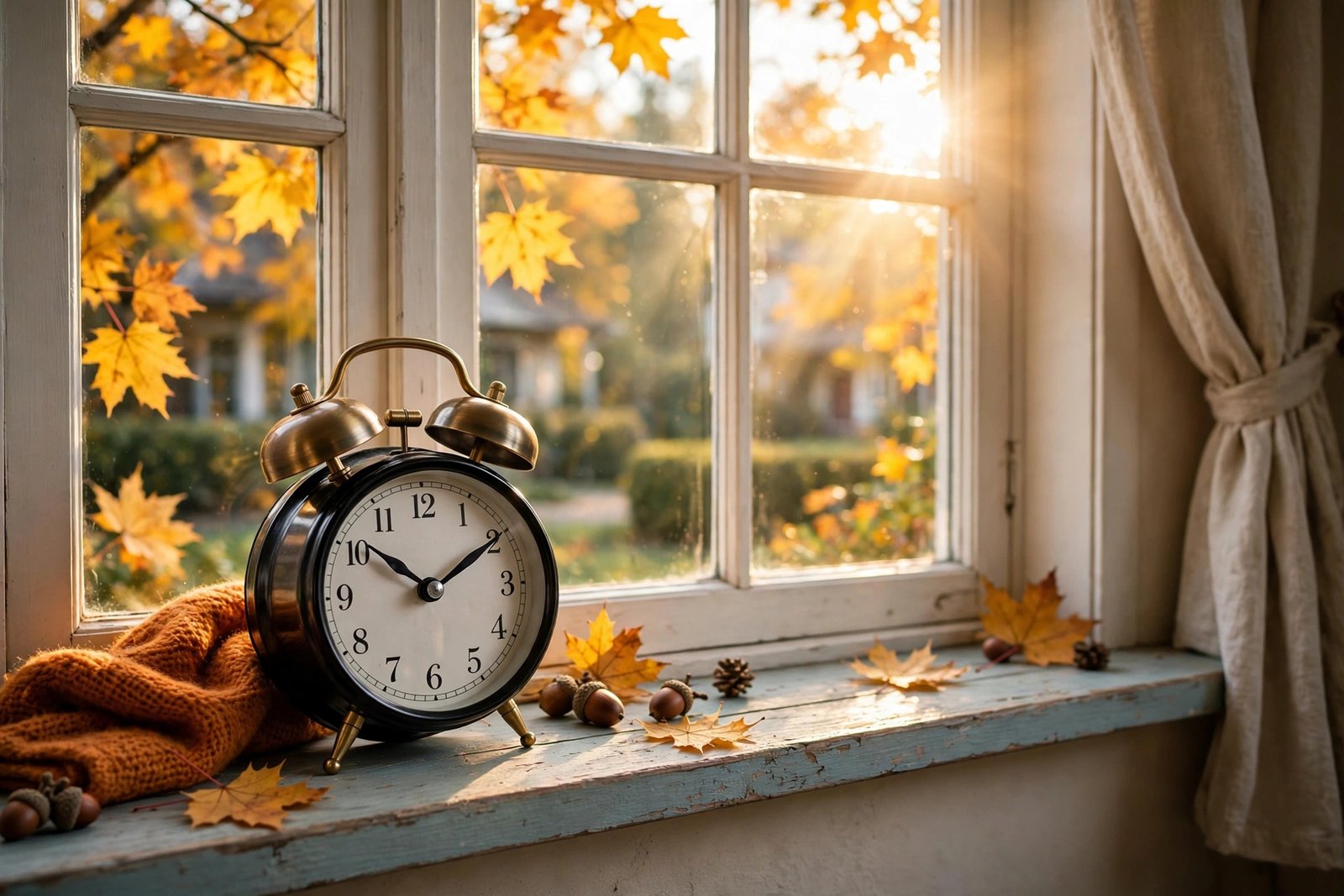
Set your clocks back and enjoy an extra hour of sleep: daylight saving time ends in most of the United States on Sunday, November 1, 2026. At 2:00 a.m. local time, clocks fall back one hour to 1:00 a.m., returning the country to standard time for the winter months. If you have ever wondered why the change lands the night after Halloween this year, or whether this could finally be the last time you have to do it, this guide has you covered.
Here is the simple version first. The change happens overnight from Saturday, October 31, into Sunday, November 1. Most phones, computers, and smart devices will adjust themselves. The clocks you need to check are the old-fashioned ones: the microwave, the oven, the car dashboard, and the wall clock in the hallway. Do it before bed on Saturday night, and you will wake up on schedule on Sunday morning with a bonus hour tucked into the night.
When Exactly Do the Clocks Fall Back in 2026?
Daylight saving time ends at 2:00 a.m. local time on Sunday, November 1, 2026, when clocks move back one hour to 1:00 a.m. That means the hour from 1:00 a.m. to 2:00 a.m. happens twice. If you stay up late on Saturday night, you will live through that hour, watch the clock reset, and live through it again. For most people, of course, the whole thing happens while they are asleep, and the only evidence is a slightly longer night and a Sunday that feels like it starts a little later.
The timing is not random. Under current federal law, daylight saving time begins on the second Sunday in March and ends on the first Sunday in November. In 2026, November 1 happens to be a Sunday, so the switch falls on the earliest possible date in November. That is also why it lands the night after Halloween: trick-or-treaters on Saturday evening get one last evening of later daylight, and then everyone gains an hour of sleep afterwards. Daylight saving time will return on Sunday, March 14, 2027, when clocks spring forward again.
One detail that trips people up every year: the change does not happen at the same instant everywhere. It happens at 2:00 a.m. in each local time zone. So the East Coast falls back three hours before the West Coast does, just as it springs forward three hours earlier in March. If you are scheduling a call or a flight for the early hours of November 1, double-check which side of the change you are on.
What Does “Fall Back” Actually Mean?
The phrase “fall back” is the autumn half of the rhyme every American schoolchild learns: spring forward, fall back. In March, clocks jump ahead an hour and an hour of sleep is lost. In November, clocks drop back an hour and an hour is gained. The total amount of daylight in a day does not change at all. All that changes is how daylight lines up with the clock.
After the November change, mornings get lighter earlier and evenings get darker earlier. Sunrise and sunset both shift one hour earlier on the clock. That is why the first week of November can feel so abrupt: the evening commute that was still light on Friday is suddenly dark on Monday. The trade-off is brighter mornings, which many early risers and schoolchildren appreciate as winter approaches and days shorten anyway.
It is worth remembering that the clock change does not create or destroy daylight. The Earth keeps turning on its same schedule. Daylight saving time simply shifts an hour of daylight from the morning to the evening during the warmer months, and the November change hands that hour back to the morning for the winter. The days will keep getting shorter until the winter solstice in December regardless of what the clocks say.
Which States and Places Do Not Change Their Clocks?
Not everyone in the United States will be turning clocks back on November 1. Hawaii and most of Arizona stay on standard time all year, so nothing changes there. Several U.S. territories also skip the change, including American Samoa, Guam, Puerto Rico, the Northern Mariana Islands, and the U.S. Virgin Islands. If you live in one of these places, November 1 is just another Sunday.
There is one important exception inside Arizona: the Navajo Nation does observe daylight saving time, even though the rest of the state does not. That can create a confusing patchwork for travelers driving through the region, since the time can change as you cross reservation boundaries. If you are visiting Arizona in early November, it is worth checking the local time rather than assuming the whole state runs on the same clock.
Under current federal law, states can choose to stay on standard time year-round, but they cannot unilaterally adopt permanent daylight saving time without Congress changing the law. That is why the national debate matters so much: individual states cannot simply opt out of the twice-yearly switch in the direction most of them seem to want.
Will This Be the Last Time Change? The Sunshine Protection Act
Every year, the same question comes up: is this finally the last time we will have to change the clocks? In 2026, the answer is still no, but the debate has moved further than it has in years. The Sunshine Protection Act, which would make daylight saving time permanent across the country and end the twice-yearly changes, passed the House of Representatives in July 2026 with a bipartisan vote of 308 to 117. President Donald Trump has also expressed support for ending the seasonal clock changes.
However, the bill has stalled in the Senate, where it was referred to committee and has not yet received a vote. Until both chambers pass it and the president signs it, the current system stays in place. That means Americans should plan on turning their clocks back on November 1, 2026, and on springing forward again in March 2027. Congress could still act, but as things stand, the November change is going ahead.
The debate itself is genuinely split. Supporters of permanent daylight saving time point to the extra evening daylight in winter, which they argue helps retail businesses, outdoor recreation, and road safety in the evening hours. Supporters of permanent standard time, including many sleep researchers, argue that standard time lines up better with the body’s natural rhythms, especially for schoolchildren who would otherwise wait for buses in the dark on winter mornings. For now, both sides agree on one thing: the twice-yearly switch itself is unpopular, even if they disagree on which time should win.
How to Prepare for the Fall Back
The fall change is the easier of the two, since you gain an hour rather than losing one, but a little preparation still goes a long way. Start on Saturday evening. Before bed, walk through the house and set back the clocks that do not update themselves: the microwave, the oven, the coffee maker, the car, and any wall clocks or watches. Your phone will handle itself, but it is worth glancing at it on Sunday morning to confirm it shows the right time before you head out.
Use the extra hour as a reminder for the small safety jobs that are easy to forget. Fire departments have long promoted the clock change as a good moment to check smoke alarms and carbon monoxide detectors, replacing batteries where needed. It is also a sensible time to check flashlights, restock emergency supplies, and make sure your car’s headlights and taillights are working, since you will be driving in the dark much more often from now on.
Your body may still need a day or two to adjust, even though the change is only an hour. The shift in light can throw off sleep patterns, especially for children and early risers. Try to keep regular bedtimes and wake times through the first week of November, get some bright morning light when you wake up, and avoid bright screens late in the evening. Most people settle into the new schedule within a few days.
Drivers should take extra care in the first week after the change. The evening commute suddenly happens in darkness, and pedestrians, cyclists, and runners are harder to see. Slow down in residential areas, watch for people in dark clothing, and remember that the glare of low sun during the morning commute can be just as hazardous as darkness in the evening.
What Changes After November 1?
Once the clocks fall back, standard time stays in effect for about four and a half months, until March 14, 2027. Evenings will feel noticeably shorter, and the sunset will arrive roughly an hour earlier on the clock than it did the week before. Mornings, by contrast, will be brighter earlier, which can make the early hours of the day feel easier even as the days themselves continue to shorten toward December.
For travelers, the change is one more thing to keep in mind when booking flights, checking schedules, or calling friends in another time zone. Flight times, television schedules, and appointment times are all published in local time, so they adjust automatically, but your own sense of what time it is can lag behind for a day or two. If you have an early flight on Sunday, November 1, set two alarms and confirm the departure time on Saturday night.
For more on the exact timing and the rules behind the change, see the detailed breakdown at timeanddate.com, the coverage at USA Today, and the explainer at Nacionale. The National Institute of Standards and Technology, which maintains official U.S. time, publishes the federal daylight saving time rules that set the second Sunday in March and the first Sunday in November as the transition dates.
Related reading
- Veterans Day 2026: History, Parades and Free Meals
- Thanksgiving 2026 Travel: Record Crowds and Busiest Days
- New England Fall Foliage Drives and Towns 2026
Frequently Asked Questions
When does daylight saving time end in 2026?
Daylight saving time ends at 2:00 a.m. local time on Sunday, November 1, 2026, when clocks fall back one hour to 1:00 a.m. Most of the United States returns to standard time at that moment.
Do I gain or lose an hour in November?
You gain an hour. Clocks move backward, so the night of October 31 to November 1 lasts one hour longer than usual. That is why the autumn change is called “fall back.”
Which states do not observe daylight saving time?
Hawaii and most of Arizona do not observe daylight saving time and stay on standard time year-round. The Navajo Nation in Arizona is an exception and does observe it. Several U.S. territories, including Puerto Rico and Guam, also skip the change.
Has the Sunshine Protection Act become law?
No. The House passed the bill in July 2026, but it still needs Senate approval and the president’s signature. Until that happens, the twice-yearly clock changes continue under current law.
When do the clocks go forward again?
Daylight saving time returns on Sunday, March 14, 2027, when clocks spring forward one hour at 2:00 a.m. local time.